Kingdom
Pseudomonadati
Phylum
Pseudomonadota
Class
Gammaproteobacteria
Order
Enterobacterales
Family
Enterobacteriaceae
Genus
Shigella
Description
Taxonomy
| Kingdom | Pseudomonadati |
|---|---|
| Phylum | Pseudomonadota |
| Class | Gammaproteobacteria |
| Order | Enterobacterales |
| Family | Enterobacteriaceae |
| Genus | Shigella |
| Species | Shigella dysenteriae |
| Strain | strain NCTC11868 |
Profile
| Physiology | |
|---|---|
| Gram staining properties | Negative |
| Shape | Rod |
| Mobility | No |
| Flagellar presence | Yes |
| Number of membranes | 2 |

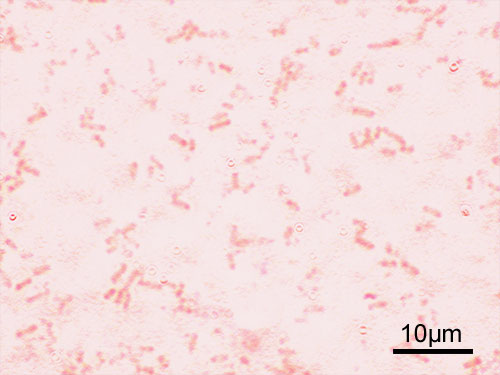
Image source: Wikipedia/Wikimedia
| Ecology, Host, and Life Cycle | |
|---|---|
| Oxygen requirements | Facultative anaerobe |
| Optimal temperature | 37 |
| Temperature range | Mesophilic |
| Habitat | HostAssociated |
| Biotic relationship | Free living |
| Host(s) | Homo sapiens, Metazoa, Primates |
| Cell arrangement | Pairs - Singles |
| Sporulation | Not Available |
| Energy source | Chemoorganotroph |
| Pathogenicity | Not Available |
Gene Summary
Adenine Count
1190643 bp
Thymine Count
1193999 bp
Guanine Count
1274902 bp
Cytosine Count
1232204 bp
Genome Length
4891748 bp
Protein-coding Genes
4588 genes
Non-Coding Genes
684 genes
# of Chromosomes/Plasmids
1
Genes
| Name | Locus Tag | UniProt ID | Strand Orientation | Gene Start/End | Protein Molecular Weight |
|---|---|---|---|---|---|
| rna polymerase sigma factor rpoe | NCTC11868_02955 | Not Available | Positive | 2747558 - 2748133 | 21697.0 |
| anti-rna polymerase sigma factor sige | NCTC11868_02956 | Not Available | Positive | 2748166 - 2748816 | 24322.8 |
| periplasmic negative regulator of sigmae | NCTC11868_02957 | Not Available | Positive | 2748816 - 2749772 | 35742.7 |
| soxr reducing system protein rsec | NCTC11868_02958 | Not Available | Positive | 2749769 - 2750248 | 16626.3 |
| gtp-binding protein lepa | NCTC11868_02959 | Not Available | Positive | 2750446 - 2752245 | 66574.1 |
| signal peptidase i | NCTC11868_02960 | Not Available | Positive | 2752261 - 2753235 | 35948.3 |
| gtp-binding protein era | NCTC11868_02962 | Not Available | Positive | 2754185 - 2755090 | 33798.1 |
| dna repair protein reco | NCTC11868_02963 | Not Available | Positive | 2755102 - 2755830 | 27420.2 |
| pyridoxine 5'-phosphate synthase | NCTC11868_02964 | Not Available | Positive | 2755842 - 2756573 | 26458.0 |
| 4'-phosphopantetheinyl transferase | NCTC11868_02965 | Not Available | Positive | 2756573 - 2756953 | 14125.3 |
Pathways
0 pathways
No pathways found
No metabolic pathways have been associated with this bacterium yet.
Health Effects
| Health Condition | Relation | Reference |
|---|---|---|
| Shigellosis | Causes | PMC5177732 |
| Hus | Causes | PMC7320338 |
| Shigellosis | Causes | PMC8742002 |
| Bacillary dysentery | Causes | PMC8742002 |
| Bacillary dysentery | Causes | PMC11098424 |
| Bacillary dysentery | Causes | PMC11143797 |
| Shigellosis | Causes | PMC11143797 |
| Epidemic shigella dysentery | Causes | PMC4445032 |