Kingdom
Pseudomonadati
Phylum
Pseudomonadota
Class
Gammaproteobacteria
Order
Enterobacterales
Family
Enterobacteriaceae
Genus
Shigella
Description
Taxonomy
| Kingdom | Pseudomonadati |
|---|---|
| Phylum | Pseudomonadota |
| Class | Gammaproteobacteria |
| Order | Enterobacterales |
| Family | Enterobacteriaceae |
| Genus | Shigella |
| Species | Shigella dysenteriae |
| Strain | strain NCTC11868 |
Profile
| Physiology | |
|---|---|
| Gram staining properties | Negative |
| Shape | Rod |
| Mobility | No |
| Flagellar presence | Yes |
| Number of membranes | 2 |

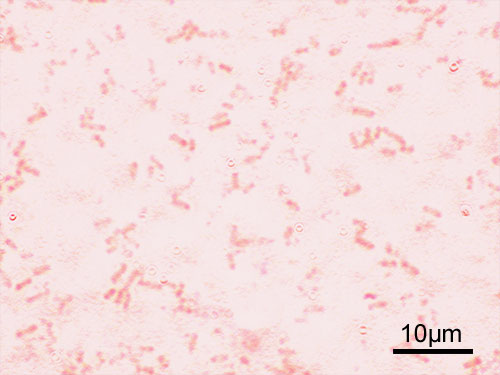
Image source: Wikipedia/Wikimedia
| Ecology, Host, and Life Cycle | |
|---|---|
| Oxygen requirements | Facultative anaerobe |
| Optimal temperature | 37 |
| Temperature range | Mesophilic |
| Habitat | HostAssociated |
| Biotic relationship | Free living |
| Host(s) | Homo sapiens, Metazoa, Primates |
| Cell arrangement | Pairs - Singles |
| Sporulation | Not Available |
| Energy source | Chemoorganotroph |
| Pathogenicity | Not Available |
Gene Summary
Adenine Count
1190643 bp
Thymine Count
1193999 bp
Guanine Count
1274902 bp
Cytosine Count
1232204 bp
Genome Length
4891748 bp
Protein-coding Genes
4588 genes
Non-Coding Genes
684 genes
# of Chromosomes/Plasmids
1
Genes
| Name | Locus Tag | UniProt ID | Strand Orientation | Gene Start/End | Protein Molecular Weight |
|---|---|---|---|---|---|
| hydrogenase 2-specific chaperone | NCTC11868_02548 | Not Available | Positive | 2373797 - 2374285 | 17964.7 |
| hydrogenase nickel incorporation protein hybf | NCTC11868_02549 | Not Available | Positive | 2374278 - 2374619 | 12698.1 |
| hydrogenase 2 accessory protein hypg | NCTC11868_02550 | Not Available | Positive | 2374632 - 2374880 | 8808.67 |
| glutathione s-transferase | NCTC11868_02551 | Not Available | Negative | 2375003 - 2375869 | 32377.4 |
| bifunctional glutathionylspermidine synthetase/amidase | NCTC11868_02552 | Not Available | Positive | 2376074 - 2377933 | 70459.7 |
| is1 protein insb | NCTC11868_02553 | Not Available | Negative | 2378179 - 2378682 | 19826.0 |
| protein ygiq | NCTC11868_02554 | Not Available | Negative | 2379036 - 2379842 | 30715.0 |
| protein ygiq | NCTC11868_02555 | Not Available | Negative | 2379785 - 2381230 | 53981.9 |
| repressor protein for ftsi | NCTC11868_02556 | Not Available | Negative | 2381341 - 2382753 | 51846.2 |
| 1-acyl-sn-glycerol-3-phosphate acyltransferase | NCTC11868_02557 | Not Available | Negative | 2382828 - 2383565 | 27424.7 |
Pathways
0 pathways
No pathways found
No metabolic pathways have been associated with this bacterium yet.
Health Effects
| Health Condition | Relation | Reference |
|---|---|---|
| Shigellosis | Causes | PMC5177732 |
| Hus | Causes | PMC7320338 |
| Shigellosis | Causes | PMC8742002 |
| Bacillary dysentery | Causes | PMC8742002 |
| Bacillary dysentery | Causes | PMC11098424 |
| Bacillary dysentery | Causes | PMC11143797 |
| Shigellosis | Causes | PMC11143797 |
| Epidemic shigella dysentery | Causes | PMC4445032 |