Kingdom
Pseudomonadati
Phylum
Pseudomonadota
Class
Gammaproteobacteria
Order
Enterobacterales
Family
Enterobacteriaceae
Genus
Shigella
Description
Taxonomy
| Kingdom | Pseudomonadati |
|---|---|
| Phylum | Pseudomonadota |
| Class | Gammaproteobacteria |
| Order | Enterobacterales |
| Family | Enterobacteriaceae |
| Genus | Shigella |
| Species | Shigella dysenteriae |
| Strain | strain NCTC11868 |
Profile
| Physiology | |
|---|---|
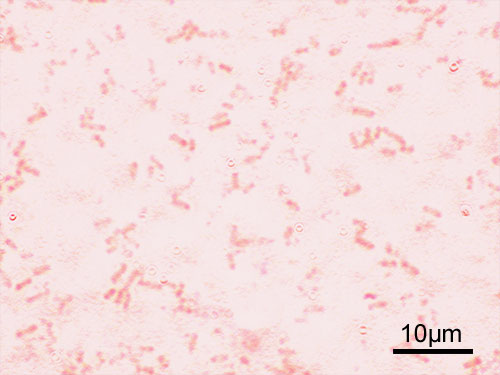
| Gram staining properties | Negative |
| Shape | Rod |
| Mobility | No |
| Flagellar presence | Yes |
| Number of membranes | 2 |

Image source: Wikipedia/Wikimedia
| Ecology, Host, and Life Cycle | |
|---|---|
| Oxygen requirements | Facultative anaerobe |
| Optimal temperature | 37 |
| Temperature range | Mesophilic |
| Habitat | HostAssociated |
| Biotic relationship | Free living |
| Host(s) | Homo sapiens, Metazoa, Primates |
| Cell arrangement | Pairs - Singles |
| Sporulation | Not Available |
| Energy source | Chemoorganotroph |
| Pathogenicity | Not Available |
Gene Summary
Adenine Count
1190643 bp
Thymine Count
1193999 bp
Guanine Count
1274902 bp
Cytosine Count
1232204 bp
Genome Length
4891748 bp
Protein-coding Genes
4588 genes
Non-Coding Genes
684 genes
# of Chromosomes/Plasmids
1
Genes
| Name | Locus Tag | UniProt ID | Strand Orientation | Gene Start/End | Protein Molecular Weight |
|---|---|---|---|---|---|
| exodeoxyribonuclease vii small subunit | NCTC11868_02160 | Not Available | Negative | 2021719 - 2021961 | 8952.42 |
| thiamine biosynthesis protein thii | NCTC11868_02161 | Not Available | Positive | 2022167 - 2023615 | 55018.4 |
| dj-1 family protein | NCTC11868_02162 | Not Available | Negative | 2023669 - 2024259 | 20793.2 |
| 2-dehydropantoate 2-reductase | NCTC11868_02163 | Not Available | Negative | 2024222 - 2025133 | 33894.8 |
| putative nucleotide-binding protein | NCTC11868_02164 | Not Available | Positive | 2025301 - 2025792 | 18344.9 |
| transporter | NCTC11868_02165 | Not Available | Negative | 2025926 - 2027284 | 48530.6 |
| protoheme ix farnesyltransferase | NCTC11868_02166 | Not Available | Negative | 2027433 - 2028323 | 32236.3 |
| cytochrome o ubiquinol oxidase subunit iv | NCTC11868_02167 | Not Available | Negative | 2028335 - 2028664 | 12030.2 |
| cytochrome o ubiquinol oxidase subunit iii | NCTC11868_02168 | Not Available | Negative | 2028664 - 2029278 | 22598.9 |
| cytochrome o ubiquinol oxidase subunit i | NCTC11868_02169 | Not Available | Negative | 2029268 - 2031259 | 74372.2 |
Pathways
0 pathways
No pathways found
No metabolic pathways have been associated with this bacterium yet.
Health Effects
| Health Condition | Relation | Reference |
|---|---|---|
| Shigellosis | Causes | PMC5177732 |
| Hus | Causes | PMC7320338 |
| Shigellosis | Causes | PMC8742002 |
| Bacillary dysentery | Causes | PMC8742002 |
| Bacillary dysentery | Causes | PMC11098424 |
| Bacillary dysentery | Causes | PMC11143797 |
| Shigellosis | Causes | PMC11143797 |
| Epidemic shigella dysentery | Causes | PMC4445032 |