Kingdom
Pseudomonadati
Phylum
Pseudomonadota
Class
Gammaproteobacteria
Order
Enterobacterales
Family
Yersiniaceae
Genus
Yersinia
Description
Taxonomy
| Kingdom | Pseudomonadati |
|---|---|
| Phylum | Pseudomonadota |
| Class | Gammaproteobacteria |
| Order | Enterobacterales |
| Family | Yersiniaceae |
| Genus | Yersinia |
| Species | Yersinia ruckeri |
| Strain | strain NCTC10476 |
Profile
| Physiology | |
|---|---|
| Gram staining properties | Not Available |
| Shape | Rod |
| Mobility | Not Available |
| Flagellar presence | Yes |
| Number of membranes | Not Available |

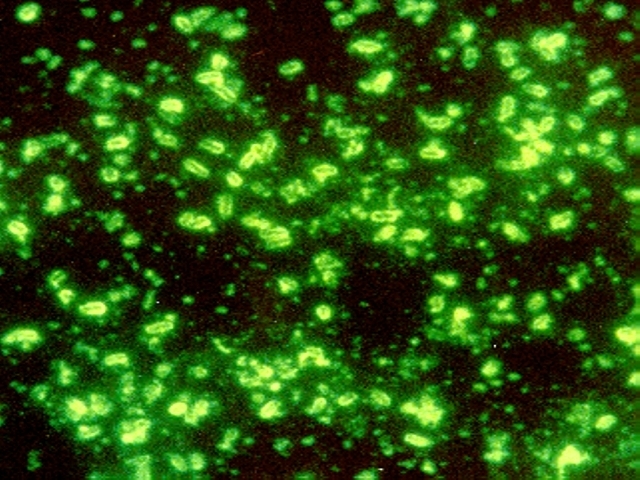
Image source: Wikipedia/Wikimedia
| Ecology, Host, and Life Cycle | |
|---|---|
| Oxygen requirements | Not Available |
| Optimal temperature | Not Available |
| Temperature range | Not Available |
| Habitat | aquatic habitats; gills |
| Biotic relationship | Not Available |
| Host(s) | Oncorhynchus mykiss, Metazoa, Salmonidae |
| Cell arrangement | Not Available |
| Sporulation | Not Available |
| Energy source | Not Available |
| Pathogenicity | Not Available |
Gene Summary
Adenine Count
1034355 bp
Thymine Count
1034856 bp
Guanine Count
930745 bp
Cytosine Count
939685 bp
Genome Length
3939641 bp
Protein-coding Genes
3405 genes
Non-Coding Genes
230 genes
# of Chromosomes/Plasmids
1
Genes
| Name | Locus Tag | UniProt ID | Strand Orientation | Gene Start/End | Protein Molecular Weight |
|---|---|---|---|---|---|
| oligopeptidase a | NCTC10476_00620 | Not Available | Negative | 637501 - 639672 | 81044.5 |
| 6-phospho-beta-glucosidase | NCTC10476_00621 | Not Available | Positive | 639885 - 641321 | 54782.1 |
| uncharacterised protein | NCTC10476_00622 | Not Available | Negative | 641485 - 641595 | 4110.85 |
| n-acylhomoserine lactone synthase yspi | NCTC10476_00623 | Not Available | Positive | 642268 - 642918 | 25245.5 |
| quorum-sensing transcriptional regulator | NCTC10476_00624 | Not Available | Negative | 642899 - 643642 | 28342.4 |
| isocitrate dehydrogenase | NCTC10476_00625 | Not Available | Negative | 644389 - 645642 | 45874.6 |
| putative pseudouridine synthase | NCTC10476_00626 | Not Available | Positive | 645774 - 646400 | 23680.7 |
| nudix family hydrolase | NCTC10476_00627 | Not Available | Positive | 646393 - 646839 | 16910.2 |
| pp_00609 | NCTC10476_00628 | Not Available | Positive | 647011 - 648126 | Not Available |
| putative lysogenization regulator | NCTC10476_00629 | Not Available | Positive | 648150 - 648776 | 22859.0 |
Pathways
0 pathways
No pathways found
No metabolic pathways have been associated with this bacterium yet.
Health Effects
| Health Condition | Relation | Reference |
|---|---|---|
| Enteric red mouth syndrome | Causes | PMC11294328 |
| Erms | Causes | PMC11294328 |
| Septicemia | Causes | PMC11294328 |
| Enteric red mouth disease | Causes | PMC7065874 |
| Enteric redmouth disease | Causes | PMC7660898 |
| Enteric redmouth disease | Causes | PMC9693156 |