Kingdom
Pseudomonadati
Phylum
Pseudomonadota
Class
Gammaproteobacteria
Order
Enterobacterales
Family
Yersiniaceae
Genus
Yersinia
Description
Taxonomy
| Kingdom | Pseudomonadati |
|---|---|
| Phylum | Pseudomonadota |
| Class | Gammaproteobacteria |
| Order | Enterobacterales |
| Family | Yersiniaceae |
| Genus | Yersinia |
| Species | Yersinia ruckeri |
| Strain | strain NCTC10476 |
Profile
| Physiology | |
|---|---|
| Gram staining properties | Not Available |
| Shape | Rod |
| Mobility | Not Available |
| Flagellar presence | Yes |
| Number of membranes | Not Available |

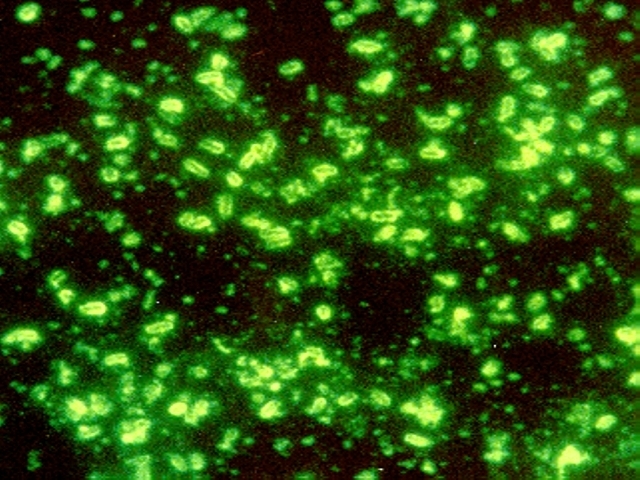
Image source: Wikipedia/Wikimedia
| Ecology, Host, and Life Cycle | |
|---|---|
| Oxygen requirements | Not Available |
| Optimal temperature | Not Available |
| Temperature range | Not Available |
| Habitat | aquatic habitats; gills |
| Biotic relationship | Not Available |
| Host(s) | Oncorhynchus mykiss, Metazoa, Salmonidae |
| Cell arrangement | Not Available |
| Sporulation | Not Available |
| Energy source | Not Available |
| Pathogenicity | Not Available |
Gene Summary
Adenine Count
1034355 bp
Thymine Count
1034856 bp
Guanine Count
930745 bp
Cytosine Count
939685 bp
Genome Length
3939641 bp
Protein-coding Genes
3405 genes
Non-Coding Genes
230 genes
# of Chromosomes/Plasmids
1
Genes
| Name | Locus Tag | UniProt ID | Strand Orientation | Gene Start/End | Protein Molecular Weight |
|---|---|---|---|---|---|
| penicillin-binding protein 1b | NCTC10476_01411 | Not Available | Negative | 1482903 - 1485383 | 91956.5 |
| atp-dependent rna helicase hrpb | NCTC10476_01412 | Not Available | Negative | 1485477 - 1487918 | 90381.8 |
| 2'-5' rna ligase | NCTC10476_01413 | Not Available | Positive | 1488134 - 1488694 | 20964.3 |
| sugar fermentation stimulation protein a | NCTC10476_01414 | Not Available | Positive | 1488684 - 1489391 | 26117.2 |
| rna polymerase-binding transcription factor | NCTC10476_01415 | Not Available | Positive | 1489588 - 1490043 | 17385.6 |
| glutamyl-q trna(asp) synthetase | NCTC10476_01416 | Not Available | Positive | 1490123 - 1491037 | 34564.9 |
| poly(a) polymerase i | NCTC10476_01417 | Not Available | Positive | 1491271 - 1492593 | 51104.7 |
| 2-amino-4-hydroxy-6- hydroxymethyldihydropteridinepyrophosphokinase | NCTC10476_01418 | Not Available | Positive | 1492602 - 1493081 | 18106.9 |
| 3-methyl-2-oxobutanoate hydroxymethyltransferase | NCTC10476_01419 | Not Available | Positive | 1493312 - 1494106 | 28743.9 |
| pantoate--beta-alanine ligase | NCTC10476_01420 | Not Available | Positive | 1494268 - 1495122 | 31903.6 |
Pathways
0 pathways
No pathways found
No metabolic pathways have been associated with this bacterium yet.
Health Effects
| Health Condition | Relation | Reference |
|---|---|---|
| Enteric red mouth syndrome | Causes | PMC11294328 |
| Erms | Causes | PMC11294328 |
| Septicemia | Causes | PMC11294328 |
| Enteric red mouth disease | Causes | PMC7065874 |
| Enteric redmouth disease | Causes | PMC7660898 |
| Enteric redmouth disease | Causes | PMC9693156 |