Kingdom
Bacillati
Phylum
Bacillota
Class
Bacilli
Order
Lactobacillales
Family
Streptococcaceae
Genus
Streptococcus
Description
Taxonomy
| Kingdom | Bacillati |
|---|---|
| Phylum | Bacillota |
| Class | Bacilli |
| Order | Lactobacillales |
| Family | Streptococcaceae |
| Genus | Streptococcus |
| Species | Streptococcus equi |
| Strain | subsp. equi strain NCTC12092 |
Profile
| Physiology | |
|---|---|
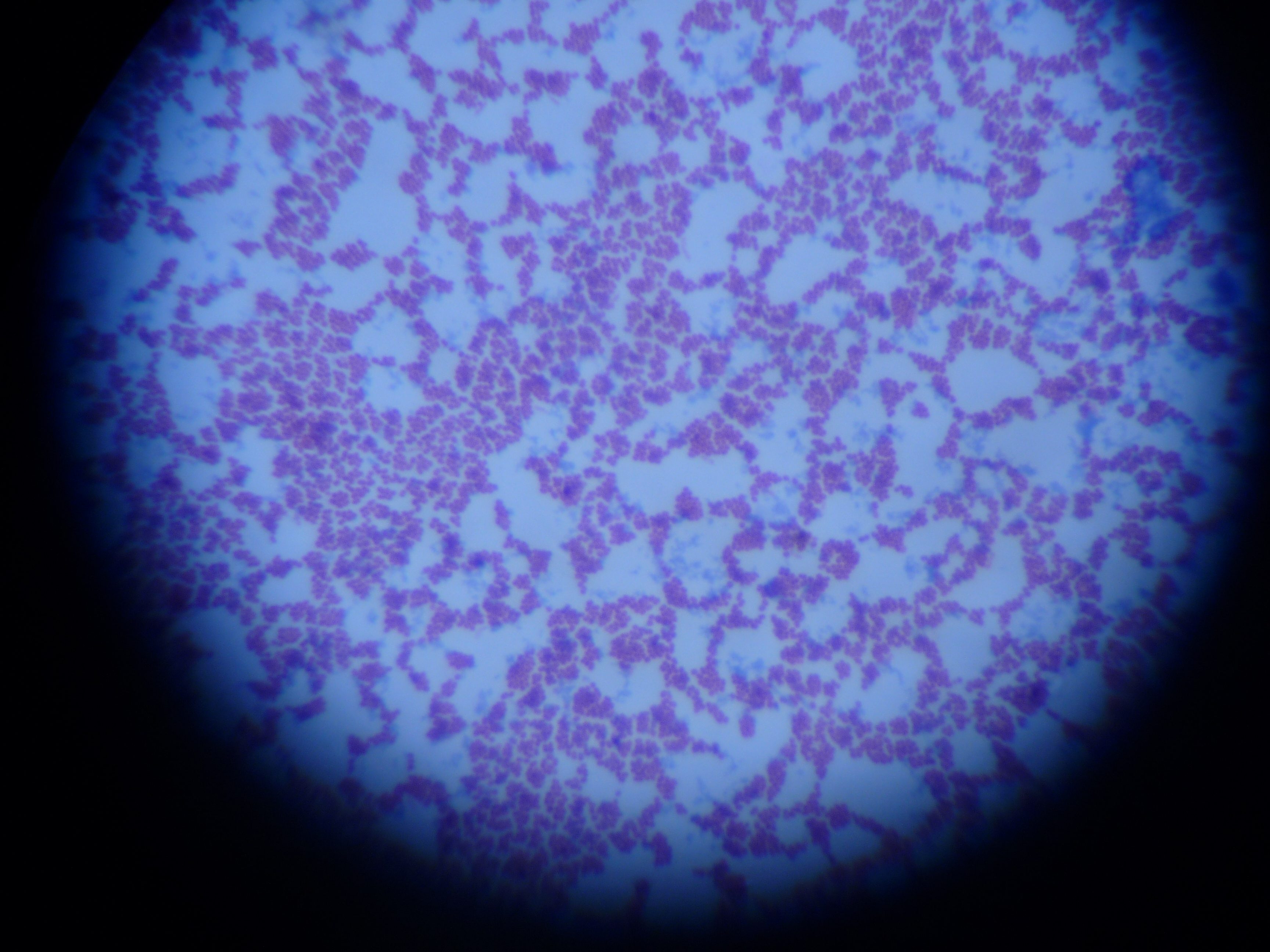
| Gram staining properties | Positive |
| Shape | Cocci |
| Mobility | No |
| Flagellar presence | Yes |
| Number of membranes | 1 |

Image source: Wikipedia/Wikimedia
| Ecology, Host, and Life Cycle | |
|---|---|
| Oxygen requirements | Facultative |
| Optimal temperature | Not Available |
| Temperature range | Mesophilic |
| Habitat | HostAssociated |
| Biotic relationship | Free living |
| Host(s) | Homo sapiens, Equus caballus, Equidae |
| Cell arrangement | Pairs-Chains |
| Sporulation | Nonsporulating |
| Energy source | Not Available |
| Pathogenicity | horses |
Gene Summary
Adenine Count
645797 bp
Thymine Count
638851 bp
Guanine Count
458307 bp
Cytosine Count
452722 bp
Genome Length
2195677 bp
Protein-coding Genes
1938 genes
Non-Coding Genes
165 genes
# of Chromosomes/Plasmids
1
Genes
| Name | Locus Tag | UniProt ID | Strand Orientation | Gene Start/End | Protein Molecular Weight |
|---|---|---|---|---|---|
| Dna (cytosine-5-)-methyltransferase | NCTC12092_00158 | Not Available | Positive | 154326 - 154970 | 24454.3 |
| Dna_methylase domain protein | NCTC12092_00159 | Not Available | Positive | 154958 - 155113 | 5549.8 |
| C-5 cytosine-specific dna methylase | NCTC12092_00160 | Not Available | Positive | 155094 - 155672 | 21611.8 |
| Hypothetical protein | NCTC12092_00161 | Not Available | Positive | 155641 - 156153 | 19943.8 |
| uncharacterised protein | NCTC12092_00162 | Not Available | Positive | 156221 - 156442 | 8481.3 |
| Putative single-stranded dna-binding protein | NCTC12092_00163 | Not Available | Positive | 156439 - 156648 | 7959.65 |
| Hypothetical protein | NCTC12092_00164 | Not Available | Positive | 156844 - 157122 | 10635.9 |
| Putative immunity repressor protein | NCTC12092_00165 | Not Available | Positive | 157119 - 157457 | 12784.5 |
| uncharacterised protein | NCTC12092_00166 | Not Available | Positive | 157460 - 157708 | 9691.47 |
| Phage protein | NCTC12092_00167 | Not Available | Positive | 157705 - 157884 | 6869.69 |
Pathways
0 pathways
No pathways found
No metabolic pathways have been associated with this bacterium yet.
Health Effects
| Health Condition | Relation | Reference |
|---|---|---|
| Strangles | Causes | PMC10399742 |
| Lymph node abscesses | Causes | PMC10399742 |
| Disease | Causes | PMC5021838 |
| Strangles | Causes | PMC5312586 |
| Strangles | Causes | PMC2705793 |