Kingdom
Pseudomonadati
Phylum
Pseudomonadota
Class
Gammaproteobacteria
Order
Enterobacterales
Family
Enterobacteriaceae
Genus
Salmonella
Description
Taxonomy
| Kingdom | Pseudomonadati |
|---|---|
| Phylum | Pseudomonadota |
| Class | Gammaproteobacteria |
| Order | Enterobacterales |
| Family | Enterobacteriaceae |
| Genus | Salmonella |
| Species | Salmonella enterica |
| Strain | subsp. diarizonae strain NCTC10060 |
Profile
| Physiology | |
|---|---|
| Gram staining properties | Negative |
| Shape | Spirilla |
| Mobility | No |
| Flagellar presence | Yes |
| Number of membranes | 2 |

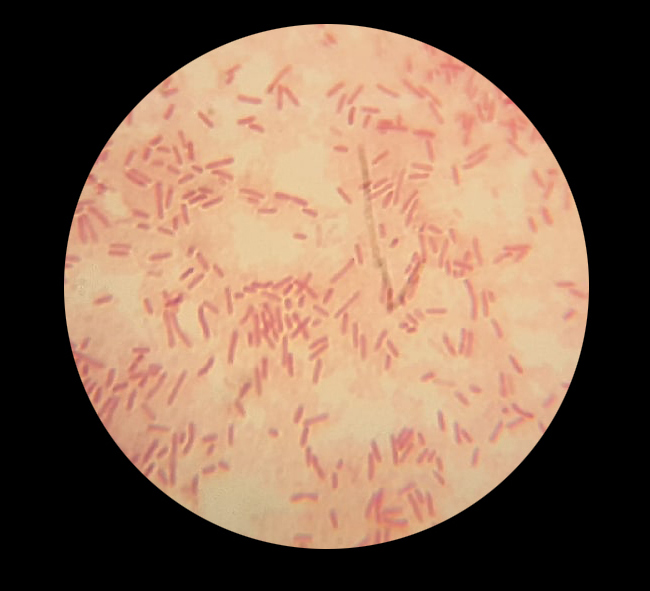
Image source: Wikipedia/Wikimedia
| Ecology, Host, and Life Cycle | |
|---|---|
| Oxygen requirements | Microaerophilic |
| Optimal temperature | 37 |
| Temperature range | Mesophilic |
| Habitat | HostAssociated |
| Biotic relationship | Free living |
| Host(s) | Not Available |
| Cell arrangement | Chains - Singles |
| Sporulation | Not Available |
| Energy source | Chemoorganotroph |
| Pathogenicity | Not Available |
Gene Summary
Adenine Count
1216053 bp
Thymine Count
1220445 bp
Guanine Count
1288457 bp
Cytosine Count
1289818 bp
Genome Length
5014773 bp
Protein-coding Genes
5399 genes
Non-Coding Genes
178 genes
# of Chromosomes/Plasmids
1
Genes
| Name | Locus Tag | UniProt ID | Strand Orientation | Gene Start/End | Protein Molecular Weight |
|---|---|---|---|---|---|
| outer membrane receptor fepa | NCTC10060_04103 | Not Available | Positive | 3545050 - 3547305 | 83001.8 |
| phosphopantetheinyltransferase component of enterobactin synthase multienzyme complex | NCTC10060_04104 | Not Available | Positive | 3547305 - 3548042 | 27120.5 |
| carboxylate-amine ligase | NCTC10060_04105 | Not Available | Positive | 3548070 - 3549188 | 41743.6 |
| putative inner membrane protein | NCTC10060_04106 | Not Available | Positive | 3549255 - 3549503 | 9411.06 |
| transcriptional activator rama | NCTC10060_04107 | Not Available | Negative | 3549509 - 3549850 | 13477.1 |
| tetr family transcriptional regulator | NCTC10060_04108 | Not Available | Positive | 3550140 - 3550721 | 21953.4 |
| putative cytoplasmic protein | NCTC10060_04109 | Not Available | Positive | 3550721 - 3551089 | 14185.2 |
| dihydropteridine reductase | NCTC10060_04110 | Not Available | Positive | 3551197 - 3551850 | 24010.5 |
| mannosyl-d-glycerate transport/metabolism system repressor | NCTC10060_04111 | Not Available | Negative | 3552281 - 3552979 | 26910.6 |
| pts system n,n'-diacetylchitobiose-specific transporter subunit iib | NCTC10060_04112 | Not Available | Positive | 3553178 - 3553501 | 11764.5 |
Pathways
0 pathways
No pathways found
No metabolic pathways have been associated with this bacterium yet.
Health Effects
No health effects information available for this bacterium.