Kingdom
Pseudomonadati
Phylum
Pseudomonadota
Class
Gammaproteobacteria
Order
Legionellales
Family
Legionellaceae
Genus
Legionella
Description
Taxonomy
| Kingdom | Pseudomonadati |
|---|---|
| Phylum | Pseudomonadota |
| Class | Gammaproteobacteria |
| Order | Legionellales |
| Family | Legionellaceae |
| Genus | Legionella |
| Species | Legionella wadsworthii |
| Strain | strain NCTC11532 |
Profile
| Physiology | |
|---|---|
| Gram staining properties | Not Available |
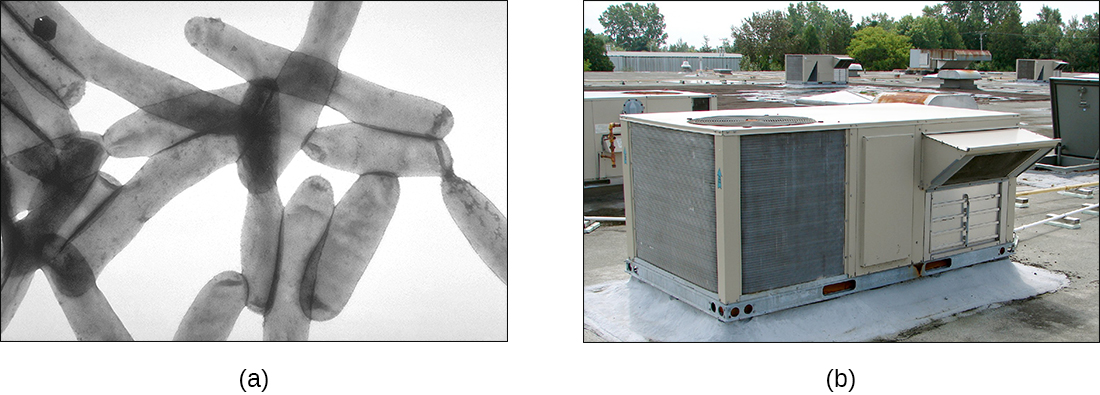
| Shape | Rod |
| Mobility | Not Available |
| Flagellar presence | Yes |
| Number of membranes | Not Available |

Image source: Wikipedia/Wikimedia
| Ecology, Host, and Life Cycle | |
|---|---|
| Oxygen requirements | microaerophile |
| Optimal temperature | Not Available |
| Temperature range | Not Available |
| Habitat | Not Available |
| Biotic relationship | Not Available |
| Host(s) | Homo sapiens |
| Cell arrangement | Not Available |
| Sporulation | Not Available |
| Energy source | Not Available |
| Pathogenicity | Not Available |
Gene Summary
Adenine Count
1115350 bp
Thymine Count
1115351 bp
Guanine Count
685498 bp
Cytosine Count
686418 bp
Genome Length
3602617 bp
Protein-coding Genes
3181 genes
Non-Coding Genes
55 genes
# of Chromosomes/Plasmids
1
Genes
| Name | Locus Tag | UniProt ID | Strand Orientation | Gene Start/End | Protein Molecular Weight |
|---|---|---|---|---|---|
| 3-deoxy-manno-octulosonate cytidylyltransferase | NCTC11532_02979 | Not Available | Positive | 3342483 - 3343307 | 30367.7 |
| phosphoglycerate mutase | NCTC11532_02980 | Not Available | Positive | 3343304 - 3343939 | 23708.4 |
| dot/icm secretion system substrate | NCTC11532_02981 | Not Available | Negative | 3344051 - 3345370 | 50630.2 |
| endoglucanase | NCTC11532_02982 | Not Available | Negative | 3345621 - 3347042 | 52918.6 |
| uncharacterised protein | NCTC11532_02983 | Not Available | Negative | 3347256 - 3347750 | 18554.9 |
| substrate of the dot/icm secretion system | NCTC11532_02984 | Not Available | Negative | 3348078 - 3350399 | 89431.5 |
| uncharacterised protein | NCTC11532_02985 | Not Available | Positive | 3350656 - 3350925 | 9881.87 |
| uncharacterised acr, yage family cog1723 | NCTC11532_02986 | Not Available | Positive | 3351055 - 3351861 | 31678.4 |
| n-terminal gnat family acetyltransferase | NCTC11532_02987 | Not Available | Positive | 3351940 - 3352824 | 34183.3 |
| 3-oxoacyl-acp synthase | NCTC11532_02988 | Not Available | Positive | 3353009 - 3354238 | 44259.1 |
Pathways
0 pathways
No pathways found
No metabolic pathways have been associated with this bacterium yet.