Kingdom
Pseudomonadati
Phylum
Pseudomonadota
Class
Gammaproteobacteria
Order
Enterobacterales
Family
Enterobacteriaceae
Genus
Escherichia
Description
Taxonomy
| Kingdom | Pseudomonadati |
|---|---|
| Phylum | Pseudomonadota |
| Class | Gammaproteobacteria |
| Order | Enterobacterales |
| Family | Enterobacteriaceae |
| Genus | Escherichia |
| Species | Escherichia coli |
| Strain | strain NCTC9706 |
Profile
| Physiology | |
|---|---|
| Gram staining properties | Negative |
| Shape | Rod |
| Mobility | Yes |
| Flagellar presence | Yes |
| Number of membranes | 2 |

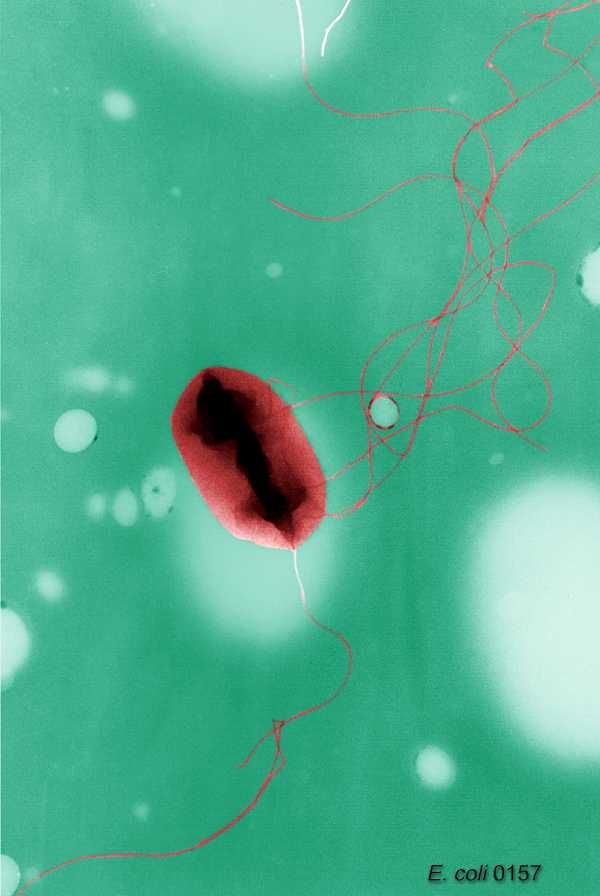
Image source: Wikipedia/Wikimedia
| Ecology, Host, and Life Cycle | |
|---|---|
| Oxygen requirements | Facultative anaerobe |
| Optimal temperature | 37 |
| Temperature range | Mesophilic |
| Habitat | HostAssociated |
| Biotic relationship | Free living |
| Host(s) | Homo sapiens, Gallus gallus, Bos taurus |
| Cell arrangement | Pairs - Singles |
| Sporulation | Not Available |
| Energy source | Not Available |
| Pathogenicity | Human |
Gene Summary
Adenine Count
1356279 bp
Thymine Count
1353614 bp
Guanine Count
1396411 bp
Cytosine Count
1414637 bp
Genome Length
5520941 bp
Protein-coding Genes
4833 genes
Non-Coding Genes
706 genes
# of Chromosomes/Plasmids
1
Genes
| Name | Locus Tag | UniProt ID | Strand Orientation | Gene Start/End | Protein Molecular Weight |
|---|---|---|---|---|---|
| Trna-glu | Not Available | Not Available | Positive | 1985791 - 1985866 | Not Available |
| glutamate racemase | NCTC9706_02024 | Not Available | Negative | 1987865 - 1988722 | 31065.7 |
| vitamin b12/cobalamin outer membrane transporter | NCTC9706_02025 | Not Available | Negative | 1988667 - 1990511 | 68457.9 |
| trna (uracil-5)-methyltransferase | NCTC9706_02027 | Not Available | Positive | 1990880 - 1991980 | 41969.3 |
| inner membrane protein | NCTC9706_02028 | Not Available | Negative | 1992020 - 1992379 | 13024.3 |
| tetr-family transcriptional regulator | NCTC9706_02029 | Not Available | Negative | 1992379 - 1993083 | 26554.9 |
| soluble pyridine nucleotide transhydrogenase | NCTC9706_02030 | Not Available | Positive | 1993360 - 1994760 | 51570.5 |
| dna-binding transcriptional regulator oxyr | NCTC9706_02031 | Not Available | Negative | 1994743 - 1995660 | 34278.0 |
| argininosuccinate lyase | NCTC9706_02033 | Not Available | Negative | 1995927 - 1997300 | 50321.1 |
| acetylglutamate kinase | NCTC9706_02034 | Not Available | Negative | 1997361 - 1998134 | 27030.1 |
Pathways
1297 pathways
Health Effects
| Health Condition | Relation | Reference |
|---|---|---|
| Gi disease | Causes | PMC11149725 |
| Utis | Causes | PMC11434687 |
| Colorectal cancer | Causes | PMC12198655 |
| Pyogenic liver abscesses | Causes | PMC12392612 |
| Uti | Causes | PMC13014981 |
| Colibacillosis | Causes | PMC13255289 |
| Enteric infections | Causes | PMC13255289 |
| Foodborne infections | Causes | PMC13255289 |
| Clinical mastitis | Causes | PMC13293316 |
| Diarrhea | Causes | PMC3035056 |