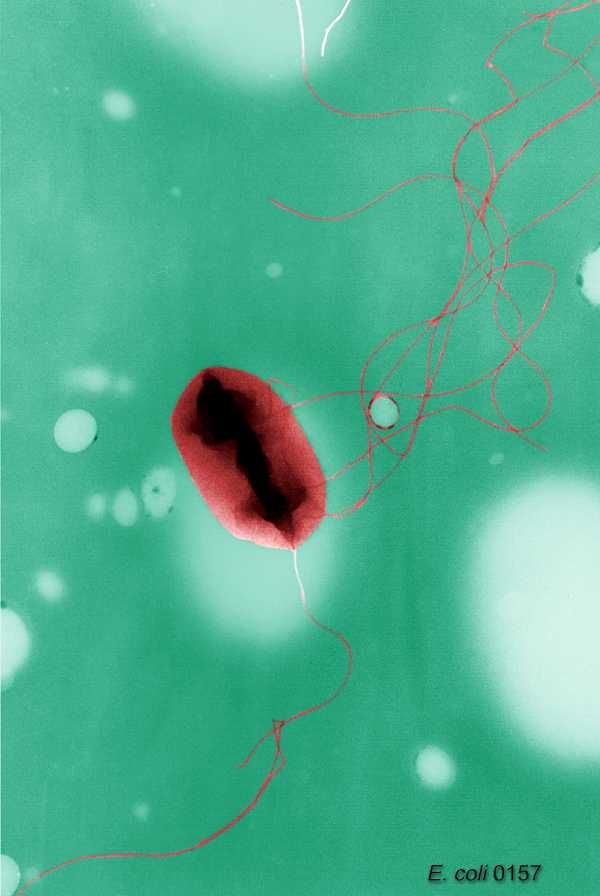
Kingdom
Pseudomonadati
Phylum
Pseudomonadota
Class
Gammaproteobacteria
Order
Enterobacterales
Family
Enterobacteriaceae
Genus
Escherichia
Description
Taxonomy
| Kingdom | Pseudomonadati |
|---|---|
| Phylum | Pseudomonadota |
| Class | Gammaproteobacteria |
| Order | Enterobacterales |
| Family | Enterobacteriaceae |
| Genus | Escherichia |
| Species | Escherichia coli |
| Strain | strain NCTC8621 |
Profile
| Physiology | |
|---|---|
| Gram staining properties | Negative |
| Shape | Rod |
| Mobility | Yes |
| Flagellar presence | Yes |
| Number of membranes | 2 |
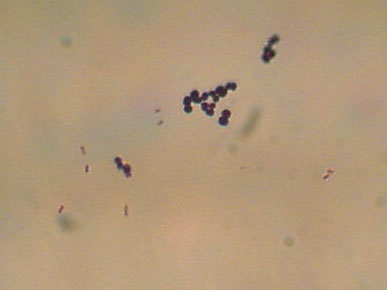
Image source: Wikipedia/Wikimedia
| Ecology, Host, and Life Cycle | |
|---|---|
| Oxygen requirements | Facultative anaerobe |
| Optimal temperature | 37 |
| Temperature range | Mesophilic |
| Habitat | HostAssociated |
| Biotic relationship | Free living |
| Host(s) | Homo sapiens, Gallus gallus, Bos taurus |
| Cell arrangement | Pairs - Singles |
| Sporulation | Not Available |
| Energy source | Not Available |
| Pathogenicity | Human |
Gene Summary
Adenine Count
1296697 bp
Thymine Count
1303842 bp
Guanine Count
1332519 bp
Cytosine Count
1318136 bp
Genome Length
5251194 bp
Protein-coding Genes
4468 genes
Non-Coding Genes
800 genes
# of Chromosomes/Plasmids
1
Genes
| Name | Locus Tag | UniProt ID | Strand Orientation | Gene Start/End | Protein Molecular Weight |
|---|---|---|---|---|---|
| putative propanediol utilization polyhedral bodies pduu | NCTC8621_02057 | Not Available | Negative | 2029371 - 2029721 | 12414.2 |
| propanediol utilization protein pdut | NCTC8621_02058 | Not Available | Negative | 2029721 - 2030275 | 19140.5 |
| propanediol utilization protein pdus | NCTC8621_02059 | Not Available | Negative | 2030278 - 2031621 | 48000.1 |
| propanediol utilization protein pduq | NCTC8621_02060 | Not Available | Negative | 2031618 - 2032730 | 39596.8 |
| propanediol utilization protein pdup | NCTC8621_02061 | Not Available | Negative | 2032741 - 2034126 | 49138.6 |
| propanediol utilization protein, pduo | NCTC8621_02062 | Not Available | Negative | 2034123 - 2035130 | 36872.2 |
| propanediol utilization protein pdun | NCTC8621_02063 | Not Available | Negative | 2035142 - 2035417 | 9260.25 |
| propanediol utilization protein pdum | NCTC8621_02064 | Not Available | Negative | 2035421 - 2035912 | 18770.0 |
| propanediol utilization protein pdul | NCTC8621_02065 | Not Available | Negative | 2035909 - 2036541 | 23003.8 |
| propanediol utilization protein pduk | NCTC8621_02066 | Not Available | Negative | 2036544 - 2036966 | 14393.4 |
Pathways
1297 pathways
Health Effects
| Health Condition | Relation | Reference |
|---|---|---|
| Gi disease | Causes | PMC11149725 |
| Utis | Causes | PMC11434687 |
| Colorectal cancer | Causes | PMC12198655 |
| Pyogenic liver abscesses | Causes | PMC12392612 |
| Uti | Causes | PMC13014981 |
| Colibacillosis | Causes | PMC13255289 |
| Enteric infections | Causes | PMC13255289 |
| Foodborne infections | Causes | PMC13255289 |
| Clinical mastitis | Causes | PMC13293316 |
| Diarrhea | Causes | PMC3035056 |