Kingdom
Pseudomonadati
Phylum
Pseudomonadota
Class
Gammaproteobacteria
Order
Enterobacterales
Family
Enterobacteriaceae
Genus
Escherichia
Description
Taxonomy
| Kingdom | Pseudomonadati |
|---|---|
| Phylum | Pseudomonadota |
| Class | Gammaproteobacteria |
| Order | Enterobacterales |
| Family | Enterobacteriaceae |
| Genus | Escherichia |
| Species | Escherichia coli |
| Strain | strain NCTC10767 |
Profile
| Physiology | |
|---|---|
| Gram staining properties | Negative |
| Shape | Rod |
| Mobility | Yes |
| Flagellar presence | Yes |
| Number of membranes | 2 |

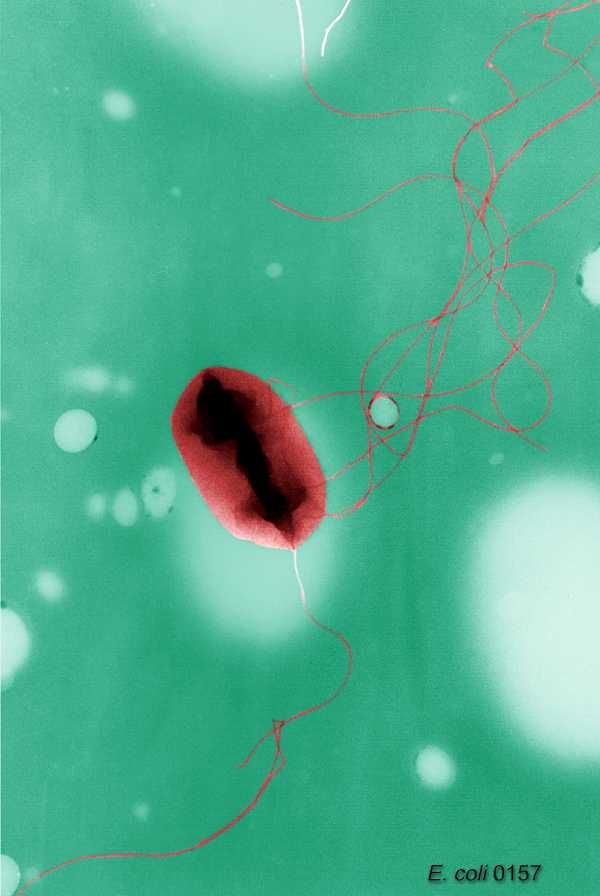
Image source: Wikipedia/Wikimedia
| Ecology, Host, and Life Cycle | |
|---|---|
| Oxygen requirements | Facultative anaerobe |
| Optimal temperature | 37 |
| Temperature range | Mesophilic |
| Habitat | HostAssociated |
| Biotic relationship | Free living |
| Host(s) | Homo sapiens, Gallus gallus, Bos taurus |
| Cell arrangement | Pairs - Singles |
| Sporulation | Not Available |
| Energy source | Not Available |
| Pathogenicity | Human |
Gene Summary
Adenine Count
1360598 bp
Thymine Count
1369659 bp
Guanine Count
1433902 bp
Cytosine Count
1365701 bp
Genome Length
5529860 bp
Protein-coding Genes
5043 genes
Non-Coding Genes
909 genes
# of Chromosomes/Plasmids
1
Genes
| Name | Locus Tag | UniProt ID | Strand Orientation | Gene Start/End | Protein Molecular Weight |
|---|---|---|---|---|---|
| yeca family protein | NCTC10767_02156 | Not Available | Positive | 2003502 - 2004080 | 21230.8 |
| proline aminopeptidase ii | NCTC10767_02157 | Not Available | Positive | 2004106 - 2004888 | 29782.0 |
| proline aminopeptidase ii | NCTC10767_02158 | Not Available | Positive | 2004863 - 2005087 | 8459.28 |
| proline aminopeptidase ii | NCTC10767_02159 | Not Available | Positive | 2005069 - 2005407 | 12379.0 |
| 2-octaprenyl-6-methoxyphenol hydroxylase | NCTC10767_02160 | Not Available | Positive | 2005427 - 2005861 | 14883.2 |
| 2-octaprenyl-6-methoxyphenol hydroxylase | NCTC10767_02161 | Not Available | Positive | 2005879 - 2006646 | 27963.6 |
| putative monooxygenase | NCTC10767_02162 | Not Available | Positive | 2006628 - 2007830 | 44247.2 |
| aminomethyltransferase (glycine cleavage system protein) | NCTC10767_02163 | Not Available | Positive | 2008277 - 2009371 | 40151.0 |
| glycine cleavage system protein h | NCTC10767_02164 | Not Available | Positive | 2009395 - 2009784 | 13825.9 |
| glycine dehydrogenase | NCTC10767_02165 | Not Available | Positive | 2009902 - 2012775 | 104299.0 |
Pathways
1297 pathways
Health Effects
| Health Condition | Relation | Reference |
|---|---|---|
| Gi disease | Causes | PMC11149725 |
| Utis | Causes | PMC11434687 |
| Colorectal cancer | Causes | PMC12198655 |
| Pyogenic liver abscesses | Causes | PMC12392612 |
| Uti | Causes | PMC13014981 |
| Colibacillosis | Causes | PMC13255289 |
| Enteric infections | Causes | PMC13255289 |
| Foodborne infections | Causes | PMC13255289 |
| Clinical mastitis | Causes | PMC13293316 |
| Diarrhea | Causes | PMC3035056 |