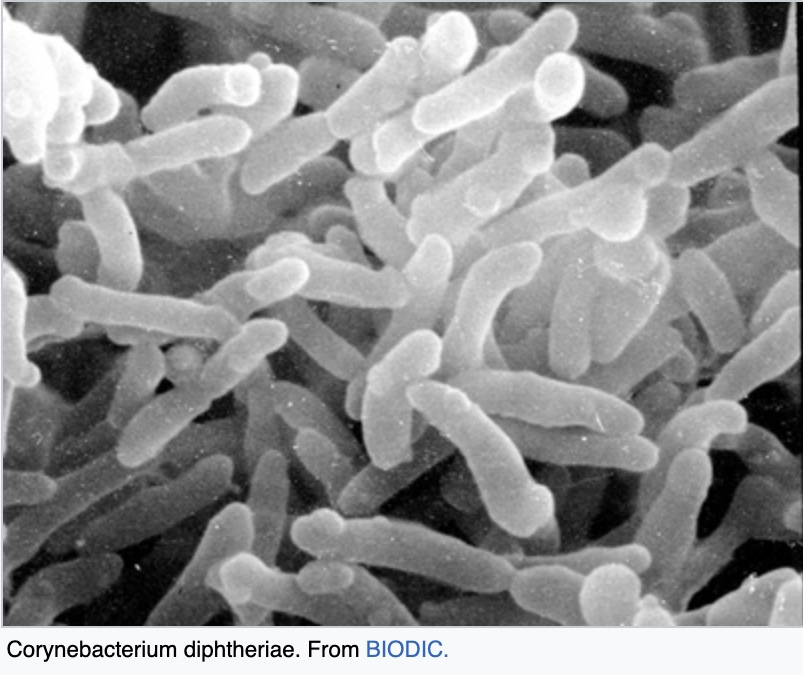
Kingdom
Bacillati
Phylum
Actinomycetota
Class
Actinomycetes
Order
Mycobacteriales
Family
Corynebacteriaceae
Genus
Corynebacterium
Description
Taxonomy
| Kingdom | Bacillati |
|---|---|
| Phylum | Actinomycetota |
| Class | Actinomycetes |
| Order | Mycobacteriales |
| Family | Corynebacteriaceae |
| Genus | Corynebacterium |
| Species | Corynebacterium diphtheriae |
| Strain | strain NCTC10838 |
Profile
| Physiology | |
|---|---|
| Gram staining properties | Positive |
| Shape | Rod |
| Mobility | No |
| Flagellar presence | Yes |
| Number of membranes | 1 |

Image source: Wikipedia/Wikimedia
| Ecology, Host, and Life Cycle | |
|---|---|
| Oxygen requirements | Aerobe |
| Optimal temperature | 37 |
| Temperature range | Mesophilic |
| Habitat | Multiple |
| Biotic relationship | Not Available |
| Host(s) | Homo sapiens |
| Cell arrangement | Not Available |
| Sporulation | Not Available |
| Energy source | Not Available |
| Pathogenicity | Not Available |
Gene Summary
Adenine Count
665308 bp
Thymine Count
671655 bp
Guanine Count
777580 bp
Cytosine Count
771687 bp
Genome Length
2886230 bp
Protein-coding Genes
2833 genes
Non-Coding Genes
147 genes
# of Chromosomes/Plasmids
1
Genes
| Name | Locus Tag | UniProt ID | Strand Orientation | Gene Start/End | Protein Molecular Weight |
|---|---|---|---|---|---|
| uncharacterised protein | NCTC10838_02166 | Not Available | Positive | 2102321 - 2102659 | 12531.0 |
| major facilitator superfamily permease | NCTC10838_02167 | Not Available | Positive | 2102660 - 2103817 | 40493.0 |
| transposase | NCTC10838_02168 | Not Available | Negative | 2103872 - 2104198 | 11877.3 |
| resa | NCTC10838_02169 | Not Available | Negative | 2104167 - 2104325 | 5299.46 |
| transposase-like protein | NCTC10838_02170 | Not Available | Positive | 2104654 - 2104761 | 3989.7 |
| transposase-like protein | NCTC10838_02171 | Not Available | Positive | 2104795 - 2105013 | 8304.95 |
| transposase | NCTC10838_02172 | Not Available | Positive | 2105244 - 2105690 | 16481.6 |
| transposase-like protein | NCTC10838_02173 | Not Available | Positive | 2105853 - 2106086 | 8535.55 |
| hypothetical membrane protein | NCTC10838_02174 | Not Available | Negative | 2106664 - 2107077 | 15415.4 |
| dihydrofolate synthase / folylpolyglutamate synthase | NCTC10838_02175 | Not Available | Negative | 2107074 - 2108570 | 53135.9 |
Pathways
0 pathways
No pathways found
No metabolic pathways have been associated with this bacterium yet.
Health Effects
| Health Condition | Relation | Reference |
|---|---|---|
| Diphtheria | Causes | PMC4152248 |
| Endocarditis | Causes | PMC4152248 |
| Systemic disease | Causes | PMC4152248 |
| Diphtheria | Causes | PMC8325488 |
| Diphtheria | Causes | PMC5944148 |