Kingdom
Bacillati
Phylum
Actinomycetota
Class
Actinomycetes
Order
Mycobacteriales
Family
Corynebacteriaceae
Genus
Corynebacterium
Description
Taxonomy
| Kingdom | Bacillati |
|---|---|
| Phylum | Actinomycetota |
| Class | Actinomycetes |
| Order | Mycobacteriales |
| Family | Corynebacteriaceae |
| Genus | Corynebacterium |
| Species | Corynebacterium diphtheriae |
| Strain | strain NCTC10838 |
Profile
| Physiology | |
|---|---|
| Gram staining properties | Positive |
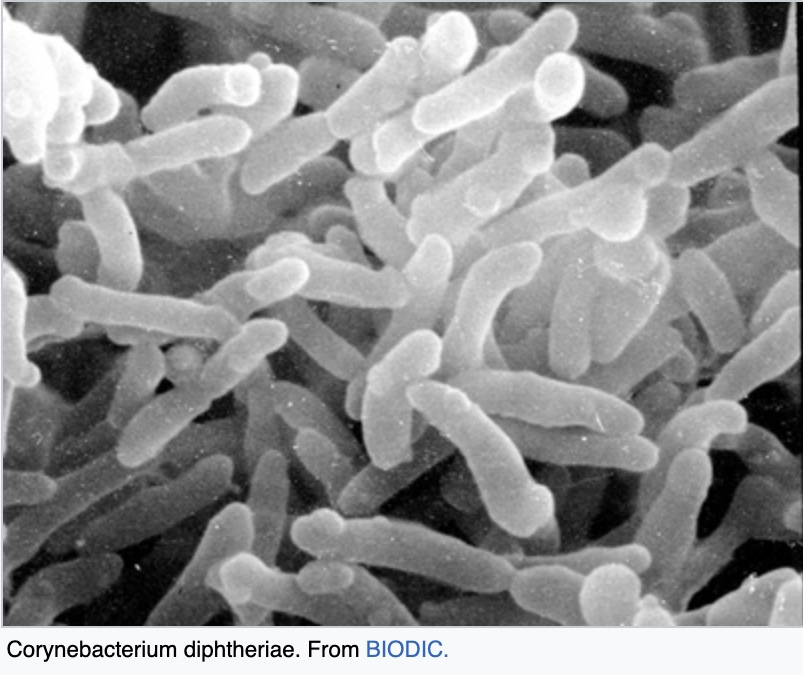
| Shape | Rod |
| Mobility | No |
| Flagellar presence | Yes |
| Number of membranes | 1 |

Image source: Wikipedia/Wikimedia
| Ecology, Host, and Life Cycle | |
|---|---|
| Oxygen requirements | Aerobe |
| Optimal temperature | 37 |
| Temperature range | Mesophilic |
| Habitat | Multiple |
| Biotic relationship | Not Available |
| Host(s) | Homo sapiens |
| Cell arrangement | Not Available |
| Sporulation | Not Available |
| Energy source | Not Available |
| Pathogenicity | Not Available |
Gene Summary
Adenine Count
665308 bp
Thymine Count
671655 bp
Guanine Count
777580 bp
Cytosine Count
771687 bp
Genome Length
2886230 bp
Protein-coding Genes
2833 genes
Non-Coding Genes
147 genes
# of Chromosomes/Plasmids
1
Genes
| Name | Locus Tag | UniProt ID | Strand Orientation | Gene Start/End | Protein Molecular Weight |
|---|---|---|---|---|---|
| uncharacterised protein | NCTC10838_01281 | Not Available | Negative | 1214025 - 1214849 | 30382.6 |
| uncharacterised protein | NCTC10838_01282 | Not Available | Negative | 1214989 - 1215552 | 21846.4 |
| uncharacterised protein | NCTC10838_01283 | Not Available | Positive | 1215853 - 1216215 | 13756.5 |
| transposase is3508a | NCTC10838_01284 | Not Available | Positive | 1216479 - 1217828 | 49858.4 |
| putative secreted protein | NCTC10838_01285 | Not Available | Positive | 1218161 - 1219069 | 31077.1 |
| transposase for insertion sequence | NCTC10838_01286 | Not Available | Negative | 1220050 - 1221207 | 43501.5 |
| cutinase | NCTC10838_01287 | Not Available | Positive | 1221277 - 1222059 | 27470.9 |
| uncharacterised protein | NCTC10838_01288 | Not Available | Positive | 1222544 - 1222678 | 5047.85 |
| Trna-glu | Not Available | Not Available | Positive | 1222817 - 1222890 | Not Available |
| phosphoenolpyruvate carboxylase | NCTC10838_01290 | Not Available | Positive | 1223064 - 1225772 | 100980.0 |
Pathways
0 pathways
No pathways found
No metabolic pathways have been associated with this bacterium yet.
Health Effects
| Health Condition | Relation | Reference |
|---|---|---|
| Diphtheria | Causes | PMC4152248 |
| Endocarditis | Causes | PMC4152248 |
| Systemic disease | Causes | PMC4152248 |
| Diphtheria | Causes | PMC8325488 |
| Diphtheria | Causes | PMC5944148 |