Kingdom
Pseudomonadati
Phylum
Pseudomonadota
Class
Gammaproteobacteria
Order
Enterobacterales
Family
Enterobacteriaceae
Genus
Escherichia
Description
Taxonomy
| Kingdom | Pseudomonadati |
|---|---|
| Phylum | Pseudomonadota |
| Class | Gammaproteobacteria |
| Order | Enterobacterales |
| Family | Enterobacteriaceae |
| Genus | Escherichia |
| Species | Escherichia coli |
| Strain | strain VREC0506 |
Profile
| Physiology | |
|---|---|
| Gram staining properties | Negative |
| Shape | Rod |
| Mobility | Yes |
| Flagellar presence | Yes |
| Number of membranes | 2 |

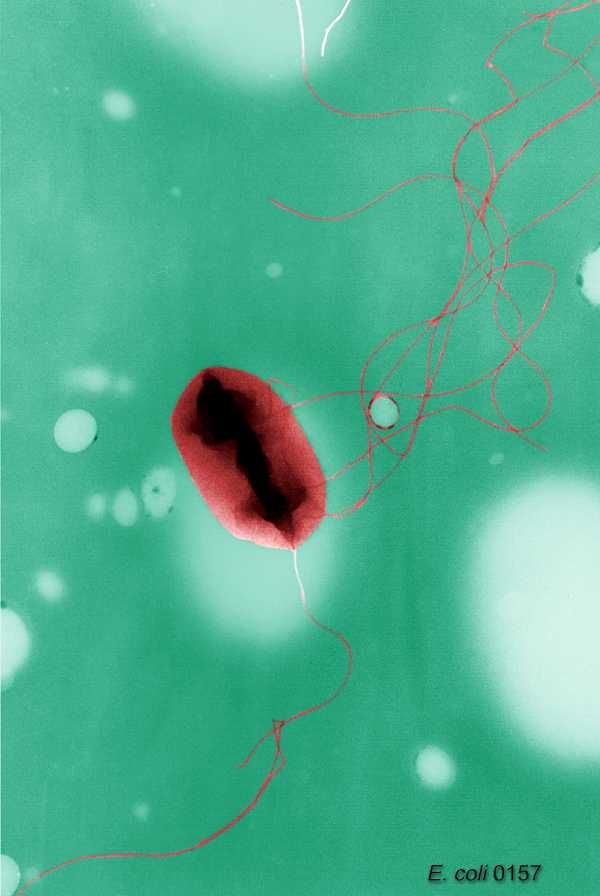
Image source: Wikipedia/Wikimedia
| Ecology, Host, and Life Cycle | |
|---|---|
| Oxygen requirements | Facultative anaerobe |
| Optimal temperature | 37 |
| Temperature range | Mesophilic |
| Habitat | HostAssociated |
| Biotic relationship | Free living |
| Host(s) | Homo sapiens, Gallus gallus, Bos taurus |
| Cell arrangement | Pairs - Singles |
| Sporulation | Not Available |
| Energy source | Not Available |
| Pathogenicity | Human |
Gene Summary
Adenine Count
1330351 bp
Thymine Count
1331131 bp
Guanine Count
1348395 bp
Cytosine Count
1373263 bp
Genome Length
5383453 bp
Protein-coding Genes
4777 genes
Non-Coding Genes
397 genes
# of Chromosomes/Plasmids
1
Genes
| Name | Locus Tag | UniProt ID | Strand Orientation | Gene Start/End | Protein Molecular Weight |
|---|---|---|---|---|---|
| Replication initiation protein | SAMEA3752553_00477 | Not Available | Positive | 519609 - 520472 | 33342.9 |
| Nonstructural protein | SAMEA3752553_00478 | Not Available | Positive | 520459 - 520728 | 10281.1 |
| Minor capsid protein | SAMEA3752553_00479 | Not Available | Positive | 520709 - 521221 | 18784.6 |
| Capsid protein | SAMEA3752553_00480 | Not Available | Positive | 521367 - 523040 | 62487.4 |
| Dna pilot protein | SAMEA3752553_00481 | Not Available | Positive | 523125 - 523895 | 27011.8 |
| Nonstructural protein | SAMEA3752553_00482 | Not Available | Positive | 523898 - 524017 | 4770.98 |
| protein hipa | SAMEA3752553_00483 | Not Available | Negative | 524139 - 525461 | 49424.9 |
| Transcription regulator | SAMEA3752553_00484 | Not Available | Negative | 525461 - 525727 | 10047.9 |
| Attl | Not Available | Not Available | Positive | 553323 - 553334 | Not Available |
| Attl | Not Available | Not Available | Positive | 563983 - 563994 | Not Available |
Pathways
1297 pathways
Health Effects
| Health Condition | Relation | Reference |
|---|---|---|
| Bloody diarrhea | Causes | PMC9147554 |
| Hemorrhagic colitis | Causes | PMC9147554 |
| Hemolytic uremic syndrome | Causes | PMC9147554 |
| Hus | Causes | PMC9147554 |
| Calf diarrhea | Causes | PMC9861278 |
| Sbp | Causes | PMC10556727 |
| Ie | Causes | PMC10972404 |
| Pregnancy loss | Causes | PMC11597549 |
| Neonatal death | Causes | PMC11597549 |
| Abortion | Causes | PMC11597549 |