
Kingdom
Pseudomonadati
Phylum
Pseudomonadota
Class
Gammaproteobacteria
Order
Enterobacterales
Family
Morganellaceae
Genus
Morganella
Description
Taxonomy
| Kingdom | Pseudomonadati |
|---|---|
| Phylum | Pseudomonadota |
| Class | Gammaproteobacteria |
| Order | Enterobacterales |
| Family | Morganellaceae |
| Genus | Morganella |
| Species | Morganella morganii |
| Strain | strain NCTC12358 |
Profile
| Physiology | |
|---|---|
| Gram staining properties | Negative |
| Shape | Rod |
| Mobility | Not Available |
| Flagellar presence | Not Available |
| Number of membranes | Not Available |
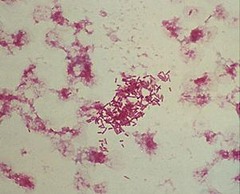
Image source: Wikipedia/Wikimedia
| Ecology, Host, and Life Cycle | |
|---|---|
| Oxygen requirements | Facultative anaerobe |
| Optimal temperature | Not Available |
| Temperature range | mesophilic |
| Habitat | natural environment; sewage |
| Biotic relationship | Not Available |
| Host(s) | Homo sapiens, Bos, Acanthamoeba castellanii |
| Cell arrangement | Not Available |
| Sporulation | Not Available |
| Energy source | Not Available |
| Pathogenicity | Not Available |
Gene Summary
Adenine Count
1046320 bp
Thymine Count
1043523 bp
Guanine Count
1066674 bp
Cytosine Count
1057914 bp
Genome Length
4214431 bp
Protein-coding Genes
3662 genes
Non-Coding Genes
411 genes
# of Chromosomes/Plasmids
1
Genes
| Name | Locus Tag | UniProt ID | Strand Orientation | Gene Start/End | Protein Molecular Weight |
|---|---|---|---|---|---|
| uncharacterised protein | NCTC12358_02587 | Not Available | Negative | 2706102 - 2706458 | 13115.6 |
| flagellar hook-basal body complex protein flie | NCTC12358_02588 | Not Available | Negative | 2707070 - 2707381 | 11004.4 |
| flagellar m-ring protein | NCTC12358_02589 | Not Available | Positive | 2707650 - 2709356 | 62264.2 |
| flagellar motor switch protein flig | NCTC12358_02590 | Not Available | Positive | 2709353 - 2710345 | 36989.4 |
| flagellar assembly protein h | NCTC12358_02591 | Not Available | Positive | 2710332 - 2711069 | 27263.2 |
| flagellum-specific atp synthase | NCTC12358_02592 | Not Available | Positive | 2711066 - 2712430 | 48904.4 |
| flagellar flij protein | NCTC12358_02593 | Not Available | Positive | 2712442 - 2712885 | 17452.5 |
| flagellar hook-length control protein | NCTC12358_02594 | Not Available | Positive | 2712885 - 2714249 | 48061.6 |
| flagellar basal body-associated protein flil | NCTC12358_02595 | Not Available | Positive | 2714413 - 2714898 | 17695.3 |
| flagellar motor switch protein flim | NCTC12358_02596 | Not Available | Positive | 2714904 - 2715917 | 38171.9 |
Pathways
1167 pathways
Health Effects
| Health Condition | Relation | Reference |
|---|---|---|
| Endophthalmitis | Causes | PMC10638747 |
| Urinary tract infections | Causes | PMC10638747 |
| Post-operative wound infections | Causes | PMC10638747 |
| Infectious ocular disease | Causes | PMC8932139 |
| Summer diarrhea | Causes | PMC8932139 |
| Sepsis | Causes | PMC8932139 |
| Hepatobiliary infections | Causes | PMC8932139 |
| Urinary tract infections | Causes | PMC8932139 |
| Wound infections | Causes | PMC8932139 |
| Ocular infection | Causes | PMC8932139 |
