
Kingdom
Pseudomonadati
Phylum
Pseudomonadota
Class
Betaproteobacteria
Order
Burkholderiales
Family
Burkholderiaceae
Genus
Burkholderia
Description
Taxonomy
| Kingdom | Pseudomonadati |
|---|---|
| Phylum | Pseudomonadota |
| Class | Betaproteobacteria |
| Order | Burkholderiales |
| Family | Burkholderiaceae |
| Genus | Burkholderia |
| Species | Burkholderia cepacia |
| Strain | strain NCTC10661 |
Profile
| Physiology | |
|---|---|
| Gram staining properties | Negative |
| Shape | Not Available |
| Mobility | Not Available |
| Flagellar presence | Not Available |
| Number of membranes | Not Available |
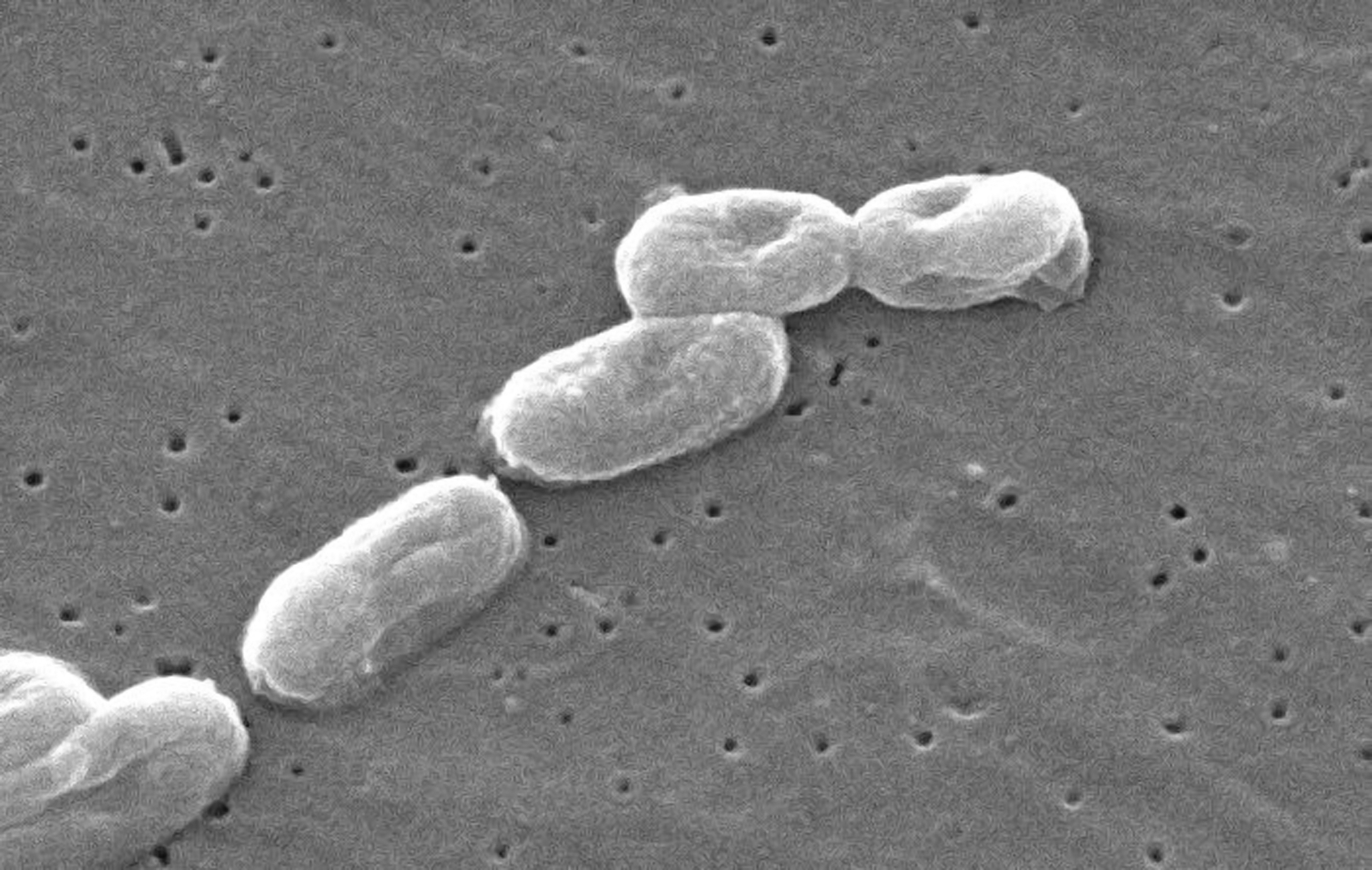
Image source: Wikipedia/Wikimedia
| Ecology, Host, and Life Cycle | |
|---|---|
| Oxygen requirements | Microaerophile |
| Optimal temperature | Not Available |
| Temperature range | Not Available |
| Habitat | rhizosphere |
| Biotic relationship | Not Available |
| Host(s) | Homo sapiens, Viridiplantae, Anura |
| Cell arrangement | Not Available |
| Sporulation | Not Available |
| Energy source | Not Available |
| Pathogenicity | Not Available |
Gene Summary
Adenine Count
1416701 bp
Thymine Count
1415774 bp
Guanine Count
2829969 bp
Cytosine Count
2840706 bp
Genome Length
8503150 bp
Protein-coding Genes
7521 genes
Non-Coding Genes
167 genes
# of Chromosomes/Plasmids
1
Genes
| Name | Locus Tag | UniProt ID | Strand Orientation | Gene Start/End | Protein Molecular Weight |
|---|---|---|---|---|---|
| apolipoprotein n-acyltransferase | NCTC10661_05592 | Not Available | Positive | 6204686 - 6206374 | 60449.0 |
| tetratricopeptide tpr 2 repeat protein | NCTC10661_05593 | Not Available | Negative | 6206453 - 6208108 | 59044.3 |
| glycyl-trna synthetase subunit alpha | NCTC10661_05594 | Not Available | Positive | 6208430 - 6209434 | 38031.0 |
| glycyl-trna synthetase subunit beta | NCTC10661_05595 | Not Available | Positive | 6209457 - 6211556 | 75996.4 |
| d,d-heptose 1,7-bisphosphate phosphatase | NCTC10661_05596 | Not Available | Positive | 6211567 - 6212130 | 20260.4 |
| 1-acyl-sn-glycerol-3-phosphate acyltransferase | NCTC10661_05597 | Not Available | Positive | 6212174 - 6212938 | 28639.0 |
| zinc metalloprotease | NCTC10661_05598 | Not Available | Positive | 6212985 - 6213872 | 32904.6 |
| glyoxalase i | NCTC10661_05599 | Not Available | Negative | 6213979 - 6214368 | 14545.3 |
| drug/metabolite transporter (dmt) superfamily permease | NCTC10661_05600 | Not Available | Positive | 6214651 - 6215637 | 34308.4 |
| dimethyladenosine transferase | NCTC10661_05601 | Not Available | Negative | 6215762 - 6216592 | 30597.1 |
Pathways
1357 pathways
Health Effects
| Health Condition | Relation | Reference |
|---|---|---|
| Infective endocarditis | Causes | PMC3112426 |
| Native valve endocarditis | Causes | PMC3112426 |
| Pneumonia | Causes | PMC9294674 |



