
Kingdom
Pseudomonadati
Phylum
Pseudomonadota
Class
Betaproteobacteria
Order
Burkholderiales
Family
Burkholderiaceae
Genus
Burkholderia
Description
Taxonomy
| Kingdom | Pseudomonadati |
|---|---|
| Phylum | Pseudomonadota |
| Class | Betaproteobacteria |
| Order | Burkholderiales |
| Family | Burkholderiaceae |
| Genus | Burkholderia |
| Species | Burkholderia cepacia |
| Strain | strain NCTC10661 |
Profile
| Physiology | |
|---|---|
| Gram staining properties | Negative |
| Shape | Not Available |
| Mobility | Not Available |
| Flagellar presence | Not Available |
| Number of membranes | Not Available |
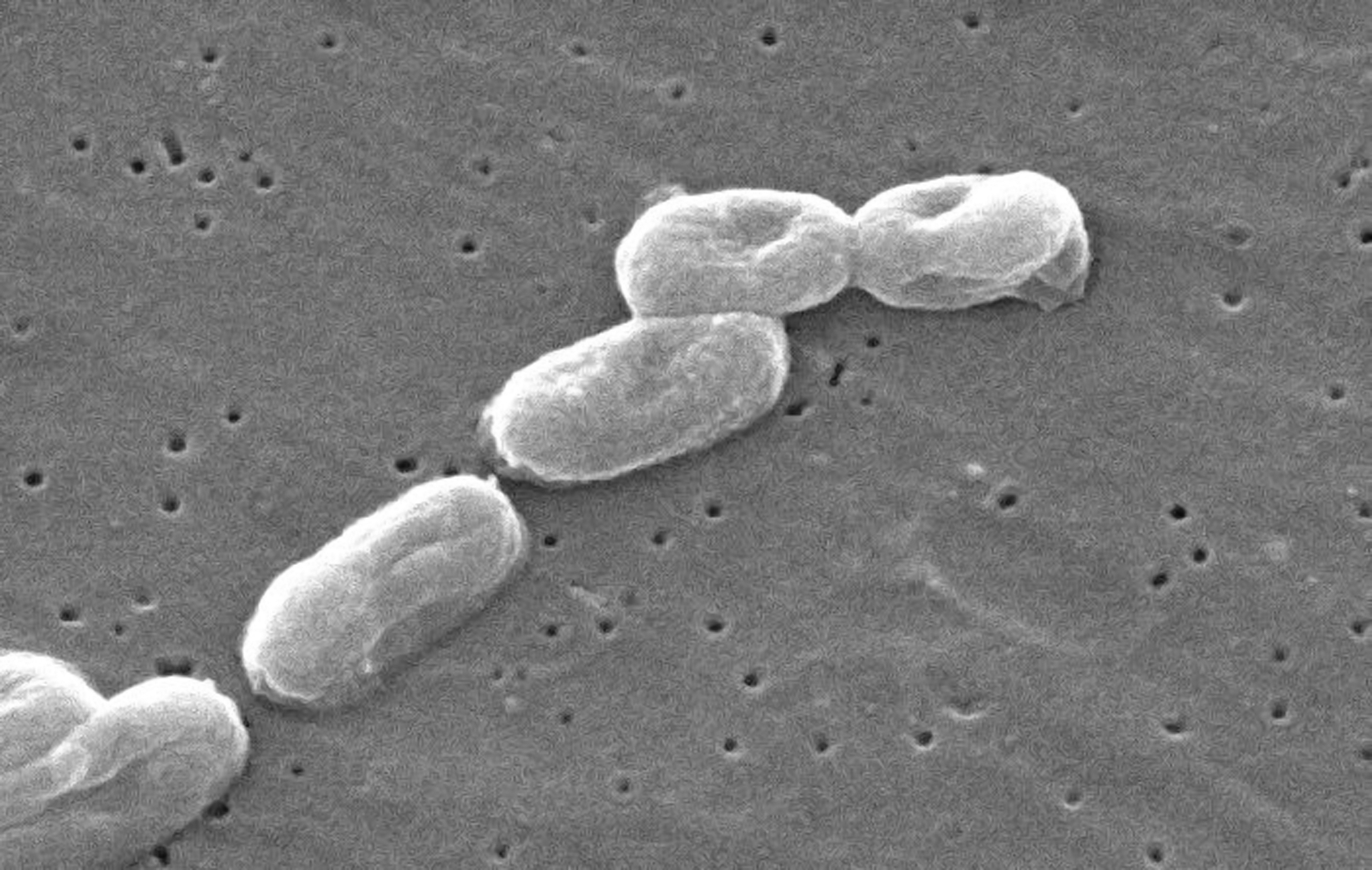
Image source: Wikipedia/Wikimedia
| Ecology, Host, and Life Cycle | |
|---|---|
| Oxygen requirements | Microaerophile |
| Optimal temperature | Not Available |
| Temperature range | Not Available |
| Habitat | rhizosphere |
| Biotic relationship | Not Available |
| Host(s) | Homo sapiens, Viridiplantae, Anura |
| Cell arrangement | Not Available |
| Sporulation | Not Available |
| Energy source | Not Available |
| Pathogenicity | Not Available |
Gene Summary
Adenine Count
1416701 bp
Thymine Count
1415774 bp
Guanine Count
2829969 bp
Cytosine Count
2840706 bp
Genome Length
8503150 bp
Protein-coding Genes
7521 genes
Non-Coding Genes
167 genes
# of Chromosomes/Plasmids
1
Genes
| Name | Locus Tag | UniProt ID | Strand Orientation | Gene Start/End | Protein Molecular Weight |
|---|---|---|---|---|---|
| dna polymerase iii subunit delta | NCTC10661_05308 | Not Available | Positive | 5892374 - 5893468 | 39610.1 |
| gamma-glutamyl phosphate reductase | NCTC10661_05309 | Not Available | Positive | 5893604 - 5894875 | 45093.2 |
| protoporphyrinogen ix oxidase | NCTC10661_05310 | Not Available | Positive | 5894895 - 5895317 | 16074.5 |
| rpir family transcriptional regulator | NCTC10661_05311 | Not Available | Negative | 5895414 - 5896262 | 29854.0 |
| phosphogluconate dehydratase | NCTC10661_05312 | Not Available | Positive | 5896557 - 5898413 | 65178.4 |
| 2-keto-3-deoxy-phosphogluconate aldolase | NCTC10661_05313 | Not Available | Positive | 5898433 - 5899059 | 21844.8 |
| gluconate transporter | NCTC10661_05314 | Not Available | Positive | 5899279 - 5900640 | 47546.0 |
| gluconate kinase | NCTC10661_05315 | Not Available | Positive | 5900654 - 5901157 | 18758.4 |
| tetr family transcriptional regulator | NCTC10661_05316 | Not Available | Negative | 5901231 - 5901878 | 22598.3 |
| fad dependent oxidoreductase | NCTC10661_05317 | Not Available | Positive | 5902153 - 5903574 | 51091.6 |
Pathways
1489 pathways
Health Effects
| Health Condition | Relation | Reference |
|---|---|---|
| Infective endocarditis | Causes | PMC3112426 |
| Native valve endocarditis | Causes | PMC3112426 |
| Pneumonia | Causes | PMC9294674 |



