
Kingdom
Pseudomonadati
Phylum
Pseudomonadota
Class
Betaproteobacteria
Order
Burkholderiales
Family
Burkholderiaceae
Genus
Burkholderia
Description
Taxonomy
| Kingdom | Pseudomonadati |
|---|---|
| Phylum | Pseudomonadota |
| Class | Betaproteobacteria |
| Order | Burkholderiales |
| Family | Burkholderiaceae |
| Genus | Burkholderia |
| Species | Burkholderia cepacia |
| Strain | strain NCTC10661 |
Profile
| Physiology | |
|---|---|
| Gram staining properties | Negative |
| Shape | Not Available |
| Mobility | Not Available |
| Flagellar presence | Not Available |
| Number of membranes | Not Available |
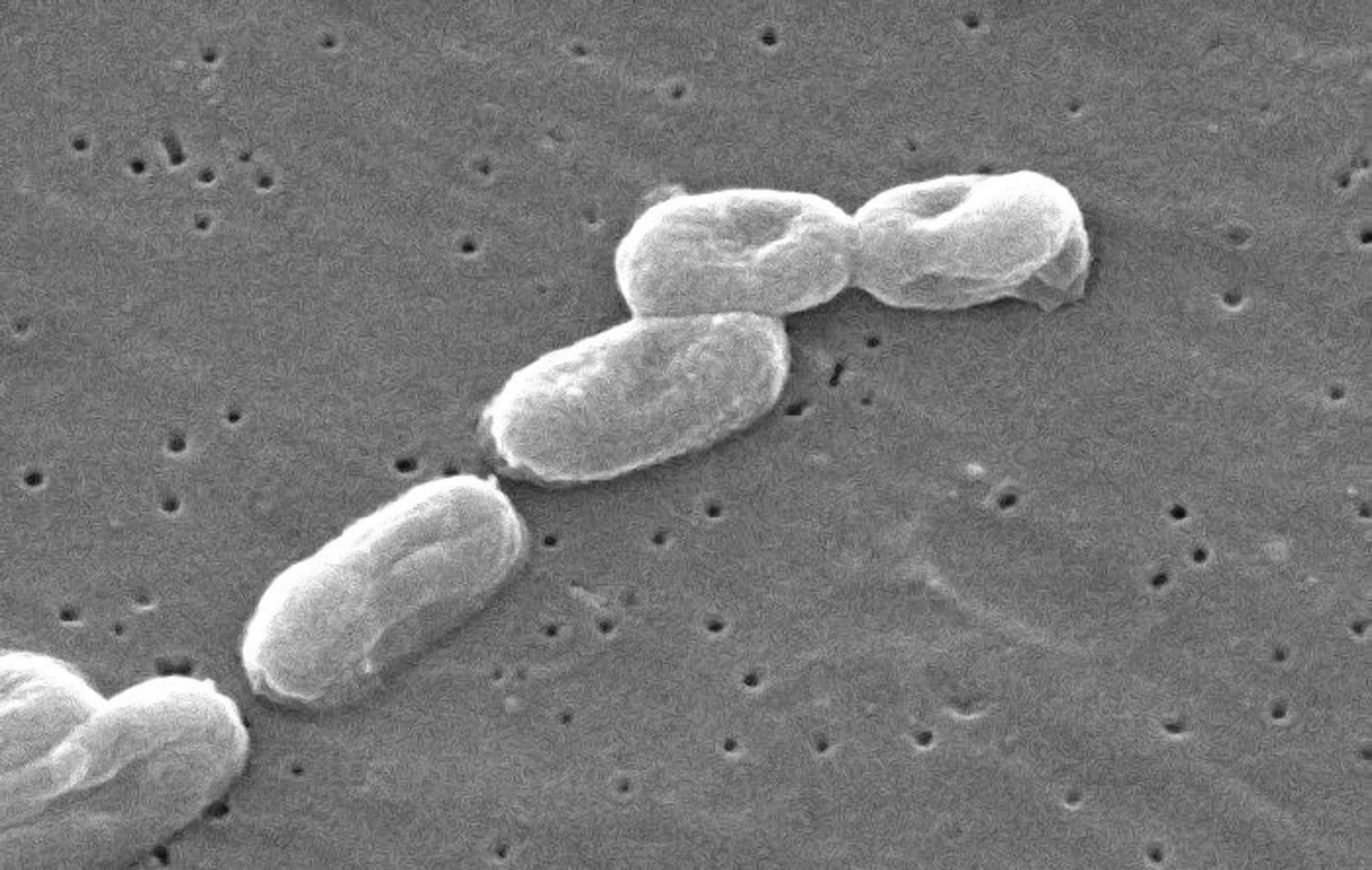
Image source: Wikipedia/Wikimedia
| Ecology, Host, and Life Cycle | |
|---|---|
| Oxygen requirements | Microaerophile |
| Optimal temperature | Not Available |
| Temperature range | Not Available |
| Habitat | rhizosphere |
| Biotic relationship | Not Available |
| Host(s) | Homo sapiens, Viridiplantae, Anura |
| Cell arrangement | Not Available |
| Sporulation | Not Available |
| Energy source | Not Available |
| Pathogenicity | Not Available |
Gene Summary
Adenine Count
1416701 bp
Thymine Count
1415774 bp
Guanine Count
2829969 bp
Cytosine Count
2840706 bp
Genome Length
8503150 bp
Protein-coding Genes
7521 genes
Non-Coding Genes
167 genes
# of Chromosomes/Plasmids
1
Genes
| Name | Locus Tag | UniProt ID | Strand Orientation | Gene Start/End | Protein Molecular Weight |
|---|---|---|---|---|---|
| nad(p)h dehydrogenase (quinone) | NCTC10661_00458 | Not Available | Negative | 494036 - 494818 | 28875.2 |
| lysr family transcriptional regulator | NCTC10661_00459 | Not Available | Positive | 494905 - 495798 | 32642.7 |
| outer membrane receptor protein | NCTC10661_00460 | Not Available | Positive | 495937 - 496347 | 15394.1 |
| 2,4-dienoyl-coa reductase | NCTC10661_00461 | Not Available | Negative | 496372 - 498405 | 73105.2 |
| arac family transcriptional regulator | NCTC10661_00462 | Not Available | Positive | 498508 - 499563 | 38996.6 |
| uncharacterised protein | NCTC10661_00463 | Not Available | Positive | 499661 - 500206 | 20199.6 |
| uncharacterised protein | NCTC10661_00464 | Not Available | Positive | 500203 - 500805 | 21834.6 |
| aconitase subunit 2 | NCTC10661_00465 | Not Available | Negative | 500835 - 501290 | 15070.1 |
| aconitase subunit 1 | NCTC10661_00466 | Not Available | Negative | 501283 - 502530 | 44285.8 |
| marr family transcriptional regulator | NCTC10661_00467 | Not Available | Negative | 502716 - 503144 | 15796.0 |
Pathways
0 pathways
No pathways found
No metabolic pathways have been associated with this bacterium yet.
Health Effects
| Health Condition | Relation | Reference |
|---|---|---|
| Infective endocarditis | Causes | PMC3112426 |
| Native valve endocarditis | Causes | PMC3112426 |
| Pneumonia | Causes | PMC9294674 |



