
Kingdom
Pseudomonadati
Phylum
Pseudomonadota
Class
Betaproteobacteria
Order
Burkholderiales
Family
Burkholderiaceae
Genus
Burkholderia
Description
Taxonomy
| Kingdom | Pseudomonadati |
|---|---|
| Phylum | Pseudomonadota |
| Class | Betaproteobacteria |
| Order | Burkholderiales |
| Family | Burkholderiaceae |
| Genus | Burkholderia |
| Species | Burkholderia cepacia |
| Strain | strain NCTC10661 |
Profile
| Physiology | |
|---|---|
| Gram staining properties | Negative |
| Shape | Not Available |
| Mobility | Not Available |
| Flagellar presence | Not Available |
| Number of membranes | Not Available |
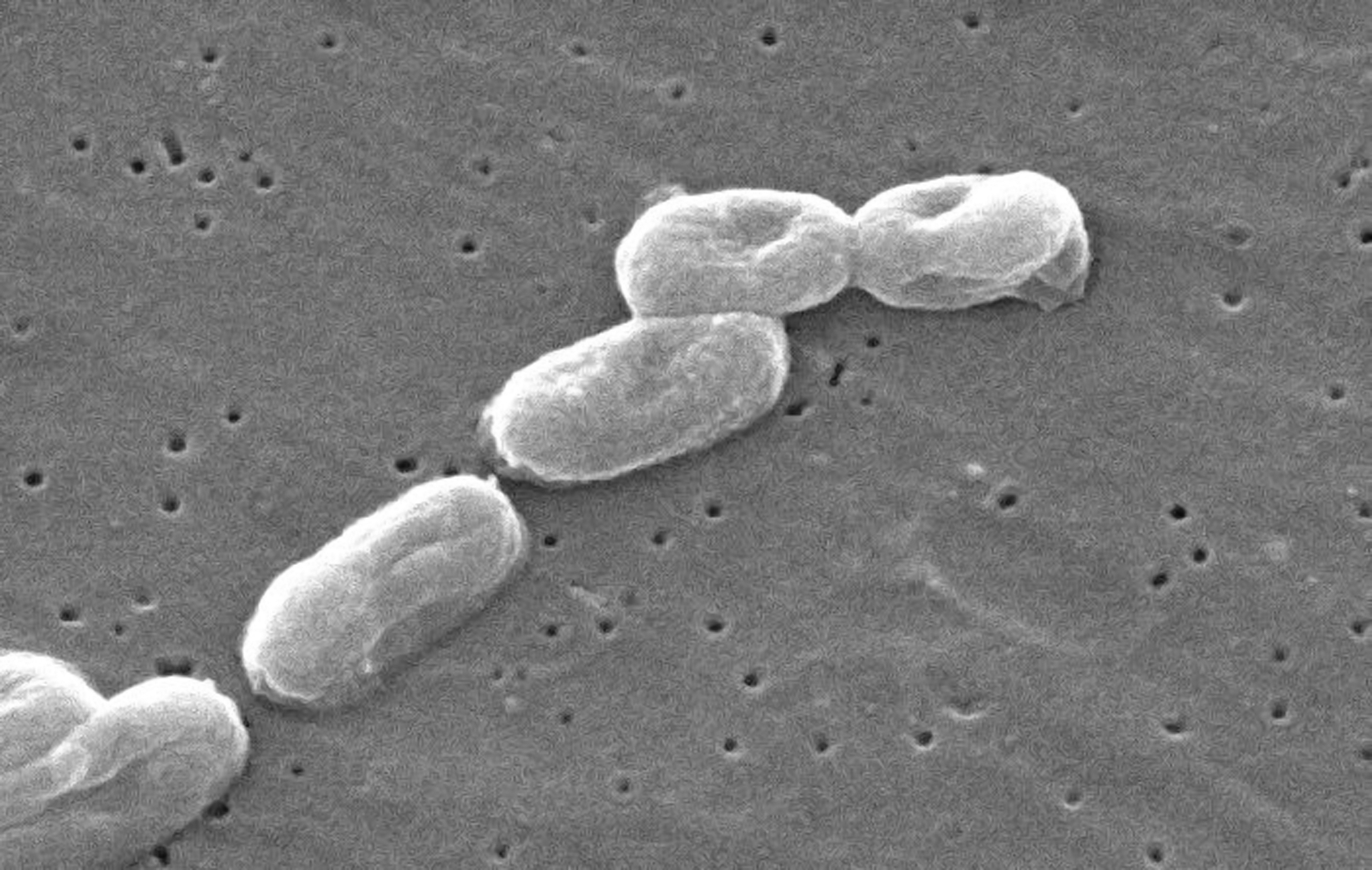
Image source: Wikipedia/Wikimedia
| Ecology, Host, and Life Cycle | |
|---|---|
| Oxygen requirements | Microaerophile |
| Optimal temperature | Not Available |
| Temperature range | Not Available |
| Habitat | rhizosphere |
| Biotic relationship | Not Available |
| Host(s) | Homo sapiens, Viridiplantae, Anura |
| Cell arrangement | Not Available |
| Sporulation | Not Available |
| Energy source | Not Available |
| Pathogenicity | Not Available |
Gene Summary
Adenine Count
1416701 bp
Thymine Count
1415774 bp
Guanine Count
2829969 bp
Cytosine Count
2840706 bp
Genome Length
8503150 bp
Protein-coding Genes
7521 genes
Non-Coding Genes
167 genes
# of Chromosomes/Plasmids
1
Genes
| Name | Locus Tag | UniProt ID | Strand Orientation | Gene Start/End | Protein Molecular Weight |
|---|---|---|---|---|---|
| prolyl-trna synthetase | NCTC10661_05238 | Not Available | Positive | 5817782 - 5819518 | 63845.8 |
| marc family integral membrane protein | NCTC10661_05239 | Not Available | Positive | 5819540 - 5820142 | 21797.9 |
| hypoxanthine-guanine phosphoribosyltransferase | NCTC10661_05240 | Not Available | Negative | 5820227 - 5820778 | 20468.8 |
| signal recognition particle subunit ffh/srp54 (srp54) | NCTC10661_05241 | Not Available | Negative | 5820873 - 5822240 | 49228.7 |
| cytochrome c assembly protein | NCTC10661_05242 | Not Available | Positive | 5822330 - 5823223 | 31993.1 |
| pyrimidine deaminase | NCTC10661_05243 | Not Available | Positive | 5823237 - 5823557 | 11047.1 |
| n-acetyl-anhydromuranmyl-l-alanine amidase | NCTC10661_05244 | Not Available | Positive | 5823554 - 5824144 | 21638.1 |
| ribonucleotide-diphosphate reductase subunit alpha | NCTC10661_05245 | Not Available | Positive | 5824596 - 5827586 | 109449.0 |
| ribonucleoside-diphosphate reductase, beta subunit | NCTC10661_05246 | Not Available | Positive | 5827952 - 5829163 | 45943.8 |
| histone h1-like protein | NCTC10661_05247 | Not Available | Positive | 5829602 - 5830270 | 21376.2 |
Pathways
1357 pathways
Health Effects
| Health Condition | Relation | Reference |
|---|---|---|
| Infective endocarditis | Causes | PMC3112426 |
| Native valve endocarditis | Causes | PMC3112426 |
| Pneumonia | Causes | PMC9294674 |



