
Kingdom
Pseudomonadati
Phylum
Pseudomonadota
Class
Betaproteobacteria
Order
Burkholderiales
Family
Burkholderiaceae
Genus
Burkholderia
Description
Taxonomy
| Kingdom | Pseudomonadati |
|---|---|
| Phylum | Pseudomonadota |
| Class | Betaproteobacteria |
| Order | Burkholderiales |
| Family | Burkholderiaceae |
| Genus | Burkholderia |
| Species | Burkholderia cepacia |
| Strain | strain NCTC10661 |
Profile
| Physiology | |
|---|---|
| Gram staining properties | Negative |
| Shape | Not Available |
| Mobility | Not Available |
| Flagellar presence | Not Available |
| Number of membranes | Not Available |
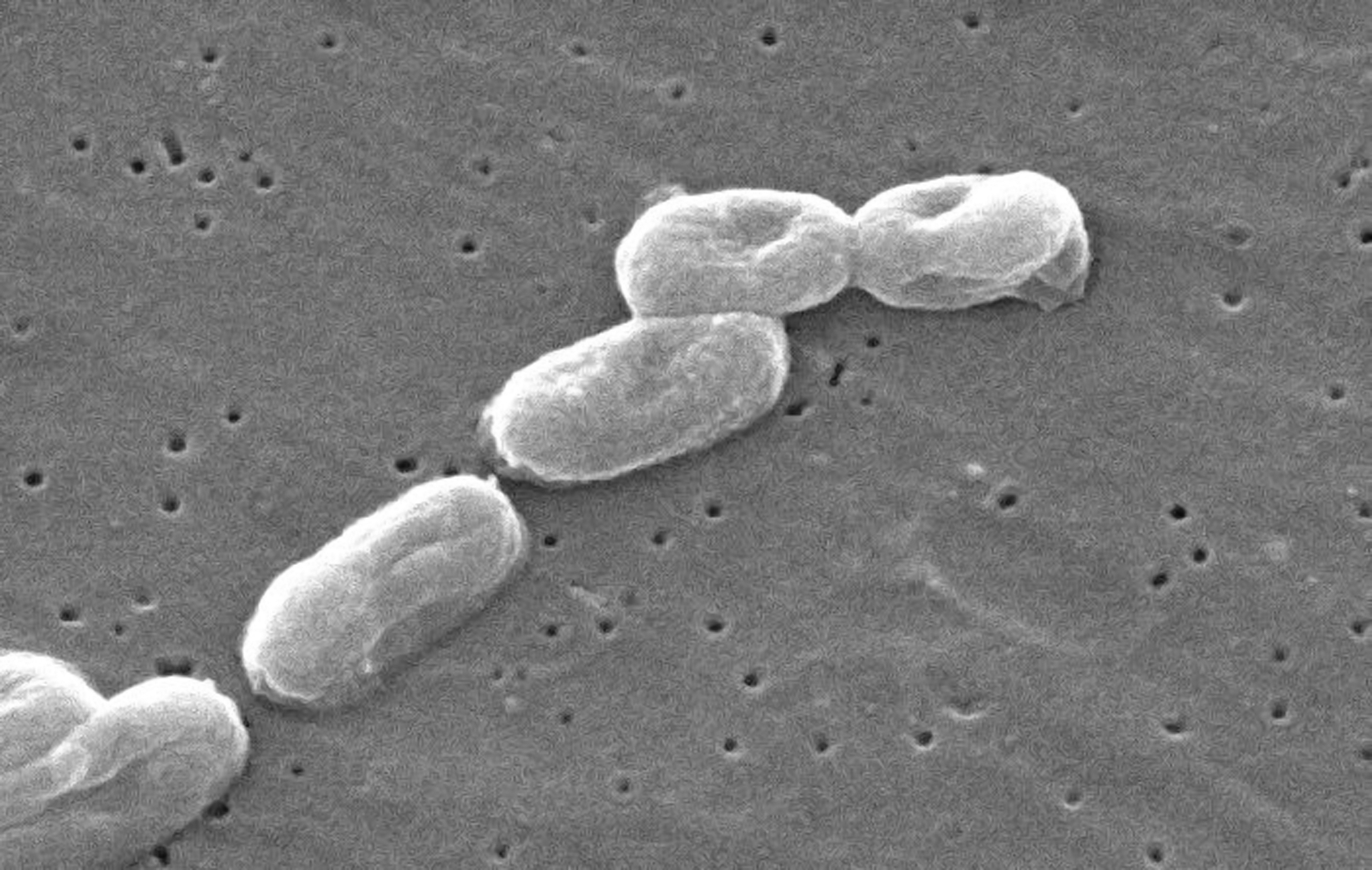
Image source: Wikipedia/Wikimedia
| Ecology, Host, and Life Cycle | |
|---|---|
| Oxygen requirements | Microaerophile |
| Optimal temperature | Not Available |
| Temperature range | Not Available |
| Habitat | rhizosphere |
| Biotic relationship | Not Available |
| Host(s) | Homo sapiens, Viridiplantae, Anura |
| Cell arrangement | Not Available |
| Sporulation | Not Available |
| Energy source | Not Available |
| Pathogenicity | Not Available |
Gene Summary
Adenine Count
1416701 bp
Thymine Count
1415774 bp
Guanine Count
2829969 bp
Cytosine Count
2840706 bp
Genome Length
8503150 bp
Protein-coding Genes
7521 genes
Non-Coding Genes
167 genes
# of Chromosomes/Plasmids
1
Genes
| Name | Locus Tag | UniProt ID | Strand Orientation | Gene Start/End | Protein Molecular Weight |
|---|---|---|---|---|---|
| fumarylacetoacetate hydrolase family protein | NCTC10661_05074 | Not Available | Positive | 5637614 - 5638792 | 41267.1 |
| methyl-accepting chemotaxis sensory transducer | NCTC10661_05075 | Not Available | Negative | 5638979 - 5639233 | 8679.09 |
| methyl-accepting chemotaxis sensory transducer | NCTC10661_05076 | Not Available | Negative | 5639255 - 5639500 | 8387.29 |
| methyl-accepting chemotaxis sensory transducer | NCTC10661_05077 | Not Available | Positive | 5639860 - 5641446 | 55053.2 |
| altronate dehydratase | NCTC10661_05078 | Not Available | Negative | 5641674 - 5643197 | 52674.7 |
| mannitol dehydrogenase-like | NCTC10661_05079 | Not Available | Negative | 5643194 - 5644354 | 42861.3 |
| alcohol dehydrogenase groes-like protein | NCTC10661_05080 | Not Available | Negative | 5644386 - 5645396 | 36178.6 |
| amidohydrolase 2 | NCTC10661_05081 | Not Available | Negative | 5645419 - 5646288 | 31891.0 |
| aldo/keto reductase | NCTC10661_05082 | Not Available | Negative | 5646285 - 5647301 | 36126.8 |
| periplasmic binding protein/laci transcriptional regulator | NCTC10661_05083 | Not Available | Negative | 5647338 - 5648285 | 32836.3 |
Pathways
1489 pathways
Health Effects
| Health Condition | Relation | Reference |
|---|---|---|
| Infective endocarditis | Causes | PMC3112426 |
| Native valve endocarditis | Causes | PMC3112426 |
| Pneumonia | Causes | PMC9294674 |



