
Kingdom
Pseudomonadati
Phylum
Pseudomonadota
Class
Betaproteobacteria
Order
Burkholderiales
Family
Burkholderiaceae
Genus
Burkholderia
Description
Taxonomy
| Kingdom | Pseudomonadati |
|---|---|
| Phylum | Pseudomonadota |
| Class | Betaproteobacteria |
| Order | Burkholderiales |
| Family | Burkholderiaceae |
| Genus | Burkholderia |
| Species | Burkholderia cepacia |
| Strain | strain NCTC10661 |
Profile
| Physiology | |
|---|---|
| Gram staining properties | Negative |
| Shape | Not Available |
| Mobility | Not Available |
| Flagellar presence | Not Available |
| Number of membranes | Not Available |
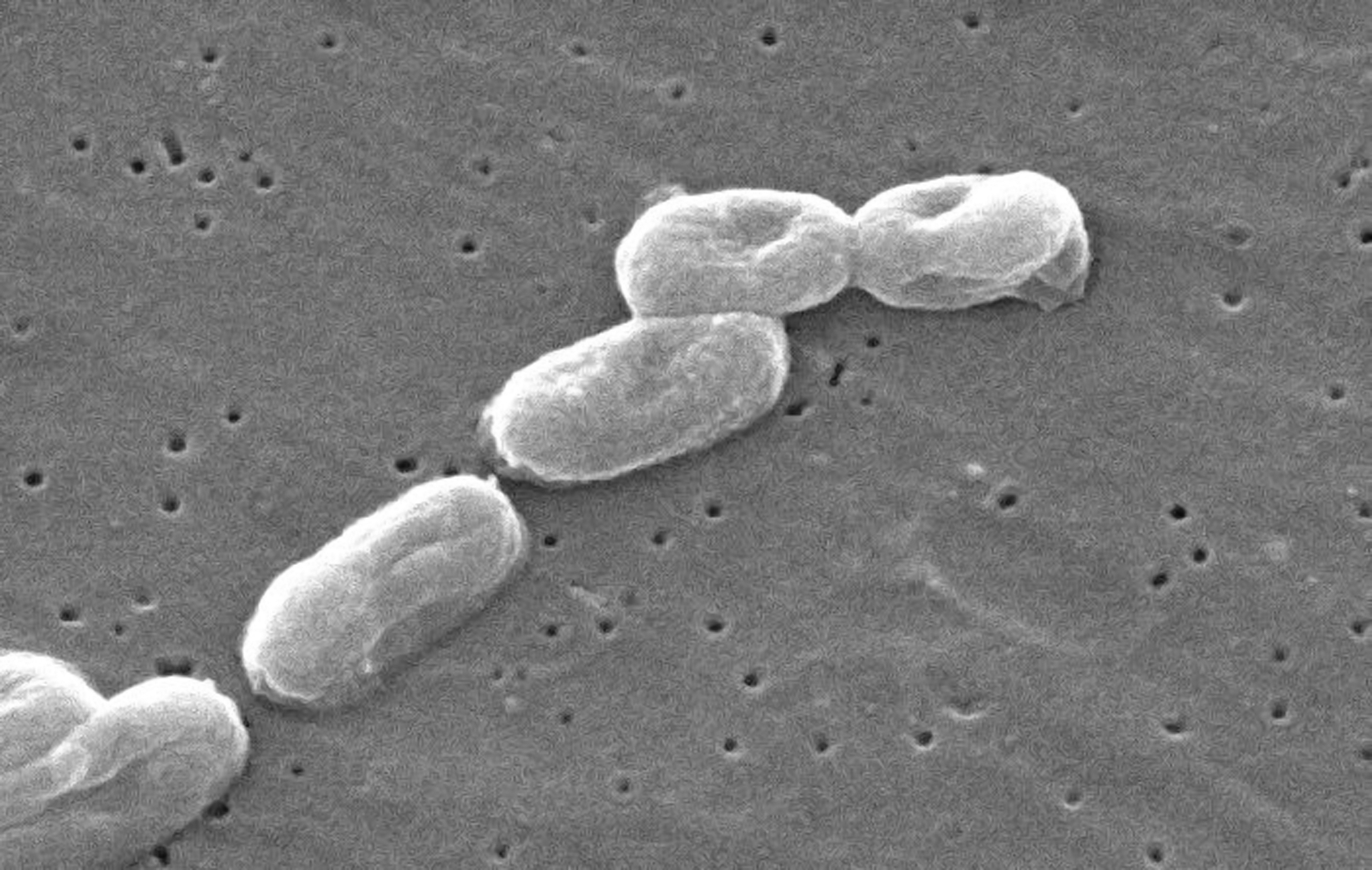
Image source: Wikipedia/Wikimedia
| Ecology, Host, and Life Cycle | |
|---|---|
| Oxygen requirements | Microaerophile |
| Optimal temperature | Not Available |
| Temperature range | Not Available |
| Habitat | rhizosphere |
| Biotic relationship | Not Available |
| Host(s) | Homo sapiens, Viridiplantae, Anura |
| Cell arrangement | Not Available |
| Sporulation | Not Available |
| Energy source | Not Available |
| Pathogenicity | Not Available |
Gene Summary
Adenine Count
1416701 bp
Thymine Count
1415774 bp
Guanine Count
2829969 bp
Cytosine Count
2840706 bp
Genome Length
8503150 bp
Protein-coding Genes
7521 genes
Non-Coding Genes
167 genes
# of Chromosomes/Plasmids
1
Genes
| Name | Locus Tag | UniProt ID | Strand Orientation | Gene Start/End | Protein Molecular Weight |
|---|---|---|---|---|---|
| tonb-dependent siderophore receptor | NCTC10661_04873 | Not Available | Negative | 5405075 - 5407198 | 76930.0 |
| pepsy-associated tm helix domain-containing protein | NCTC10661_04874 | Not Available | Positive | 5407426 - 5408667 | 44279.2 |
| dna-3-methyladenine glycosylase i | NCTC10661_04875 | Not Available | Negative | 5408785 - 5409387 | 22112.1 |
| badf/badg/bcra/bcrd type atpase | NCTC10661_04876 | Not Available | Positive | 5409530 - 5410411 | 29307.9 |
| cof family hydrolase | NCTC10661_04877 | Not Available | Positive | 5410555 - 5411379 | 29976.7 |
| aquaporin z | NCTC10661_04878 | Not Available | Negative | 5411498 - 5412238 | 24960.8 |
| histone-like nucleoid-structuring protein h-ns | NCTC10661_04879 | Not Available | Positive | 5412543 - 5412839 | 10958.2 |
| group 1 glycosyl transferase | NCTC10661_04880 | Not Available | Negative | 5412946 - 5414010 | 38924.0 |
| protein flhd | NCTC10661_04881 | Not Available | Positive | 5414673 - 5414993 | 11636.2 |
| transcriptional activator flhc | NCTC10661_04882 | Not Available | Positive | 5415090 - 5415644 | 20550.0 |
Pathways
1357 pathways
Health Effects
| Health Condition | Relation | Reference |
|---|---|---|
| Infective endocarditis | Causes | PMC3112426 |
| Native valve endocarditis | Causes | PMC3112426 |
| Pneumonia | Causes | PMC9294674 |



