
Kingdom
Pseudomonadati
Phylum
Pseudomonadota
Class
Betaproteobacteria
Order
Burkholderiales
Family
Burkholderiaceae
Genus
Burkholderia
Description
Taxonomy
| Kingdom | Pseudomonadati |
|---|---|
| Phylum | Pseudomonadota |
| Class | Betaproteobacteria |
| Order | Burkholderiales |
| Family | Burkholderiaceae |
| Genus | Burkholderia |
| Species | Burkholderia cepacia |
| Strain | strain NCTC10661 |
Profile
| Physiology | |
|---|---|
| Gram staining properties | Negative |
| Shape | Not Available |
| Mobility | Not Available |
| Flagellar presence | Not Available |
| Number of membranes | Not Available |
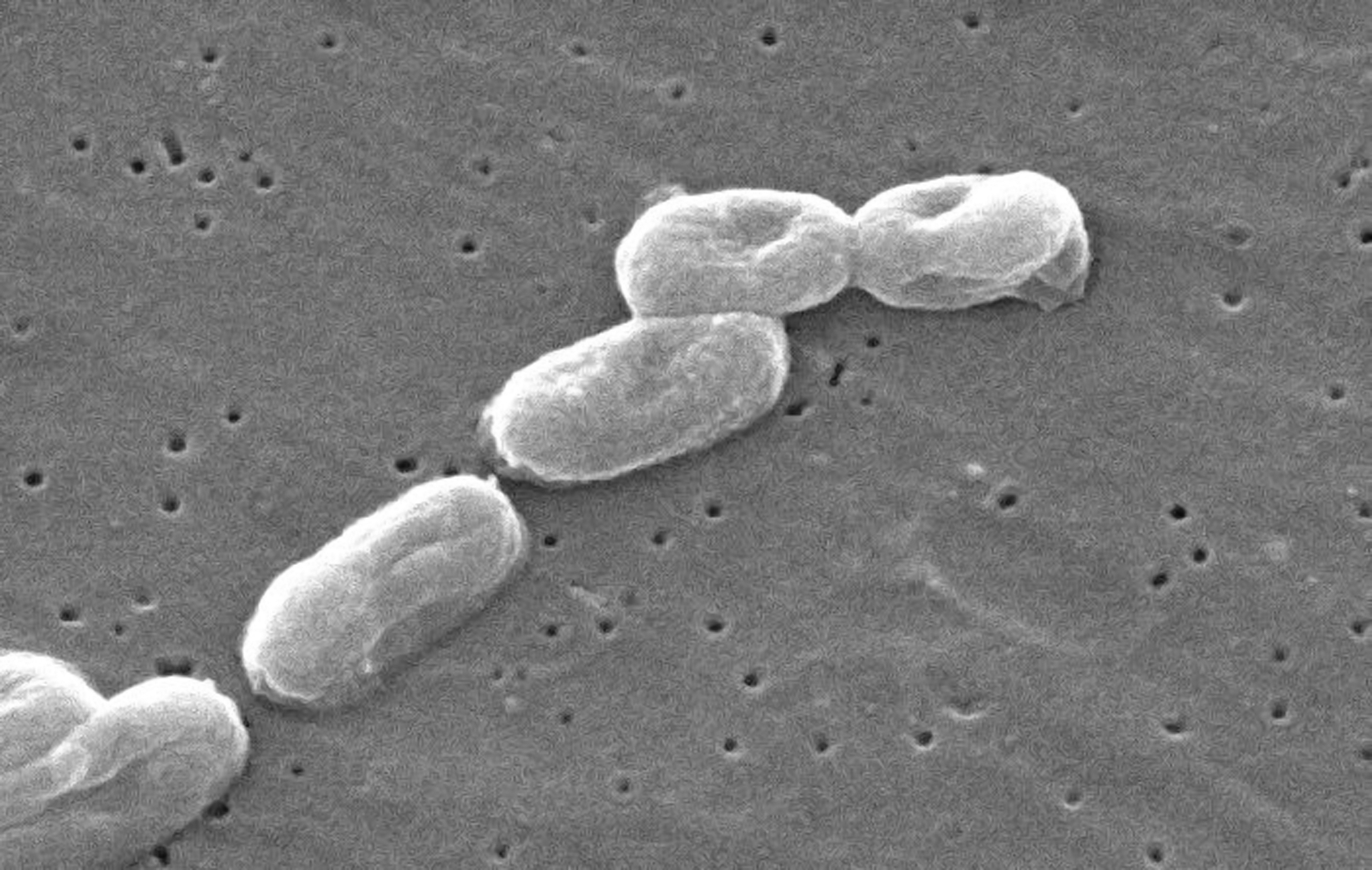
Image source: Wikipedia/Wikimedia
| Ecology, Host, and Life Cycle | |
|---|---|
| Oxygen requirements | Microaerophile |
| Optimal temperature | Not Available |
| Temperature range | Not Available |
| Habitat | rhizosphere |
| Biotic relationship | Not Available |
| Host(s) | Homo sapiens, Viridiplantae, Anura |
| Cell arrangement | Not Available |
| Sporulation | Not Available |
| Energy source | Not Available |
| Pathogenicity | Not Available |
Gene Summary
Adenine Count
1416701 bp
Thymine Count
1415774 bp
Guanine Count
2829969 bp
Cytosine Count
2840706 bp
Genome Length
8503150 bp
Protein-coding Genes
7521 genes
Non-Coding Genes
167 genes
# of Chromosomes/Plasmids
1
Genes
| Name | Locus Tag | UniProt ID | Strand Orientation | Gene Start/End | Protein Molecular Weight |
|---|---|---|---|---|---|
| uncharacterised protein | NCTC10661_04863 | Not Available | Negative | 5391952 - 5392995 | 39178.6 |
| streptogramin acetyl transferase | NCTC10661_04864 | Not Available | Positive | 5393807 - 5394550 | 27318.6 |
| putative tpr repeat protein | NCTC10661_04865 | Not Available | Positive | 5394590 - 5396530 | 70783.4 |
| hexapaptide repeat-containing transferase | NCTC10661_04866 | Not Available | Positive | 5396623 - 5397285 | 22397.2 |
| putative aminotransferase | NCTC10661_04867 | Not Available | Negative | 5397296 - 5398438 | 42154.8 |
| tpr repeat-containing protein | NCTC10661_04868 | Not Available | Negative | 5398467 - 5400806 | 84306.0 |
| flagellar flit family protein | NCTC10661_04869 | Not Available | Negative | 5401051 - 5401350 | 10745.7 |
| flagellar hook-associated 2-like protein | NCTC10661_04870 | Not Available | Negative | 5401376 - 5402884 | 48954.4 |
| flagellin | NCTC10661_04871 | Not Available | Negative | 5403017 - 5404171 | 38761.2 |
| 30s ribosomal protein s21 | NCTC10661_04872 | Not Available | Positive | 5404692 - 5404904 | 8379.54 |
Pathways
1357 pathways
Health Effects
| Health Condition | Relation | Reference |
|---|---|---|
| Infective endocarditis | Causes | PMC3112426 |
| Native valve endocarditis | Causes | PMC3112426 |
| Pneumonia | Causes | PMC9294674 |



