
Kingdom
Pseudomonadati
Phylum
Pseudomonadota
Class
Betaproteobacteria
Order
Burkholderiales
Family
Burkholderiaceae
Genus
Burkholderia
Description
Taxonomy
| Kingdom | Pseudomonadati |
|---|---|
| Phylum | Pseudomonadota |
| Class | Betaproteobacteria |
| Order | Burkholderiales |
| Family | Burkholderiaceae |
| Genus | Burkholderia |
| Species | Burkholderia cepacia |
| Strain | strain NCTC10661 |
Profile
| Physiology | |
|---|---|
| Gram staining properties | Negative |
| Shape | Not Available |
| Mobility | Not Available |
| Flagellar presence | Not Available |
| Number of membranes | Not Available |
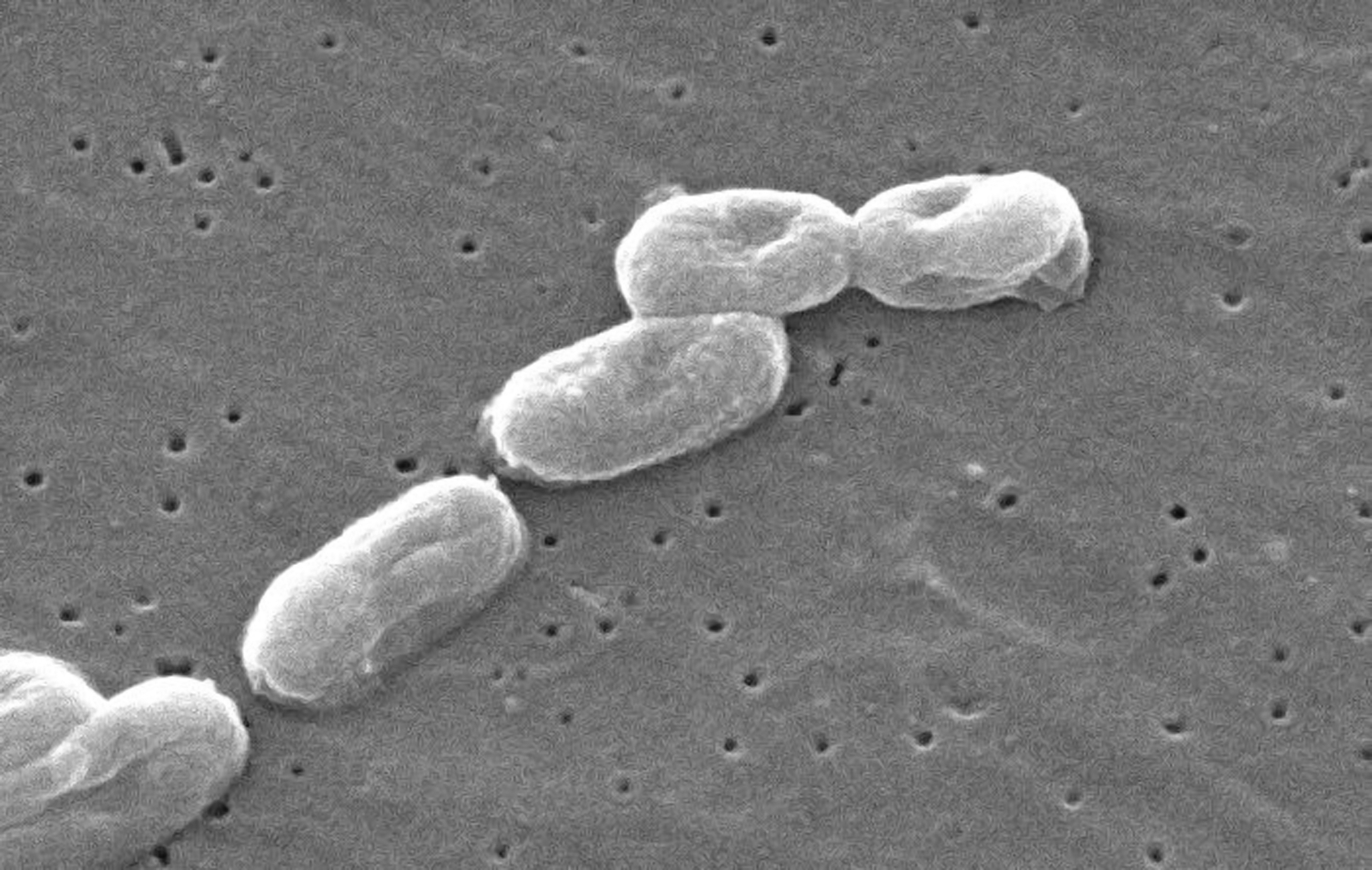
Image source: Wikipedia/Wikimedia
| Ecology, Host, and Life Cycle | |
|---|---|
| Oxygen requirements | Microaerophile |
| Optimal temperature | Not Available |
| Temperature range | Not Available |
| Habitat | rhizosphere |
| Biotic relationship | Not Available |
| Host(s) | Homo sapiens, Viridiplantae, Anura |
| Cell arrangement | Not Available |
| Sporulation | Not Available |
| Energy source | Not Available |
| Pathogenicity | Not Available |
Gene Summary
Adenine Count
1416701 bp
Thymine Count
1415774 bp
Guanine Count
2829969 bp
Cytosine Count
2840706 bp
Genome Length
8503150 bp
Protein-coding Genes
7521 genes
Non-Coding Genes
167 genes
# of Chromosomes/Plasmids
1
Genes
| Name | Locus Tag | UniProt ID | Strand Orientation | Gene Start/End | Protein Molecular Weight |
|---|---|---|---|---|---|
| uncharacterised protein | NCTC10661_04813 | Not Available | Positive | 5328943 - 5329149 | 7259.5 |
| general secretion pathway protein i | NCTC10661_04814 | Not Available | Positive | 5329478 - 5329909 | 15520.8 |
| type ii secretory pathway component pulj | NCTC10661_04815 | Not Available | Positive | 5329893 - 5330555 | 23897.1 |
| tpr repeat-containing protein | NCTC10661_04816 | Not Available | Positive | 5330742 - 5332964 | 81279.2 |
| tpr repeat-containing protein | NCTC10661_04817 | Not Available | Positive | 5333007 - 5335250 | 82464.0 |
| glycosyltransferase 9 family protein | NCTC10661_04818 | Not Available | Positive | 5335247 - 5337487 | 81023.3 |
| filamentous hemagglutinin family outer membrane protein | NCTC10661_04819 | Not Available | Positive | 5337804 - 5350541 | 422138.0 |
| phosphate-binding ding protein | NCTC10661_04820 | Not Available | Negative | 5351070 - 5352407 | 44840.1 |
| general secretion pathway protein f | NCTC10661_04821 | Not Available | Positive | 5353047 - 5354264 | 44352.6 |
| general secretion pathway protein c | NCTC10661_04822 | Not Available | Negative | 5354278 - 5354724 | 15268.7 |
Pathways
1357 pathways
Health Effects
| Health Condition | Relation | Reference |
|---|---|---|
| Infective endocarditis | Causes | PMC3112426 |
| Native valve endocarditis | Causes | PMC3112426 |
| Pneumonia | Causes | PMC9294674 |



