
Kingdom
Pseudomonadati
Phylum
Pseudomonadota
Class
Betaproteobacteria
Order
Burkholderiales
Family
Burkholderiaceae
Genus
Burkholderia
Description
Taxonomy
| Kingdom | Pseudomonadati |
|---|---|
| Phylum | Pseudomonadota |
| Class | Betaproteobacteria |
| Order | Burkholderiales |
| Family | Burkholderiaceae |
| Genus | Burkholderia |
| Species | Burkholderia cepacia |
| Strain | strain NCTC10661 |
Profile
| Physiology | |
|---|---|
| Gram staining properties | Negative |
| Shape | Not Available |
| Mobility | Not Available |
| Flagellar presence | Not Available |
| Number of membranes | Not Available |
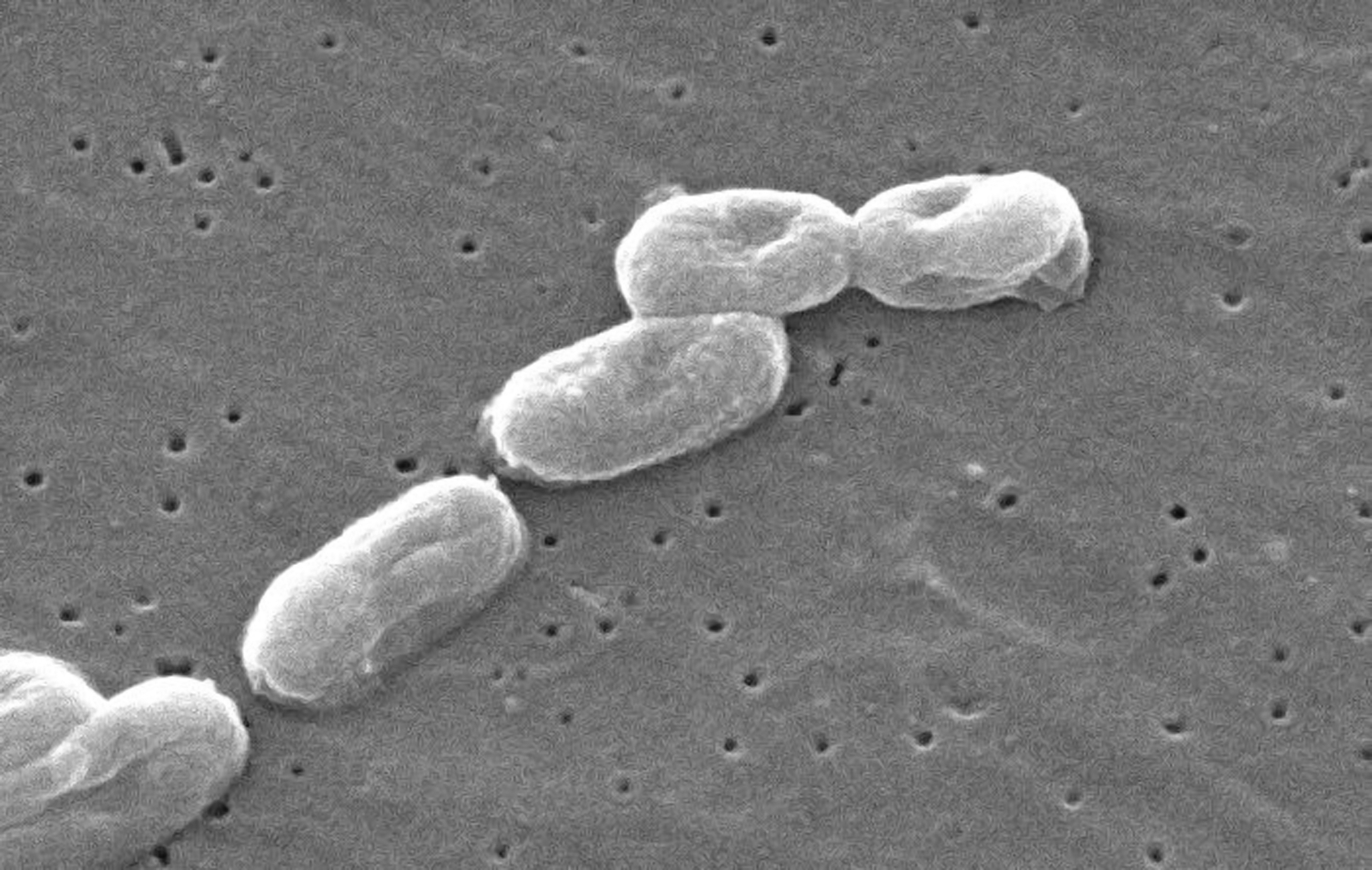
Image source: Wikipedia/Wikimedia
| Ecology, Host, and Life Cycle | |
|---|---|
| Oxygen requirements | Microaerophile |
| Optimal temperature | Not Available |
| Temperature range | Not Available |
| Habitat | rhizosphere |
| Biotic relationship | Not Available |
| Host(s) | Homo sapiens, Viridiplantae, Anura |
| Cell arrangement | Not Available |
| Sporulation | Not Available |
| Energy source | Not Available |
| Pathogenicity | Not Available |
Gene Summary
Adenine Count
1416701 bp
Thymine Count
1415774 bp
Guanine Count
2829969 bp
Cytosine Count
2840706 bp
Genome Length
8503150 bp
Protein-coding Genes
7521 genes
Non-Coding Genes
167 genes
# of Chromosomes/Plasmids
1
Genes
| Name | Locus Tag | UniProt ID | Strand Orientation | Gene Start/End | Protein Molecular Weight |
|---|---|---|---|---|---|
| iron-sulfur protein | NCTC10661_04359 | Not Available | Negative | 4848204 - 4848515 | 10647.8 |
| fad dependent oxidoreductase | NCTC10661_04360 | Not Available | Negative | 4848699 - 4849808 | 39126.1 |
| atpase aaa | NCTC10661_04361 | Not Available | Negative | 4849962 - 4850942 | 35533.3 |
| nitroreductase | NCTC10661_04362 | Not Available | Positive | 4851173 - 4851892 | 26463.4 |
| uncharacterised protein | NCTC10661_04363 | Not Available | Positive | 4852039 - 4852527 | 17303.4 |
| endonuclease/exonuclease/phosphatase | NCTC10661_04364 | Not Available | Positive | 4852533 - 4853348 | 30047.1 |
| lysine exporter protein lyse/ygga | NCTC10661_04365 | Not Available | Positive | 4853511 - 4853672 | 5392.79 |
| lysine exporter protein lyse/ygga | NCTC10661_04366 | Not Available | Positive | 4853685 - 4854158 | 17098.0 |
| ferredoxin-nadp reductase | NCTC10661_04367 | Not Available | Positive | 4854393 - 4855163 | 28699.4 |
| signal transduction histidine kinase | NCTC10661_04368 | Not Available | Positive | 4855579 - 4856394 | 27932.9 |
Pathways
1357 pathways
Health Effects
| Health Condition | Relation | Reference |
|---|---|---|
| Infective endocarditis | Causes | PMC3112426 |
| Native valve endocarditis | Causes | PMC3112426 |
| Pneumonia | Causes | PMC9294674 |



