
Kingdom
Pseudomonadati
Phylum
Pseudomonadota
Class
Betaproteobacteria
Order
Burkholderiales
Family
Burkholderiaceae
Genus
Burkholderia
Description
Taxonomy
| Kingdom | Pseudomonadati |
|---|---|
| Phylum | Pseudomonadota |
| Class | Betaproteobacteria |
| Order | Burkholderiales |
| Family | Burkholderiaceae |
| Genus | Burkholderia |
| Species | Burkholderia cepacia |
| Strain | strain NCTC10661 |
Profile
| Physiology | |
|---|---|
| Gram staining properties | Negative |
| Shape | Not Available |
| Mobility | Not Available |
| Flagellar presence | Not Available |
| Number of membranes | Not Available |
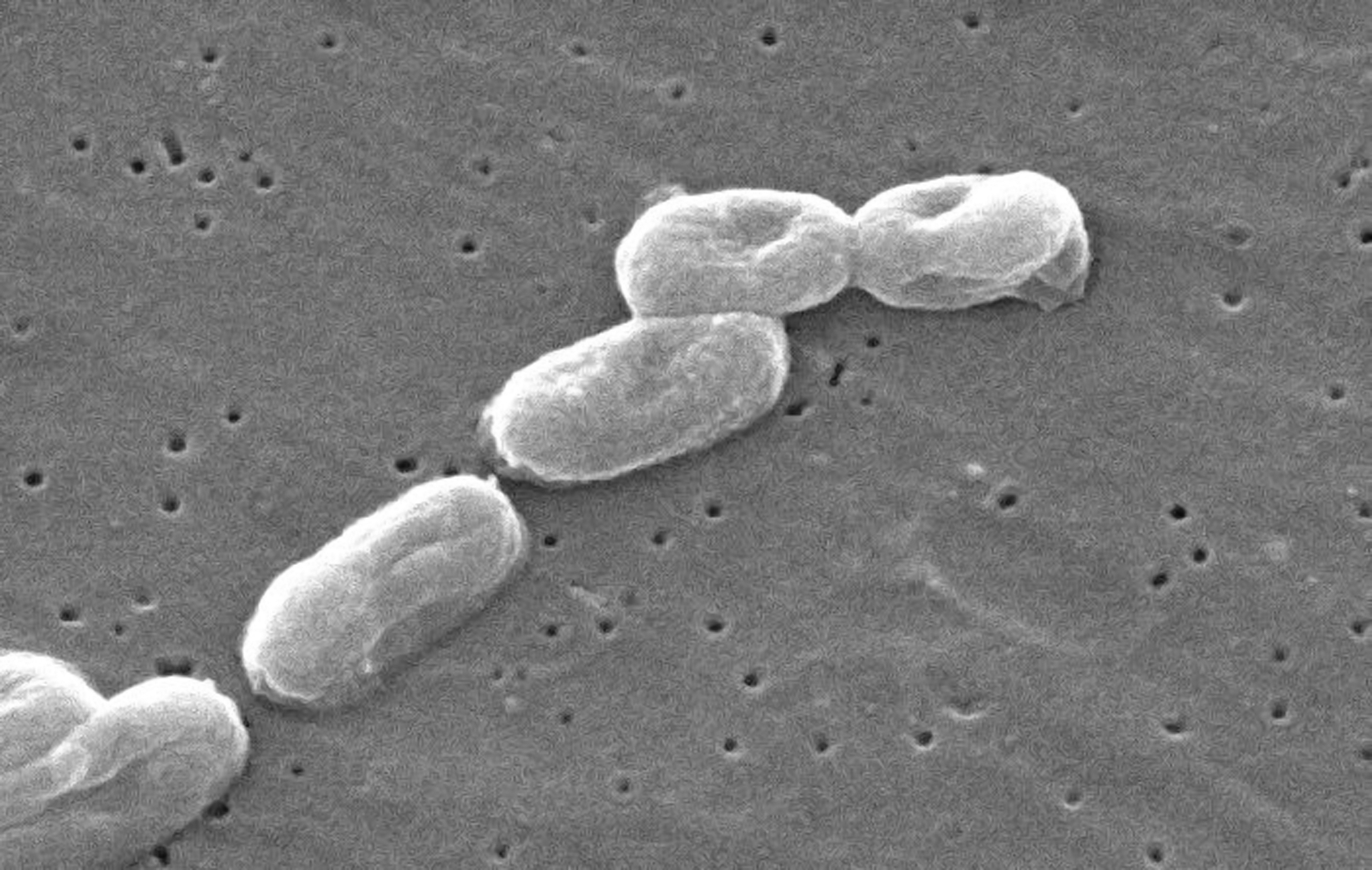
Image source: Wikipedia/Wikimedia
| Ecology, Host, and Life Cycle | |
|---|---|
| Oxygen requirements | Microaerophile |
| Optimal temperature | Not Available |
| Temperature range | Not Available |
| Habitat | rhizosphere |
| Biotic relationship | Not Available |
| Host(s) | Homo sapiens, Viridiplantae, Anura |
| Cell arrangement | Not Available |
| Sporulation | Not Available |
| Energy source | Not Available |
| Pathogenicity | Not Available |
Gene Summary
Adenine Count
1416701 bp
Thymine Count
1415774 bp
Guanine Count
2829969 bp
Cytosine Count
2840706 bp
Genome Length
8503150 bp
Protein-coding Genes
7521 genes
Non-Coding Genes
167 genes
# of Chromosomes/Plasmids
1
Genes
| Name | Locus Tag | UniProt ID | Strand Orientation | Gene Start/End | Protein Molecular Weight |
|---|---|---|---|---|---|
| flagellar basal body l-ring protein | NCTC10661_04329 | Not Available | Negative | 4815133 - 4815825 | 24155.8 |
| flagellar basal body rod protein flgg | NCTC10661_04330 | Not Available | Negative | 4815847 - 4816635 | 27612.3 |
| flagellar basal body rod protein flgf | NCTC10661_04331 | Not Available | Negative | 4816670 - 4817428 | 26035.4 |
| flagellar hook protein flge | NCTC10661_04332 | Not Available | Negative | 4817448 - 4818689 | 42596.7 |
| flagellar basal body rod modification protein | NCTC10661_04333 | Not Available | Negative | 4818723 - 4819475 | 24693.5 |
| flagellar basal body rod protein flgc | NCTC10661_04334 | Not Available | Negative | 4819540 - 4819965 | 14596.3 |
| flagellar basal-body rod protein flgb | NCTC10661_04335 | Not Available | Negative | 4820006 - 4820494 | 17225.4 |
| flagellar basal body p-ring biosynthesis protein flga | NCTC10661_04336 | Not Available | Positive | 4820738 - 4821967 | 40476.4 |
| anti-sigma-28 factor flgm | NCTC10661_04337 | Not Available | Positive | 4822086 - 4822415 | 10706.3 |
| flgn protein | NCTC10661_04338 | Not Available | Positive | 4822495 - 4822935 | 16087.4 |
Pathways
1357 pathways
Health Effects
| Health Condition | Relation | Reference |
|---|---|---|
| Infective endocarditis | Causes | PMC3112426 |
| Native valve endocarditis | Causes | PMC3112426 |
| Pneumonia | Causes | PMC9294674 |



