
Kingdom
Pseudomonadati
Phylum
Pseudomonadota
Class
Betaproteobacteria
Order
Burkholderiales
Family
Burkholderiaceae
Genus
Burkholderia
Description
Taxonomy
| Kingdom | Pseudomonadati |
|---|---|
| Phylum | Pseudomonadota |
| Class | Betaproteobacteria |
| Order | Burkholderiales |
| Family | Burkholderiaceae |
| Genus | Burkholderia |
| Species | Burkholderia cepacia |
| Strain | strain NCTC10661 |
Profile
| Physiology | |
|---|---|
| Gram staining properties | Negative |
| Shape | Not Available |
| Mobility | Not Available |
| Flagellar presence | Not Available |
| Number of membranes | Not Available |
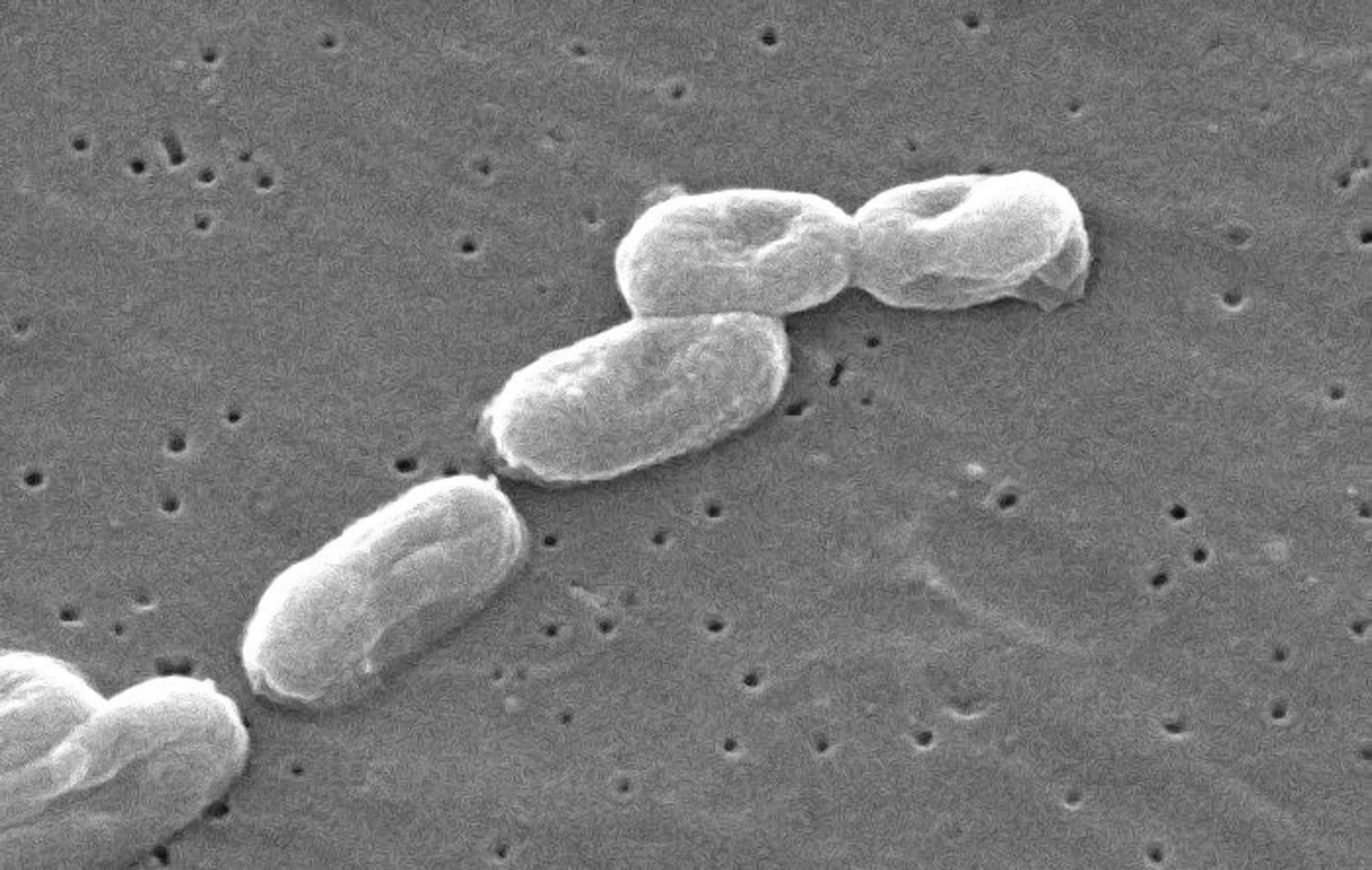
Image source: Wikipedia/Wikimedia
| Ecology, Host, and Life Cycle | |
|---|---|
| Oxygen requirements | Microaerophile |
| Optimal temperature | Not Available |
| Temperature range | Not Available |
| Habitat | rhizosphere |
| Biotic relationship | Not Available |
| Host(s) | Homo sapiens, Viridiplantae, Anura |
| Cell arrangement | Not Available |
| Sporulation | Not Available |
| Energy source | Not Available |
| Pathogenicity | Not Available |
Gene Summary
Adenine Count
1416701 bp
Thymine Count
1415774 bp
Guanine Count
2829969 bp
Cytosine Count
2840706 bp
Genome Length
8503150 bp
Protein-coding Genes
7521 genes
Non-Coding Genes
167 genes
# of Chromosomes/Plasmids
1
Genes
| Name | Locus Tag | UniProt ID | Strand Orientation | Gene Start/End | Protein Molecular Weight |
|---|---|---|---|---|---|
| transcriptional regulator | NCTC10661_00358 | Not Available | Positive | 388888 - 389880 | 36340.8 |
| tautomerase enzyme family protein | NCTC10661_00359 | Not Available | Positive | 390030 - 390593 | 20282.3 |
| uncharacterised protein | NCTC10661_00360 | Not Available | Negative | 390710 - 390892 | 6097.79 |
| amp nucleosidase | NCTC10661_00361 | Not Available | Negative | 391204 - 392730 | 57303.2 |
| putative transmembrane protein | NCTC10661_00362 | Not Available | Positive | 392860 - 393255 | 14026.5 |
| homoserine kinase | NCTC10661_00363 | Not Available | Positive | 393357 - 394355 | 37198.3 |
| major facilitator superfamily permease | NCTC10661_00364 | Not Available | Positive | 394346 - 395155 | 28893.1 |
| marr family transcriptional regulator | NCTC10661_00365 | Not Available | Positive | 395343 - 395795 | 17002.6 |
| osmc-like protein | NCTC10661_00366 | Not Available | Positive | 395952 - 396371 | 14415.1 |
| protein of uncharacterised function (duf3563) | NCTC10661_00367 | Not Available | Negative | 396490 - 396666 | 6922.33 |
Pathways
0 pathways
No pathways found
No metabolic pathways have been associated with this bacterium yet.
Health Effects
| Health Condition | Relation | Reference |
|---|---|---|
| Infective endocarditis | Causes | PMC3112426 |
| Native valve endocarditis | Causes | PMC3112426 |
| Pneumonia | Causes | PMC9294674 |



