
Kingdom
Pseudomonadati
Phylum
Pseudomonadota
Class
Betaproteobacteria
Order
Burkholderiales
Family
Burkholderiaceae
Genus
Burkholderia
Description
Taxonomy
| Kingdom | Pseudomonadati |
|---|---|
| Phylum | Pseudomonadota |
| Class | Betaproteobacteria |
| Order | Burkholderiales |
| Family | Burkholderiaceae |
| Genus | Burkholderia |
| Species | Burkholderia cepacia |
| Strain | strain NCTC10661 |
Profile
| Physiology | |
|---|---|
| Gram staining properties | Negative |
| Shape | Not Available |
| Mobility | Not Available |
| Flagellar presence | Not Available |
| Number of membranes | Not Available |
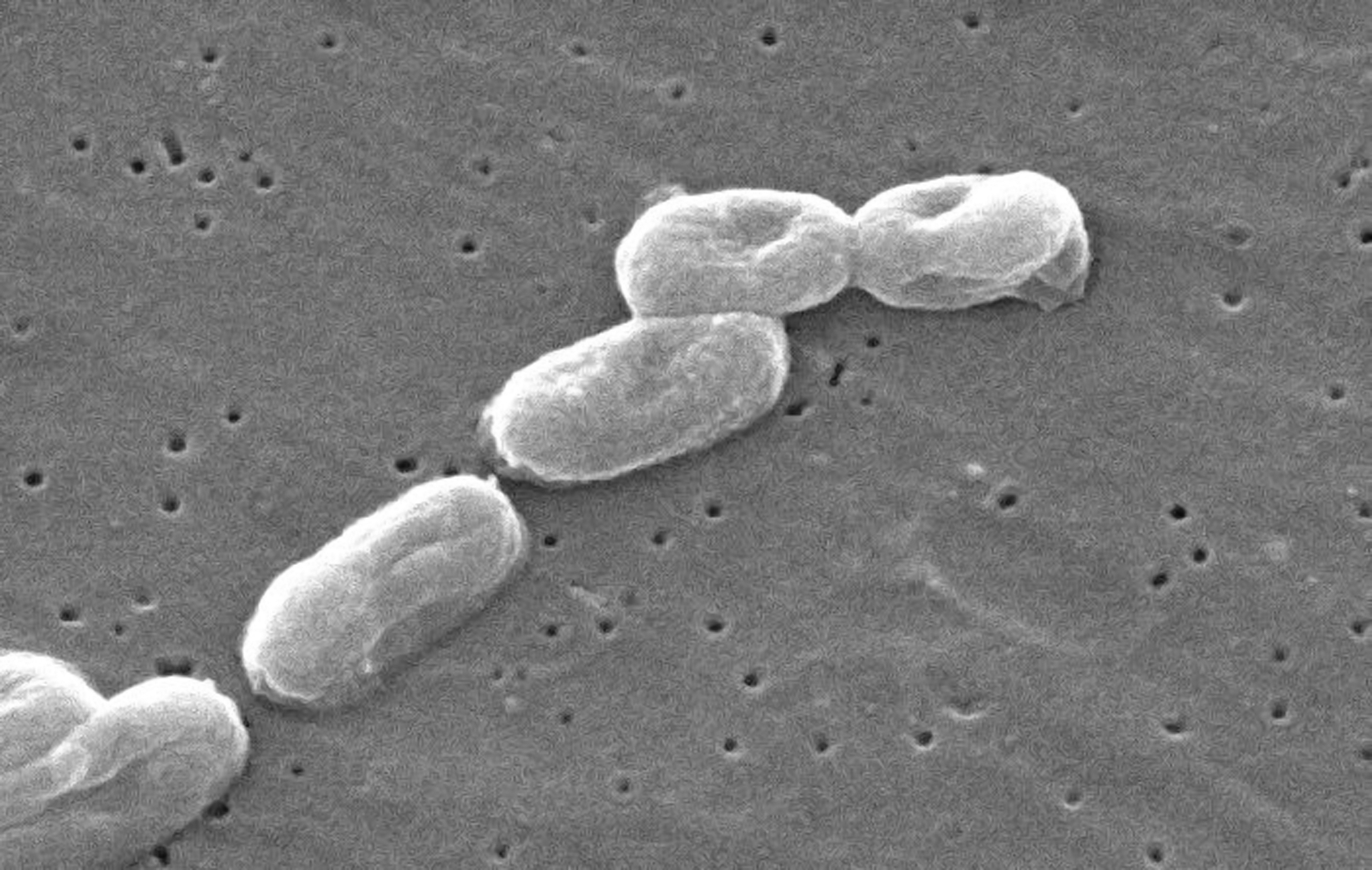
Image source: Wikipedia/Wikimedia
| Ecology, Host, and Life Cycle | |
|---|---|
| Oxygen requirements | Microaerophile |
| Optimal temperature | Not Available |
| Temperature range | Not Available |
| Habitat | rhizosphere |
| Biotic relationship | Not Available |
| Host(s) | Homo sapiens, Viridiplantae, Anura |
| Cell arrangement | Not Available |
| Sporulation | Not Available |
| Energy source | Not Available |
| Pathogenicity | Not Available |
Gene Summary
Adenine Count
1416701 bp
Thymine Count
1415774 bp
Guanine Count
2829969 bp
Cytosine Count
2840706 bp
Genome Length
8503150 bp
Protein-coding Genes
7521 genes
Non-Coding Genes
167 genes
# of Chromosomes/Plasmids
1
Genes
| Name | Locus Tag | UniProt ID | Strand Orientation | Gene Start/End | Protein Molecular Weight |
|---|---|---|---|---|---|
| 1,6-dihydroxycyclohexa-2,4-diene-1-carboxylate dehydrogenase | NCTC10661_03809 | Not Available | Negative | 4251659 - 4252435 | 26923.2 |
| oxidoreductase fad/nad(p)-binding subunit | NCTC10661_03810 | Not Available | Negative | 4252432 - 4253454 | 36437.3 |
| 2-chlorobenzoate 1,2-dioxygenase | NCTC10661_03811 | Not Available | Negative | 4253494 - 4253982 | 19361.5 |
| ring hydroxylating dioxygenase, alpha subunit | NCTC10661_03812 | Not Available | Negative | 4253979 - 4255337 | 51190.2 |
| catechol 1,2-dioxygenase | NCTC10661_03813 | Not Available | Negative | 4255455 - 4256399 | 33538.4 |
| muconate and chloromuconate cycloisomerase | NCTC10661_03814 | Not Available | Negative | 4256451 - 4257587 | 40547.1 |
| uncharacterised protein | NCTC10661_03815 | Not Available | Positive | 4258149 - 4259165 | 39516.4 |
| uncharacterised protein | NCTC10661_03816 | Not Available | Negative | 4260504 - 4260671 | 6263.59 |
| uncharacterised protein | NCTC10661_03817 | Not Available | Positive | 4262090 - 4262260 | 6430.87 |
| uncharacterised protein | NCTC10661_03818 | Not Available | Negative | 4262984 - 4263217 | 8416.8 |
Pathways
1357 pathways
Health Effects
| Health Condition | Relation | Reference |
|---|---|---|
| Infective endocarditis | Causes | PMC3112426 |
| Native valve endocarditis | Causes | PMC3112426 |
| Pneumonia | Causes | PMC9294674 |



