
Kingdom
Pseudomonadati
Phylum
Pseudomonadota
Class
Betaproteobacteria
Order
Burkholderiales
Family
Burkholderiaceae
Genus
Burkholderia
Description
Taxonomy
| Kingdom | Pseudomonadati |
|---|---|
| Phylum | Pseudomonadota |
| Class | Betaproteobacteria |
| Order | Burkholderiales |
| Family | Burkholderiaceae |
| Genus | Burkholderia |
| Species | Burkholderia cepacia |
| Strain | strain NCTC10661 |
Profile
| Physiology | |
|---|---|
| Gram staining properties | Negative |
| Shape | Not Available |
| Mobility | Not Available |
| Flagellar presence | Not Available |
| Number of membranes | Not Available |
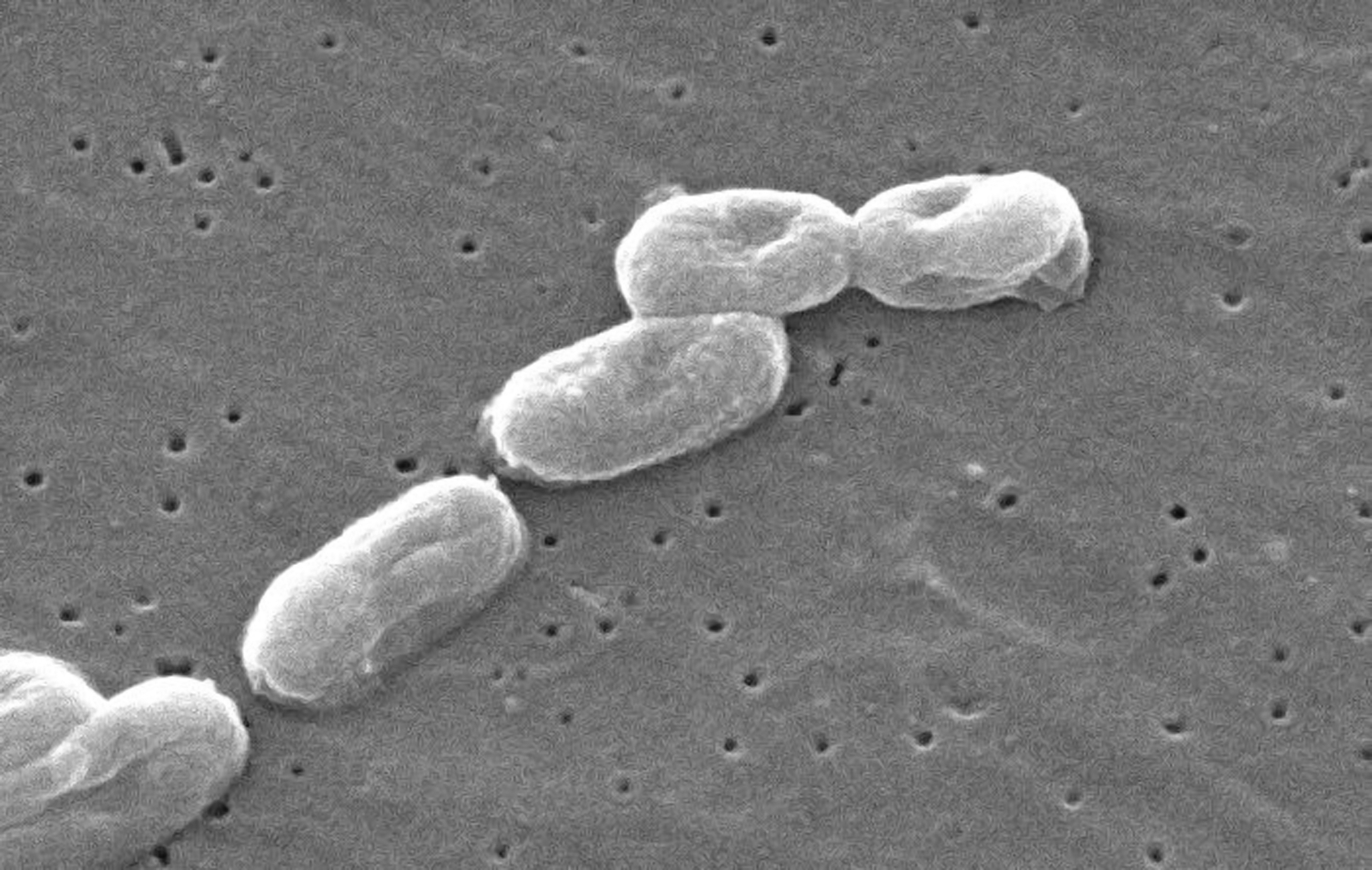
Image source: Wikipedia/Wikimedia
| Ecology, Host, and Life Cycle | |
|---|---|
| Oxygen requirements | Microaerophile |
| Optimal temperature | Not Available |
| Temperature range | Not Available |
| Habitat | rhizosphere |
| Biotic relationship | Not Available |
| Host(s) | Homo sapiens, Viridiplantae, Anura |
| Cell arrangement | Not Available |
| Sporulation | Not Available |
| Energy source | Not Available |
| Pathogenicity | Not Available |
Gene Summary
Adenine Count
1416701 bp
Thymine Count
1415774 bp
Guanine Count
2829969 bp
Cytosine Count
2840706 bp
Genome Length
8503150 bp
Protein-coding Genes
7521 genes
Non-Coding Genes
167 genes
# of Chromosomes/Plasmids
1
Genes
| Name | Locus Tag | UniProt ID | Strand Orientation | Gene Start/End | Protein Molecular Weight |
|---|---|---|---|---|---|
| uncharacterised protein | NCTC10661_03608 | Not Available | Positive | 4025386 - 4025826 | 16057.4 |
| acyl-coa dehydrogenase | NCTC10661_03609 | Not Available | Positive | 4026071 - 4027861 | 63438.8 |
| electron transfer flavoprotein-ubiquinone oxidoreductase | NCTC10661_03610 | Not Available | Positive | 4027898 - 4029571 | 60751.2 |
| beta-ketothiolase | NCTC10661_03611 | Not Available | Positive | 4029620 - 4030813 | 41133.4 |
| 3-hydroxyacyl-coa dehydrogenase | NCTC10661_03612 | Not Available | Positive | 4030851 - 4031705 | 29845.5 |
| uncharacterised protein | NCTC10661_03613 | Not Available | Positive | 4032268 - 4033026 | 26674.9 |
| beta-ketoacyl synthase | NCTC10661_03614 | Not Available | Negative | 4033399 - 4035540 | 77729.6 |
| amp-dependent synthetase/ligase | NCTC10661_03615 | Not Available | Negative | 4035552 - 4039388 | 137697.0 |
| beta-lactamase domain-containing protein | NCTC10661_03616 | Not Available | Negative | 4039478 - 4040374 | 33216.6 |
| 3-oxoacyl-acp synthase | NCTC10661_03617 | Not Available | Negative | 4040380 - 4041378 | 35921.4 |
Pathways
1357 pathways
Health Effects
| Health Condition | Relation | Reference |
|---|---|---|
| Infective endocarditis | Causes | PMC3112426 |
| Native valve endocarditis | Causes | PMC3112426 |
| Pneumonia | Causes | PMC9294674 |



