
Kingdom
Pseudomonadati
Phylum
Pseudomonadota
Class
Betaproteobacteria
Order
Burkholderiales
Family
Burkholderiaceae
Genus
Burkholderia
Description
Taxonomy
| Kingdom | Pseudomonadati |
|---|---|
| Phylum | Pseudomonadota |
| Class | Betaproteobacteria |
| Order | Burkholderiales |
| Family | Burkholderiaceae |
| Genus | Burkholderia |
| Species | Burkholderia cepacia |
| Strain | strain NCTC10661 |
Profile
| Physiology | |
|---|---|
| Gram staining properties | Negative |
| Shape | Not Available |
| Mobility | Not Available |
| Flagellar presence | Not Available |
| Number of membranes | Not Available |
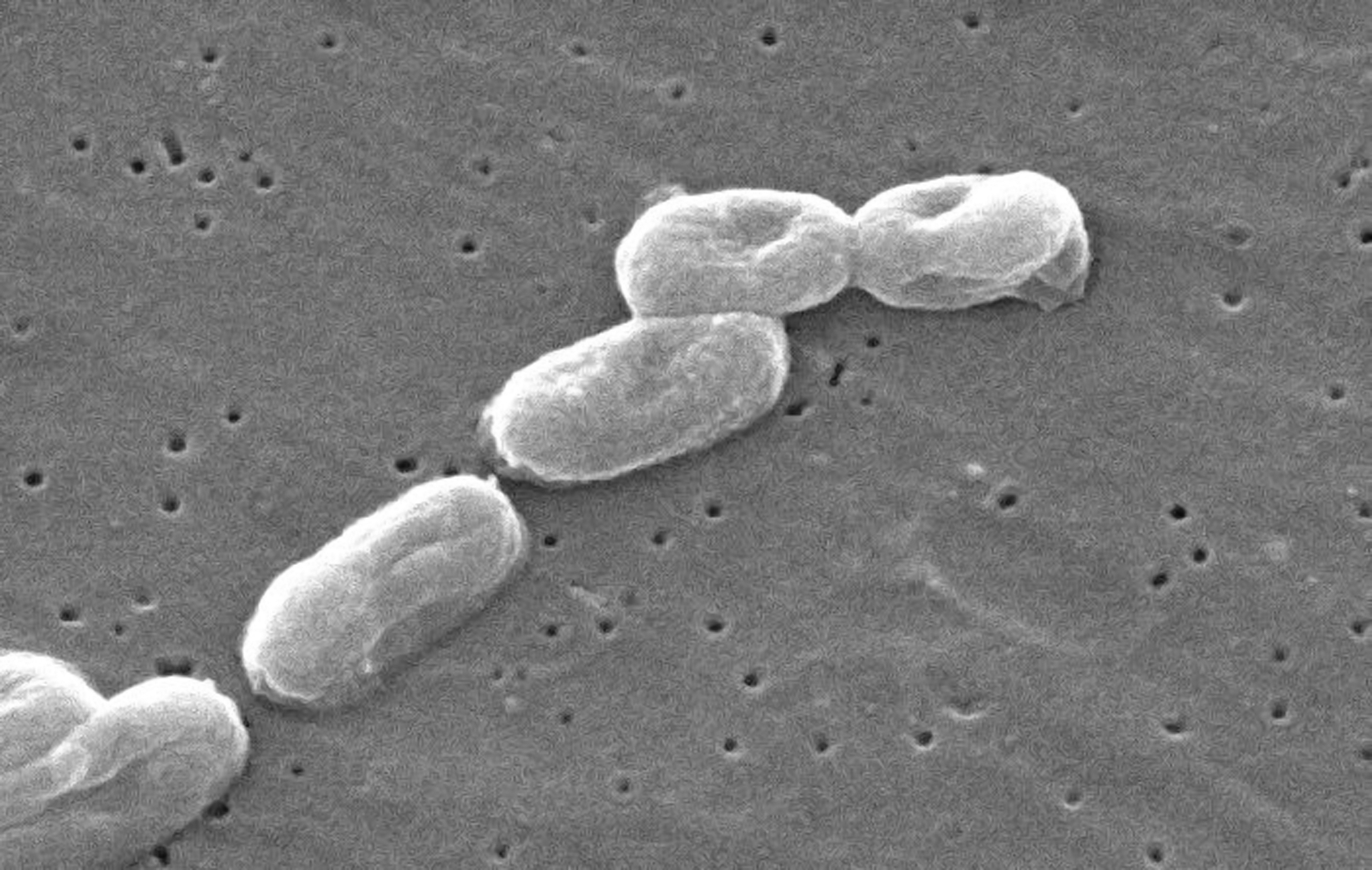
Image source: Wikipedia/Wikimedia
| Ecology, Host, and Life Cycle | |
|---|---|
| Oxygen requirements | Microaerophile |
| Optimal temperature | Not Available |
| Temperature range | Not Available |
| Habitat | rhizosphere |
| Biotic relationship | Not Available |
| Host(s) | Homo sapiens, Viridiplantae, Anura |
| Cell arrangement | Not Available |
| Sporulation | Not Available |
| Energy source | Not Available |
| Pathogenicity | Not Available |
Gene Summary
Adenine Count
1416701 bp
Thymine Count
1415774 bp
Guanine Count
2829969 bp
Cytosine Count
2840706 bp
Genome Length
8503150 bp
Protein-coding Genes
7521 genes
Non-Coding Genes
167 genes
# of Chromosomes/Plasmids
1
Genes
| Name | Locus Tag | UniProt ID | Strand Orientation | Gene Start/End | Protein Molecular Weight |
|---|---|---|---|---|---|
| 50s ribosomal protein l3 | NCTC10661_03497 | Not Available | Positive | 3926923 - 3927573 | 22586.4 |
| 50s ribosomal protein l4/l1e | NCTC10661_03498 | Not Available | Positive | 3927573 - 3928193 | 22995.8 |
| 50s ribosomal protein l23 | NCTC10661_03499 | Not Available | Positive | 3928190 - 3928504 | 11740.4 |
| 50s ribosomal protein l2 | NCTC10661_03500 | Not Available | Positive | 3928507 - 3929334 | 30102.5 |
| 30s ribosomal protein s19 | NCTC10661_03501 | Not Available | Positive | 3929345 - 3929620 | 10108.4 |
| 50s ribosomal protein l22 | NCTC10661_03502 | Not Available | Positive | 3929633 - 3929962 | 11816.5 |
| 30s ribosomal protein s3 | NCTC10661_03503 | Not Available | Positive | 3929974 - 3930774 | 29936.1 |
| 50s ribosomal protein l16 | NCTC10661_03504 | Not Available | Positive | 3930777 - 3931193 | 15597.2 |
| 50s ribosomal protein l29 | NCTC10661_03505 | Not Available | Positive | 3931203 - 3931397 | 7312.06 |
| 30s ribosomal protein s17 | NCTC10661_03506 | Not Available | Positive | 3931394 - 3931666 | 10321.5 |
Pathways
1357 pathways
Health Effects
| Health Condition | Relation | Reference |
|---|---|---|
| Infective endocarditis | Causes | PMC3112426 |
| Native valve endocarditis | Causes | PMC3112426 |
| Pneumonia | Causes | PMC9294674 |



