
Kingdom
Pseudomonadati
Phylum
Pseudomonadota
Class
Betaproteobacteria
Order
Burkholderiales
Family
Burkholderiaceae
Genus
Burkholderia
Description
Taxonomy
| Kingdom | Pseudomonadati |
|---|---|
| Phylum | Pseudomonadota |
| Class | Betaproteobacteria |
| Order | Burkholderiales |
| Family | Burkholderiaceae |
| Genus | Burkholderia |
| Species | Burkholderia cepacia |
| Strain | strain NCTC10661 |
Profile
| Physiology | |
|---|---|
| Gram staining properties | Negative |
| Shape | Not Available |
| Mobility | Not Available |
| Flagellar presence | Not Available |
| Number of membranes | Not Available |
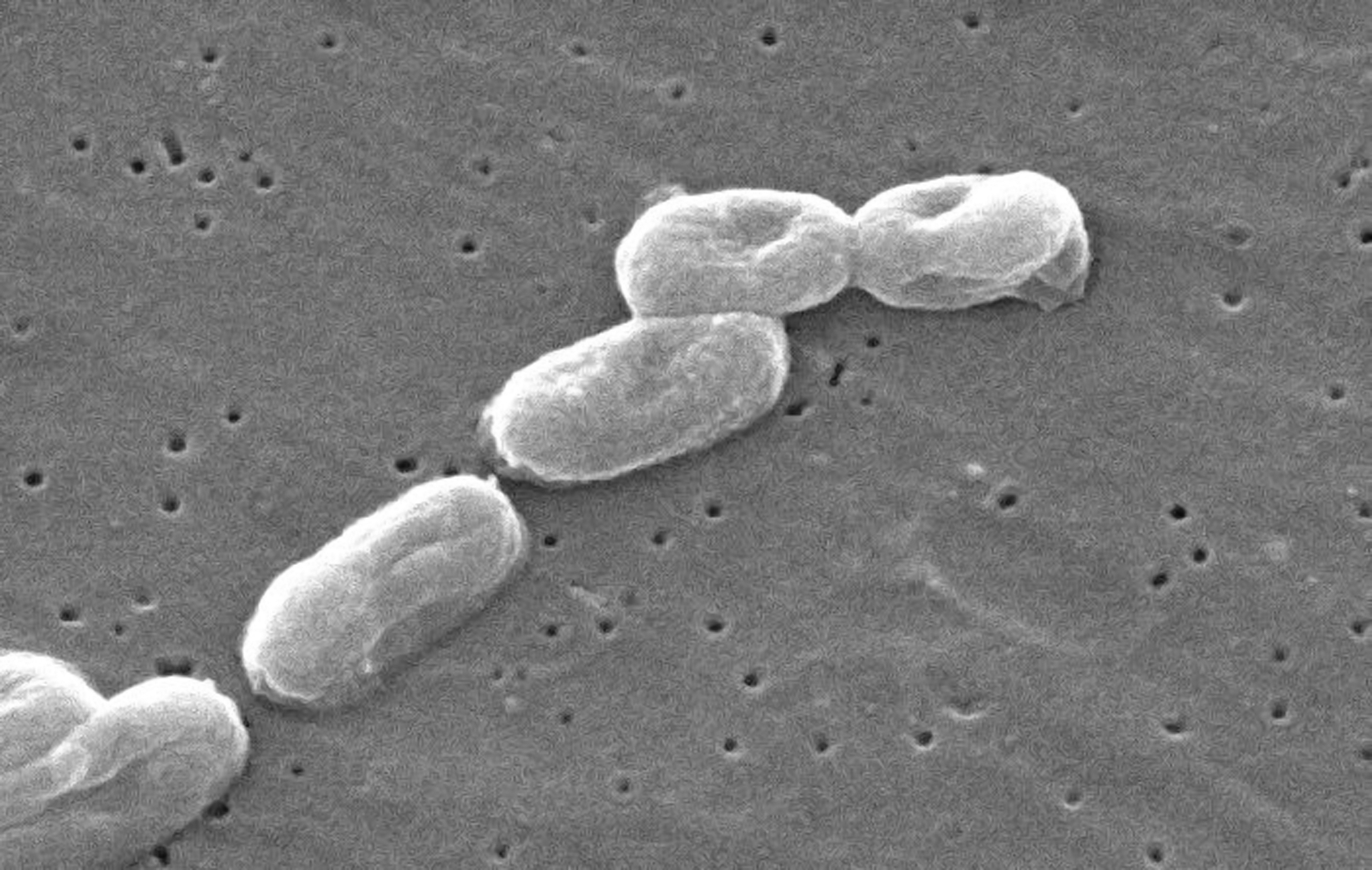
Image source: Wikipedia/Wikimedia
| Ecology, Host, and Life Cycle | |
|---|---|
| Oxygen requirements | Microaerophile |
| Optimal temperature | Not Available |
| Temperature range | Not Available |
| Habitat | rhizosphere |
| Biotic relationship | Not Available |
| Host(s) | Homo sapiens, Viridiplantae, Anura |
| Cell arrangement | Not Available |
| Sporulation | Not Available |
| Energy source | Not Available |
| Pathogenicity | Not Available |
Gene Summary
Adenine Count
1416701 bp
Thymine Count
1415774 bp
Guanine Count
2829969 bp
Cytosine Count
2840706 bp
Genome Length
8503150 bp
Protein-coding Genes
7521 genes
Non-Coding Genes
167 genes
# of Chromosomes/Plasmids
1
Genes
| Name | Locus Tag | UniProt ID | Strand Orientation | Gene Start/End | Protein Molecular Weight |
|---|---|---|---|---|---|
| putative lipoprotein transmembrane | NCTC10661_03196 | Not Available | Negative | 3609058 - 3609864 | 28137.7 |
| tonb-dependent siderophore receptor | NCTC10661_03197 | Not Available | Negative | 3609920 - 3612448 | 90823.0 |
| fecr protein | NCTC10661_03198 | Not Available | Negative | 3612551 - 3613537 | 35365.4 |
| sigma-24 feci-like protein | NCTC10661_03199 | Not Available | Negative | 3613541 - 3614050 | 18984.9 |
| outer membrane protein, (porin) | NCTC10661_03200 | Not Available | Positive | 3614524 - 3615684 | 40417.3 |
| uncharacterised protein | NCTC10661_03201 | Not Available | Positive | 3615684 - 3615860 | 6171.28 |
| lytic transglycosylase, catalytic | NCTC10661_03202 | Not Available | Positive | 3616098 - 3617336 | 43128.5 |
| uncharacterized conserved protein | NCTC10661_03203 | Not Available | Negative | 3617388 - 3619511 | 78260.0 |
| putative lipoprotein | NCTC10661_03204 | Not Available | Negative | 3619517 - 3619996 | 17565.9 |
| inner membrane protein yhah | NCTC10661_03205 | Not Available | Negative | 3619993 - 3620379 | 14054.0 |
Pathways
1357 pathways
Health Effects
| Health Condition | Relation | Reference |
|---|---|---|
| Infective endocarditis | Causes | PMC3112426 |
| Native valve endocarditis | Causes | PMC3112426 |
| Pneumonia | Causes | PMC9294674 |



