
Kingdom
Pseudomonadati
Phylum
Pseudomonadota
Class
Betaproteobacteria
Order
Burkholderiales
Family
Burkholderiaceae
Genus
Burkholderia
Description
Taxonomy
| Kingdom | Pseudomonadati |
|---|---|
| Phylum | Pseudomonadota |
| Class | Betaproteobacteria |
| Order | Burkholderiales |
| Family | Burkholderiaceae |
| Genus | Burkholderia |
| Species | Burkholderia cepacia |
| Strain | strain NCTC10661 |
Profile
| Physiology | |
|---|---|
| Gram staining properties | Negative |
| Shape | Not Available |
| Mobility | Not Available |
| Flagellar presence | Not Available |
| Number of membranes | Not Available |
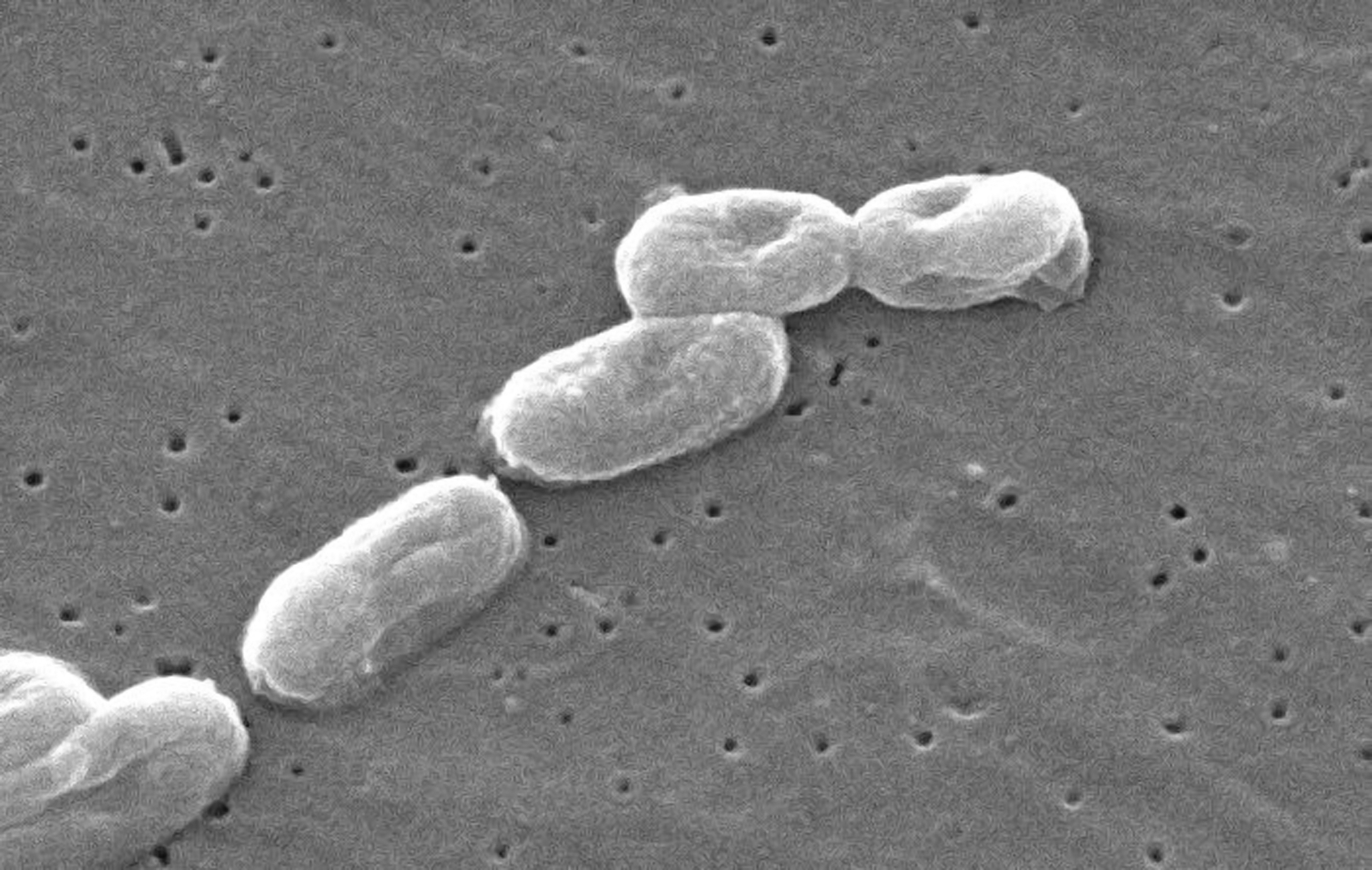
Image source: Wikipedia/Wikimedia
| Ecology, Host, and Life Cycle | |
|---|---|
| Oxygen requirements | Microaerophile |
| Optimal temperature | Not Available |
| Temperature range | Not Available |
| Habitat | rhizosphere |
| Biotic relationship | Not Available |
| Host(s) | Homo sapiens, Viridiplantae, Anura |
| Cell arrangement | Not Available |
| Sporulation | Not Available |
| Energy source | Not Available |
| Pathogenicity | Not Available |
Gene Summary
Adenine Count
1416701 bp
Thymine Count
1415774 bp
Guanine Count
2829969 bp
Cytosine Count
2840706 bp
Genome Length
8503150 bp
Protein-coding Genes
7521 genes
Non-Coding Genes
167 genes
# of Chromosomes/Plasmids
1
Genes
| Name | Locus Tag | UniProt ID | Strand Orientation | Gene Start/End | Protein Molecular Weight |
|---|---|---|---|---|---|
| 5-methyltetrahydropteroyltriglutamate-- homocysteine s-methyltransferase | NCTC10661_02592 | Not Available | Negative | 2915812 - 2918106 | 85371.8 |
| lysr family transcriptional regulator | NCTC10661_02593 | Not Available | Positive | 2918232 - 2919140 | 34158.4 |
| abc transporter permease | NCTC10661_02594 | Not Available | Negative | 2919163 - 2919885 | 25296.5 |
| uncharacterised protein | NCTC10661_02595 | Not Available | Negative | 2919899 - 2920108 | 7491.39 |
| phosphoglycerate/bisphosphoglycerate mutase | NCTC10661_02597 | Not Available | Positive | 2920335 - 2920901 | 19999.6 |
| phosphate transporter | NCTC10661_02598 | Not Available | Positive | 2921077 - 2922669 | 55866.6 |
| 2og-fe(ii) oxygenase superfamily protein | NCTC10661_02599 | Not Available | Positive | 2923092 - 2923835 | 27569.0 |
| permease of the major facilitator superfamily | NCTC10661_02600 | Not Available | Negative | 2924065 - 2925447 | 48720.3 |
| Trna-ala | Not Available | Not Available | Positive | 2929471 - 2929546 | Not Available |
| Trna-ile | Not Available | Not Available | Positive | 2929587 - 2929663 | Not Available |
Pathways
1489 pathways
Health Effects
| Health Condition | Relation | Reference |
|---|---|---|
| Infective endocarditis | Causes | PMC3112426 |
| Native valve endocarditis | Causes | PMC3112426 |
| Pneumonia | Causes | PMC9294674 |



