
Kingdom
Pseudomonadati
Phylum
Pseudomonadota
Class
Betaproteobacteria
Order
Burkholderiales
Family
Burkholderiaceae
Genus
Burkholderia
Description
Taxonomy
| Kingdom | Pseudomonadati |
|---|---|
| Phylum | Pseudomonadota |
| Class | Betaproteobacteria |
| Order | Burkholderiales |
| Family | Burkholderiaceae |
| Genus | Burkholderia |
| Species | Burkholderia cepacia |
| Strain | strain NCTC10661 |
Profile
| Physiology | |
|---|---|
| Gram staining properties | Negative |
| Shape | Not Available |
| Mobility | Not Available |
| Flagellar presence | Not Available |
| Number of membranes | Not Available |
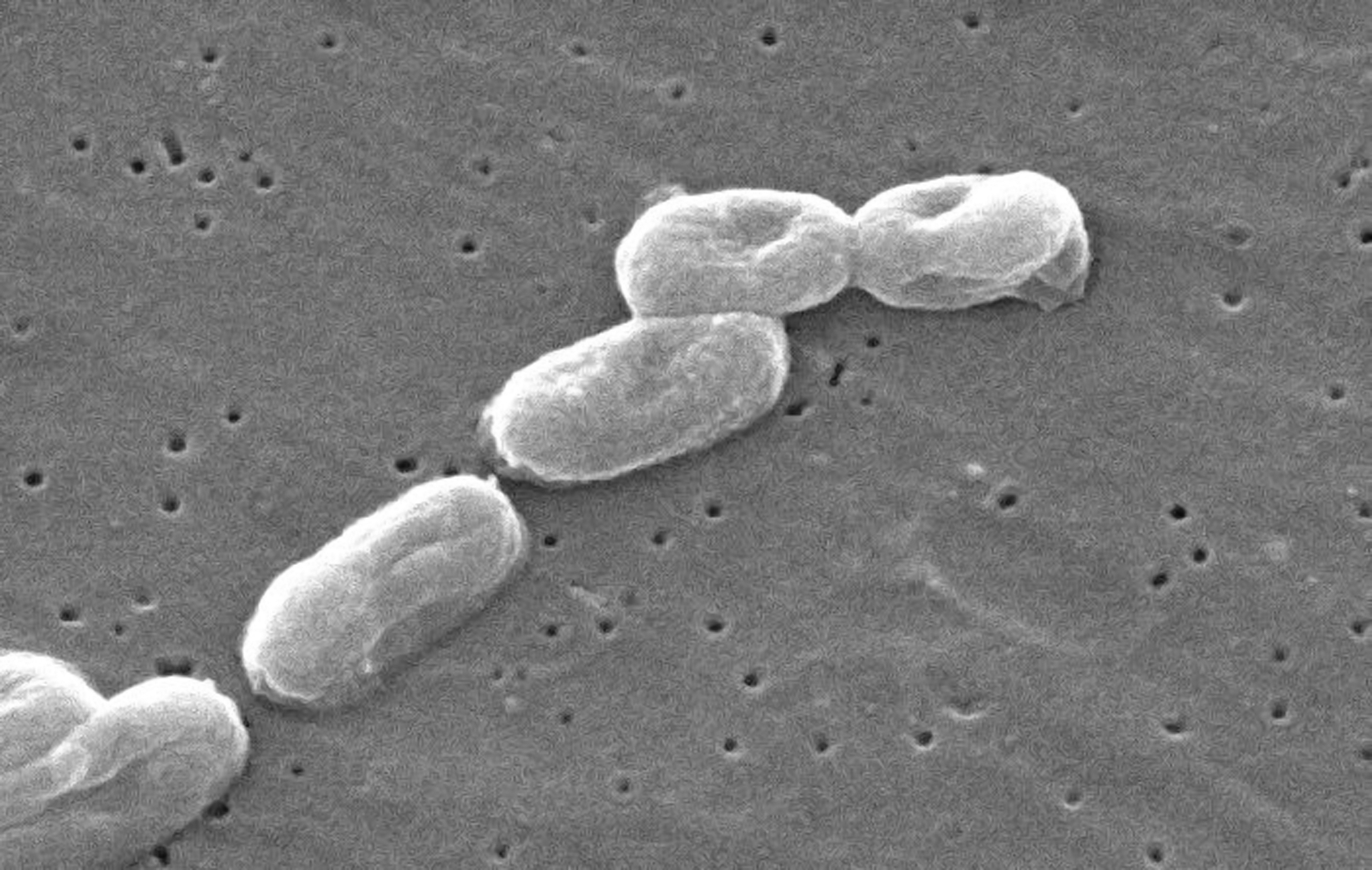
Image source: Wikipedia/Wikimedia
| Ecology, Host, and Life Cycle | |
|---|---|
| Oxygen requirements | Microaerophile |
| Optimal temperature | Not Available |
| Temperature range | Not Available |
| Habitat | rhizosphere |
| Biotic relationship | Not Available |
| Host(s) | Homo sapiens, Viridiplantae, Anura |
| Cell arrangement | Not Available |
| Sporulation | Not Available |
| Energy source | Not Available |
| Pathogenicity | Not Available |
Gene Summary
Adenine Count
1416701 bp
Thymine Count
1415774 bp
Guanine Count
2829969 bp
Cytosine Count
2840706 bp
Genome Length
8503150 bp
Protein-coding Genes
7521 genes
Non-Coding Genes
167 genes
# of Chromosomes/Plasmids
1
Genes
| Name | Locus Tag | UniProt ID | Strand Orientation | Gene Start/End | Protein Molecular Weight |
|---|---|---|---|---|---|
| hydroxyproline-2-epimerase | NCTC10661_02282 | Not Available | Negative | 2555320 - 2556255 | 32687.7 |
| dihydrodipicolinate synthetase | NCTC10661_02283 | Not Available | Positive | 2556504 - 2557424 | 33200.0 |
| amino acid transporter | NCTC10661_02284 | Not Available | Positive | 2557658 - 2559283 | 57857.3 |
| beta-lactamase domain-containing protein | NCTC10661_02285 | Not Available | Positive | 2559911 - 2560426 | 18717.0 |
| pebp family protein | NCTC10661_02286 | Not Available | Positive | 2560616 - 2561188 | 20143.0 |
| short-chain dehydrogenase/reductase sdr | NCTC10661_02287 | Not Available | Negative | 2561207 - 2561956 | 26178.4 |
| lysr family transcriptional regulator | NCTC10661_02288 | Not Available | Positive | 2562065 - 2562943 | 31586.0 |
| glucoamylase | NCTC10661_02289 | Not Available | Negative | 2562992 - 2563231 | 7819.12 |
| uncharacterised protein | NCTC10661_02290 | Not Available | Positive | 2563284 - 2564003 | 27000.4 |
| lysr family transcriptional regulator | NCTC10661_02291 | Not Available | Negative | 2565199 - 2566143 | 34220.9 |
Pathways
1357 pathways
Health Effects
| Health Condition | Relation | Reference |
|---|---|---|
| Infective endocarditis | Causes | PMC3112426 |
| Native valve endocarditis | Causes | PMC3112426 |
| Pneumonia | Causes | PMC9294674 |



