
Kingdom
Bacillati
Phylum
Bacillota
Class
Bacilli
Order
Caryophanales
Family
Bacillaceae
Genus
Bacillus
Description
Taxonomy
| Kingdom | Bacillati |
|---|---|
| Phylum | Bacillota |
| Class | Bacilli |
| Order | Caryophanales |
| Family | Bacillaceae |
| Genus | Bacillus |
| Species | Bacillus cereus |
| Strain | strain !175 |
Profile
| Physiology | |
|---|---|
| Gram staining properties | Positive |
| Shape | Rod |
| Mobility | Yes |
| Flagellar presence | Yes |
| Number of membranes | 1 |
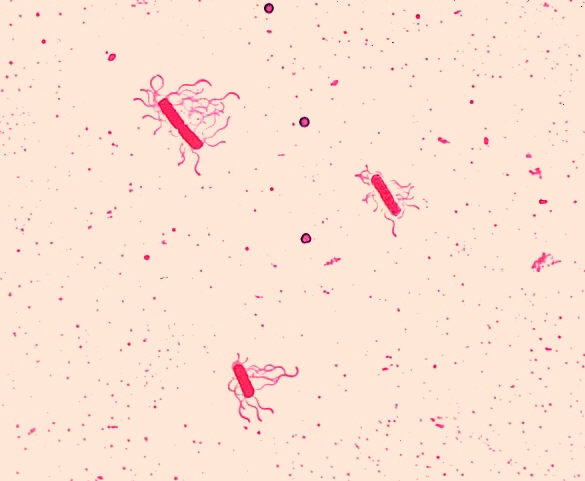
Image source: Wikipedia/Wikimedia
| Ecology, Host, and Life Cycle | |
|---|---|
| Oxygen requirements | Aerobe |
| Optimal temperature | 25 |
| Temperature range | Mesophilic |
| Habitat | Multiple |
| Biotic relationship | Free living |
| Host(s) | Homo sapiens, Gallus gallus, Metazoa |
| Cell arrangement | Chains |
| Sporulation | Not Available |
| Energy source | Not Available |
| Pathogenicity | Human |
Gene Summary
Adenine Count
1923083 bp
Thymine Count
1916163 bp
Guanine Count
1027025 bp
Cytosine Count
1020224 bp
Genome Length
5886675 bp
Protein-coding Genes
5733 genes
Non-Coding Genes
115 genes
# of Chromosomes/Plasmids
1
Genes
| Name | Locus Tag | UniProt ID | Strand Orientation | Gene Start/End | Protein Molecular Weight |
|---|---|---|---|---|---|
| duf445 domain-containing protein | FC679_21505 | Not Available | Positive | 4230418 - 4231665 | 47003.5 |
| exosporium protein exse | FC679_21510 | Not Available | Negative | 4231698 - 4232654 | 35870.9 |
| hypothetical protein | FC679_21515 | Not Available | Negative | 4232651 - 4233721 | 40542.4 |
| hypothetical protein | FC679_21520 | Not Available | Negative | 4233714 - 4234157 | 17100.9 |
| rna polymerase sigma factor | FC679_21525 | Not Available | Negative | 4234154 - 4234642 | 19590.6 |
| response regulator transcription factor | FC679_21535 | Not Available | Positive | 4234920 - 4235558 | 23972.9 |
| two-component sensor histidine kinase | FC679_21540 | Not Available | Positive | 4235563 - 4236663 | 42126.6 |
| abc transporter atp-binding protein | FC679_21545 | Not Available | Positive | 4236800 - 4237738 | 34908.4 |
| abc transporter permease | FC679_21550 | Not Available | Positive | 4237776 - 4238885 | 40335.5 |
| abc transporter permease | FC679_21555 | Not Available | Positive | 4238887 - 4240032 | 42525.8 |
Pathways
1452 pathways
Health Effects
| Health Condition | Relation | Reference |
|---|---|---|
| Late-onset neonatal sepsis | Causes | PMC11282708 |
| Neonatal sepsis | Causes | PMC11282708 |
| Food poisoning | Causes | PMC11282708 |
| Sepsis | Causes | PMC11282708 |
| Meningitis | Causes | PMC11282708 |
| Pneumonia | Causes | PMC11282708 |
| Foodborne illnesses | Causes | PMC11282708 |
| Severe systemic multi-organ failure | Causes | PMC11282708 |
| Anthrax-like skin infections | Causes | PMC11282708 |
| Severe neonatal skin infections resembling anthrax-like lesions | Causes | PMC11282708 |






