
Kingdom
Bacillati
Phylum
Bacillota
Class
Bacilli
Order
Caryophanales
Family
Bacillaceae
Genus
Bacillus
Description
Taxonomy
| Kingdom | Bacillati |
|---|---|
| Phylum | Bacillota |
| Class | Bacilli |
| Order | Caryophanales |
| Family | Bacillaceae |
| Genus | Bacillus |
| Species | Bacillus cereus |
| Strain | strain !175 |
Profile
| Physiology | |
|---|---|
| Gram staining properties | Positive |
| Shape | Rod |
| Mobility | Yes |
| Flagellar presence | Yes |
| Number of membranes | 1 |
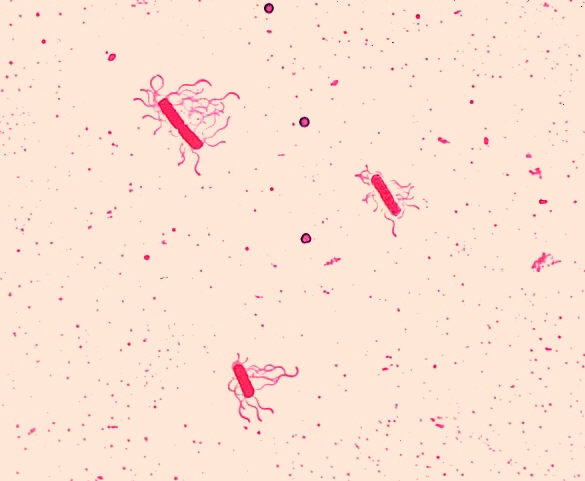
Image source: Wikipedia/Wikimedia
| Ecology, Host, and Life Cycle | |
|---|---|
| Oxygen requirements | Aerobe |
| Optimal temperature | 25 |
| Temperature range | Mesophilic |
| Habitat | Multiple |
| Biotic relationship | Free living |
| Host(s) | Homo sapiens, Gallus gallus, Metazoa |
| Cell arrangement | Chains |
| Sporulation | Not Available |
| Energy source | Not Available |
| Pathogenicity | Human |
Gene Summary
Adenine Count
1923083 bp
Thymine Count
1916163 bp
Guanine Count
1027025 bp
Cytosine Count
1020224 bp
Genome Length
5886675 bp
Protein-coding Genes
5733 genes
Non-Coding Genes
115 genes
# of Chromosomes/Plasmids
1
Genes
| Name | Locus Tag | UniProt ID | Strand Orientation | Gene Start/End | Protein Molecular Weight |
|---|---|---|---|---|---|
| voc family protein | FC679_16735 | Not Available | Positive | 3305928 - 3306836 | 33699.7 |
| gnat family n-acetyltransferase | FC679_16740 | Not Available | Negative | 3306884 - 3307402 | 19532.1 |
| mgtc/sapb family protein | FC679_16745 | Not Available | Positive | 3307694 - 3308371 | 24282.1 |
| pkd domain-containing protein | FC679_16750 | Not Available | Positive | 3308574 - 3311489 | 109957.0 |
| two-component sensor histidine kinase | FC679_16755 | Not Available | Negative | 3311847 - 3313100 | 47278.9 |
| hypothetical protein | FC679_16760 | Not Available | Positive | 3313721 - 3314161 | 15780.6 |
| dicarboxylate/amino acid:cation symporter | FC679_16765 | Not Available | Positive | 3314858 - 3316093 | 43172.7 |
| imidazoleglycerol-phosphate dehydratase | FC679_16770 | Not Available | Negative | 3316116 - 3316271 | 5603.3 |
| marr family transcriptional regulator | FC679_16775 | Not Available | Negative | 3316427 - 3316846 | 16111.5 |
| thioredoxin family protein | FC679_16785 | Not Available | Positive | 3317472 - 3318059 | 22604.3 |
Pathways
1324 pathways
Health Effects
| Health Condition | Relation | Reference |
|---|---|---|
| Late-onset neonatal sepsis | Causes | PMC11282708 |
| Neonatal sepsis | Causes | PMC11282708 |
| Food poisoning | Causes | PMC11282708 |
| Sepsis | Causes | PMC11282708 |
| Meningitis | Causes | PMC11282708 |
| Pneumonia | Causes | PMC11282708 |
| Foodborne illnesses | Causes | PMC11282708 |
| Severe systemic multi-organ failure | Causes | PMC11282708 |
| Anthrax-like skin infections | Causes | PMC11282708 |
| Severe neonatal skin infections resembling anthrax-like lesions | Causes | PMC11282708 |






