
Kingdom
Bacillati
Phylum
Bacillota
Class
Bacilli
Order
Caryophanales
Family
Bacillaceae
Genus
Bacillus
Description
Taxonomy
| Kingdom | Bacillati |
|---|---|
| Phylum | Bacillota |
| Class | Bacilli |
| Order | Caryophanales |
| Family | Bacillaceae |
| Genus | Bacillus |
| Species | Bacillus cereus |
| Strain | strain !175 |
Profile
| Physiology | |
|---|---|
| Gram staining properties | Positive |
| Shape | Rod |
| Mobility | Yes |
| Flagellar presence | Yes |
| Number of membranes | 1 |
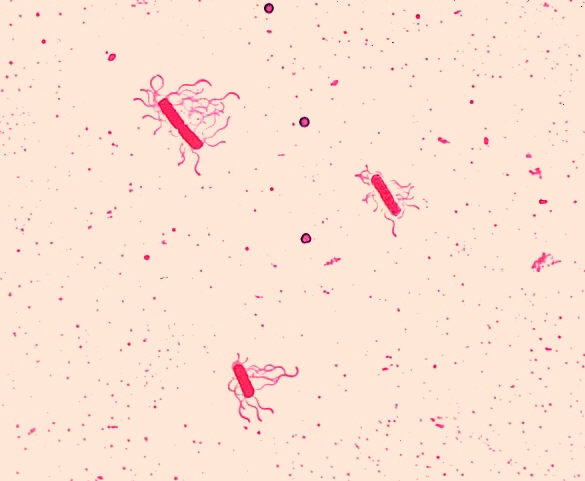
Image source: Wikipedia/Wikimedia
| Ecology, Host, and Life Cycle | |
|---|---|
| Oxygen requirements | Aerobe |
| Optimal temperature | 25 |
| Temperature range | Mesophilic |
| Habitat | Multiple |
| Biotic relationship | Free living |
| Host(s) | Homo sapiens, Gallus gallus, Metazoa |
| Cell arrangement | Chains |
| Sporulation | Not Available |
| Energy source | Not Available |
| Pathogenicity | Human |
Gene Summary
Adenine Count
1923083 bp
Thymine Count
1916163 bp
Guanine Count
1027025 bp
Cytosine Count
1020224 bp
Genome Length
5886675 bp
Protein-coding Genes
5733 genes
Non-Coding Genes
115 genes
# of Chromosomes/Plasmids
1
Genes
| Name | Locus Tag | UniProt ID | Strand Orientation | Gene Start/End | Protein Molecular Weight |
|---|---|---|---|---|---|
| hypothetical protein | FC679_15400 | Not Available | Positive | 3038040 - 3038362 | 12199.9 |
| duf3952 domain-containing protein | FC679_15405 | Not Available | Positive | 3038510 - 3039313 | 30970.8 |
| duf3952 domain-containing protein | FC679_15410 | Not Available | Positive | 3039347 - 3040165 | 31770.3 |
| winged helix-turn-helix transcriptional regulator | FC679_15420 | Not Available | Negative | 3040640 - 3040933 | 11048.8 |
| disulfide bond formation protein b | FC679_15425 | Not Available | Negative | 3041021 - 3041449 | 16066.3 |
| hypothetical protein | FC679_15430 | Not Available | Negative | 3041623 - 3041823 | 7453.36 |
| thermonuclease | FC679_15435 | Not Available | Negative | 3042342 - 3042470 | 4585.38 |
| dna integration/recombination/inversion protein | FC679_15440 | Not Available | Negative | 3043393 - 3044142 | 28743.2 |
| nerd domain-containing protein | FC679_15445 | Not Available | Negative | 3044440 - 3045078 | 25251.9 |
| hypothetical protein | FC679_15450 | Not Available | Negative | 3045095 - 3045478 | 14604.6 |
Pathways
1452 pathways
Health Effects
| Health Condition | Relation | Reference |
|---|---|---|
| Late-onset neonatal sepsis | Causes | PMC11282708 |
| Neonatal sepsis | Causes | PMC11282708 |
| Food poisoning | Causes | PMC11282708 |
| Sepsis | Causes | PMC11282708 |
| Meningitis | Causes | PMC11282708 |
| Pneumonia | Causes | PMC11282708 |
| Foodborne illnesses | Causes | PMC11282708 |
| Severe systemic multi-organ failure | Causes | PMC11282708 |
| Anthrax-like skin infections | Causes | PMC11282708 |
| Severe neonatal skin infections resembling anthrax-like lesions | Causes | PMC11282708 |






