
Kingdom
Bacillati
Phylum
Bacillota
Class
Bacilli
Order
Caryophanales
Family
Bacillaceae
Genus
Bacillus
Description
Taxonomy
| Kingdom | Bacillati |
|---|---|
| Phylum | Bacillota |
| Class | Bacilli |
| Order | Caryophanales |
| Family | Bacillaceae |
| Genus | Bacillus |
| Species | Bacillus cereus |
| Strain | strain !175 |
Profile
| Physiology | |
|---|---|
| Gram staining properties | Positive |
| Shape | Rod |
| Mobility | Yes |
| Flagellar presence | Yes |
| Number of membranes | 1 |
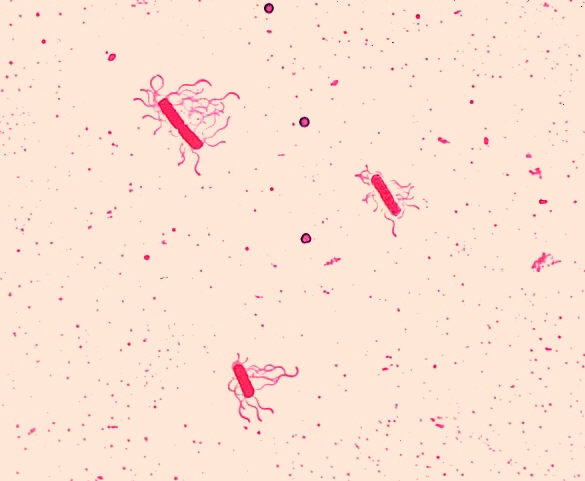
Image source: Wikipedia/Wikimedia
| Ecology, Host, and Life Cycle | |
|---|---|
| Oxygen requirements | Aerobe |
| Optimal temperature | 25 |
| Temperature range | Mesophilic |
| Habitat | Multiple |
| Biotic relationship | Free living |
| Host(s) | Homo sapiens, Gallus gallus, Metazoa |
| Cell arrangement | Chains |
| Sporulation | Not Available |
| Energy source | Not Available |
| Pathogenicity | Human |
Gene Summary
Adenine Count
1923083 bp
Thymine Count
1916163 bp
Guanine Count
1027025 bp
Cytosine Count
1020224 bp
Genome Length
5886675 bp
Protein-coding Genes
5733 genes
Non-Coding Genes
115 genes
# of Chromosomes/Plasmids
1
Genes
| Name | Locus Tag | UniProt ID | Strand Orientation | Gene Start/End | Protein Molecular Weight |
|---|---|---|---|---|---|
| recombinase reca | FC679_13965 | Not Available | Positive | 2757004 - 2758035 | 37328.5 |
| ribonuclease y | FC679_13970 | Not Available | Positive | 2758519 - 2760084 | 58763.3 |
| tigr00282 family metallophosphoesterase | FC679_13975 | Not Available | Positive | 2760243 - 2761037 | 29073.0 |
| stage v sporulation protein spovs | FC679_13980 | Not Available | Positive | 2761187 - 2761447 | 8869.99 |
| membrane dipeptidase | FC679_13985 | Not Available | Positive | 2761470 - 2762429 | 36517.6 |
| 2-oxoacid:acceptor oxidoreductase subunit alpha | FC679_13990 | Not Available | Positive | 2762655 - 2764412 | 64462.9 |
| 2-oxoacid:ferredoxin oxidoreductase subunit beta | FC679_13995 | Not Available | Positive | 2764399 - 2765265 | 31425.5 |
| trna (n6-isopentenyl adenosine(37)-c2)-methylthiotransferase miab | FC679_14000 | Not Available | Positive | 2765694 - 2767223 | 58299.8 |
| master regulator for biofilm formation | FC679_14005 | Not Available | Positive | 2767227 - 2767658 | 15857.8 |
| outer spore coat protein cote | FC679_14010 | Not Available | Positive | 2767785 - 2768327 | 20343.4 |
Pathways
1452 pathways
Health Effects
| Health Condition | Relation | Reference |
|---|---|---|
| Late-onset neonatal sepsis | Causes | PMC11282708 |
| Neonatal sepsis | Causes | PMC11282708 |
| Food poisoning | Causes | PMC11282708 |
| Sepsis | Causes | PMC11282708 |
| Meningitis | Causes | PMC11282708 |
| Pneumonia | Causes | PMC11282708 |
| Foodborne illnesses | Causes | PMC11282708 |
| Severe systemic multi-organ failure | Causes | PMC11282708 |
| Anthrax-like skin infections | Causes | PMC11282708 |
| Severe neonatal skin infections resembling anthrax-like lesions | Causes | PMC11282708 |






