
Kingdom
Pseudomonadati
Phylum
Pseudomonadota
Class
Betaproteobacteria
Order
Burkholderiales
Family
Burkholderiaceae
Genus
Burkholderia
Description
Taxonomy
| Kingdom | Pseudomonadati |
|---|---|
| Phylum | Pseudomonadota |
| Class | Betaproteobacteria |
| Order | Burkholderiales |
| Family | Burkholderiaceae |
| Genus | Burkholderia |
| Species | Burkholderia cepacia |
| Strain | strain b99 |
Profile
| Physiology | |
|---|---|
| Gram staining properties | Negative |
| Shape | Not Available |
| Mobility | Not Available |
| Flagellar presence | Not Available |
| Number of membranes | Not Available |
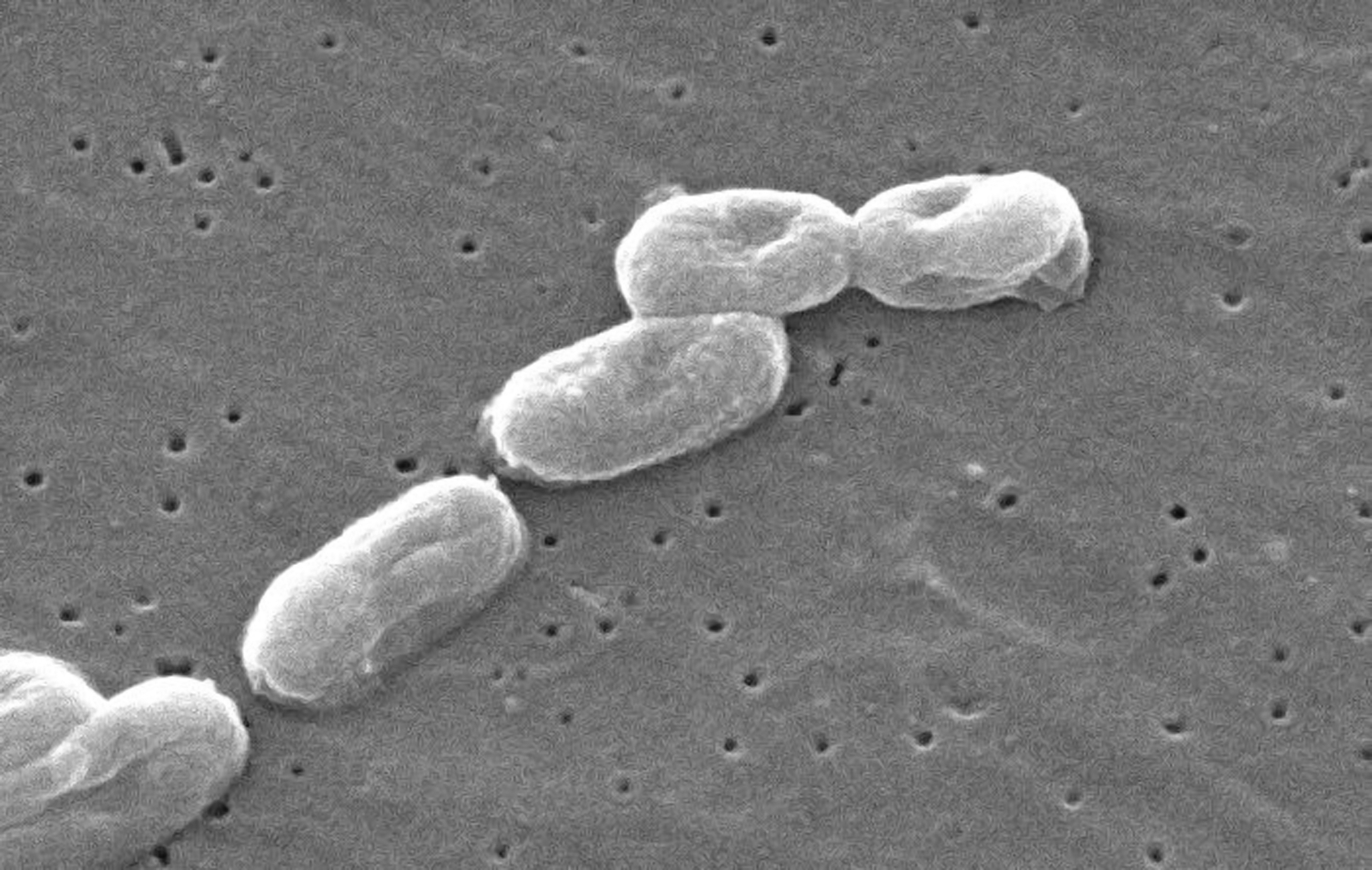
Image source: Wikipedia/Wikimedia
| Ecology, Host, and Life Cycle | |
|---|---|
| Oxygen requirements | Microaerophile |
| Optimal temperature | Not Available |
| Temperature range | Not Available |
| Habitat | rhizosphere |
| Biotic relationship | Not Available |
| Host(s) | Homo sapiens, Viridiplantae, Anura |
| Cell arrangement | Not Available |
| Sporulation | Not Available |
| Energy source | Not Available |
| Pathogenicity | Not Available |
Gene Summary
Adenine Count
1440195 bp
Thymine Count
1443559 bp
Guanine Count
2880504 bp
Cytosine Count
2878694 bp
Genome Length
8642952 bp
Protein-coding Genes
7756 genes
Non-Coding Genes
150 genes
# of Chromosomes/Plasmids
1
Genes
| Name | Locus Tag | UniProt ID | Strand Orientation | Gene Start/End | Protein Molecular Weight |
|---|---|---|---|---|---|
| type 1 fimbrial protein | E6L39_16210 | Not Available | Negative | 3505550 - 3506170 | 21486.3 |
| fimbrial biogenesis outer membrane usher protein | E6L39_16215 | Not Available | Negative | 3506641 - 3509136 | 89399.5 |
| molecular chaperone | E6L39_16220 | Not Available | Negative | 3509258 - 3509974 | 26046.7 |
| type 1 fimbrial protein | E6L39_16225 | Not Available | Negative | 3510038 - 3510637 | 19225.7 |
| hypothetical protein | E6L39_16230 | Not Available | Positive | 3510935 - 3511582 | 23900.1 |
| duf2322 family protein | E6L39_16235 | Not Available | Negative | 3511973 - 3512305 | 11582.7 |
| ybhb/ybcl family raf kinase inhibitor-like protein | E6L39_16240 | Not Available | Positive | 3512778 - 3513350 | 20152.0 |
| oxidoreductase | E6L39_16250 | Not Available | Negative | 3513536 - 3514432 | 31438.7 |
| mfs transporter | E6L39_16255 | Not Available | Negative | 3514447 - 3515649 | 41420.5 |
| transcriptional regulator gcva | E6L39_16260 | Not Available | Positive | 3515788 - 3516720 | 34284.0 |
Pathways
1357 pathways
Health Effects
| Health Condition | Relation | Reference |
|---|---|---|
| Infective endocarditis | Causes | PMC3112426 |
| Native valve endocarditis | Causes | PMC3112426 |
| Pneumonia | Causes | PMC9294674 |



