
Kingdom
Pseudomonadati
Phylum
Pseudomonadota
Class
Betaproteobacteria
Order
Burkholderiales
Family
Burkholderiaceae
Genus
Burkholderia
Description
Taxonomy
| Kingdom | Pseudomonadati |
|---|---|
| Phylum | Pseudomonadota |
| Class | Betaproteobacteria |
| Order | Burkholderiales |
| Family | Burkholderiaceae |
| Genus | Burkholderia |
| Species | Burkholderia cepacia |
| Strain | strain b99 |
Profile
| Physiology | |
|---|---|
| Gram staining properties | Negative |
| Shape | Not Available |
| Mobility | Not Available |
| Flagellar presence | Not Available |
| Number of membranes | Not Available |
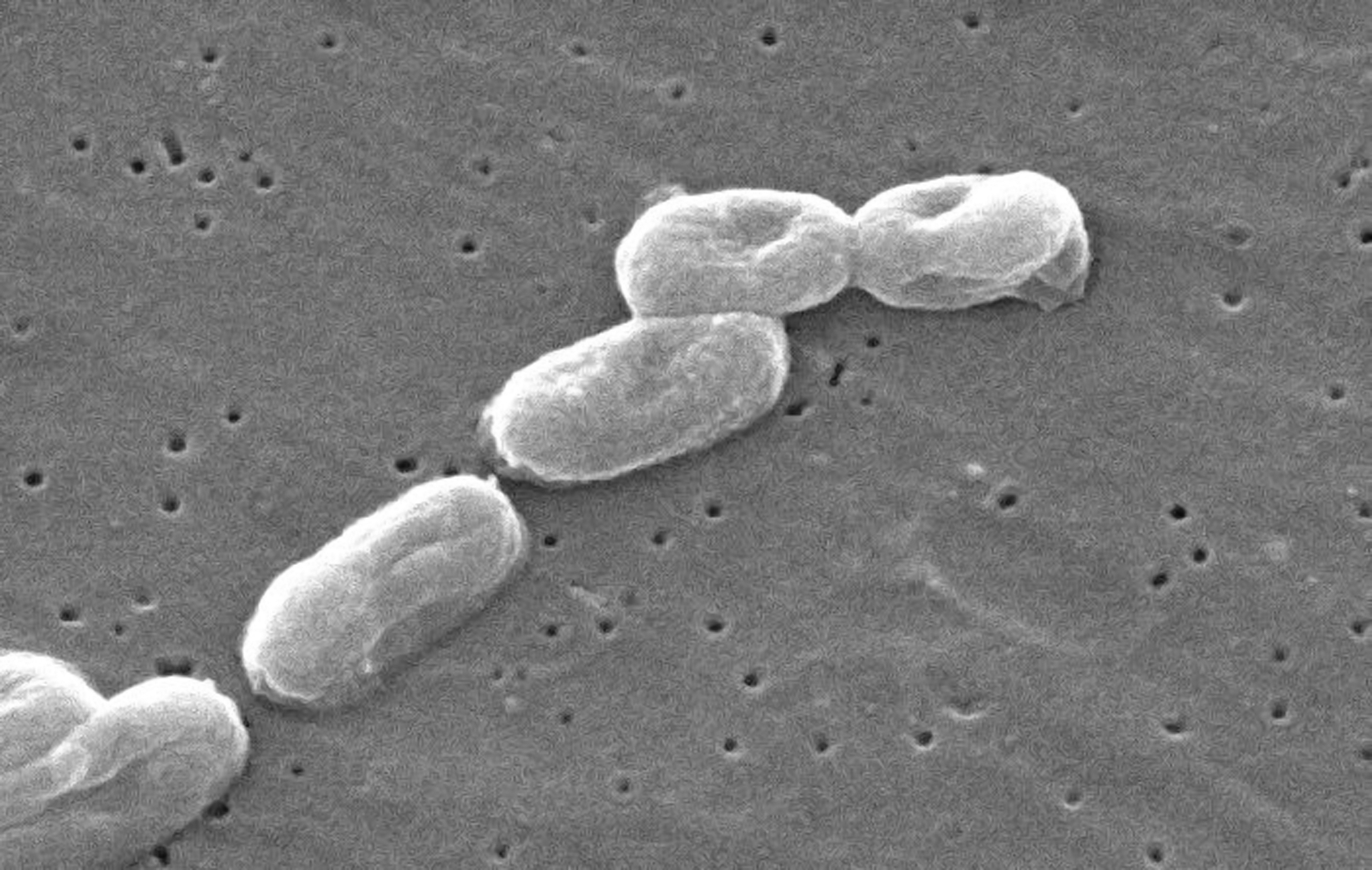
Image source: Wikipedia/Wikimedia
| Ecology, Host, and Life Cycle | |
|---|---|
| Oxygen requirements | Microaerophile |
| Optimal temperature | Not Available |
| Temperature range | Not Available |
| Habitat | rhizosphere |
| Biotic relationship | Not Available |
| Host(s) | Homo sapiens, Viridiplantae, Anura |
| Cell arrangement | Not Available |
| Sporulation | Not Available |
| Energy source | Not Available |
| Pathogenicity | Not Available |
Gene Summary
Adenine Count
1440195 bp
Thymine Count
1443559 bp
Guanine Count
2880504 bp
Cytosine Count
2878694 bp
Genome Length
8642952 bp
Protein-coding Genes
7756 genes
Non-Coding Genes
150 genes
# of Chromosomes/Plasmids
1
Genes
| Name | Locus Tag | UniProt ID | Strand Orientation | Gene Start/End | Protein Molecular Weight |
|---|---|---|---|---|---|
| eal domain-containing protein | E6L39_14985 | Not Available | Positive | 3240518 - 3242917 | 88656.4 |
| tena family transcriptional regulator | E6L39_14990 | Not Available | Positive | 3242938 - 3243675 | 27351.5 |
| response regulator transcription factor | E6L39_14995 | Not Available | Positive | 3243793 - 3244539 | 27497.7 |
| gnat family n-acetyltransferase | E6L39_15000 | Not Available | Positive | 3244888 - 3245316 | 15326.5 |
| hypothetical protein | E6L39_15010 | Not Available | Positive | 3245663 - 3246604 | 34820.8 |
| hypothetical protein | E6L39_15015 | Not Available | Positive | 3246601 - 3247290 | 24540.4 |
| alkaline phosphatase | E6L39_15025 | Not Available | Negative | 3247994 - 3249754 | 63477.1 |
| dienelactone hydrolase family protein | E6L39_15030 | Not Available | Negative | 3250067 - 3251332 | 46110.3 |
| sdr family oxidoreductase | E6L39_15035 | Not Available | Negative | 3251382 - 3252230 | 29116.5 |
| cysteine hydrolase | E6L39_15040 | Not Available | Negative | 3252227 - 3252865 | 22732.2 |
Pathways
1357 pathways
Health Effects
| Health Condition | Relation | Reference |
|---|---|---|
| Infective endocarditis | Causes | PMC3112426 |
| Native valve endocarditis | Causes | PMC3112426 |
| Pneumonia | Causes | PMC9294674 |



