
Kingdom
Pseudomonadati
Phylum
Pseudomonadota
Class
Gammaproteobacteria
Order
Vibrionales
Family
Vibrionaceae
Genus
Vibrio
Description
Taxonomy
| Kingdom | Pseudomonadati |
|---|---|
| Phylum | Pseudomonadota |
| Class | Gammaproteobacteria |
| Order | Vibrionales |
| Family | Vibrionaceae |
| Genus | Vibrio |
| Species | Vibrio parahaemolyticus |
| Strain | strain 16763 |
Profile
| Physiology | |
|---|---|
| Gram staining properties | Negative |
| Shape | Rod |
| Mobility | Yes |
| Flagellar presence | Yes |
| Number of membranes | 2 |
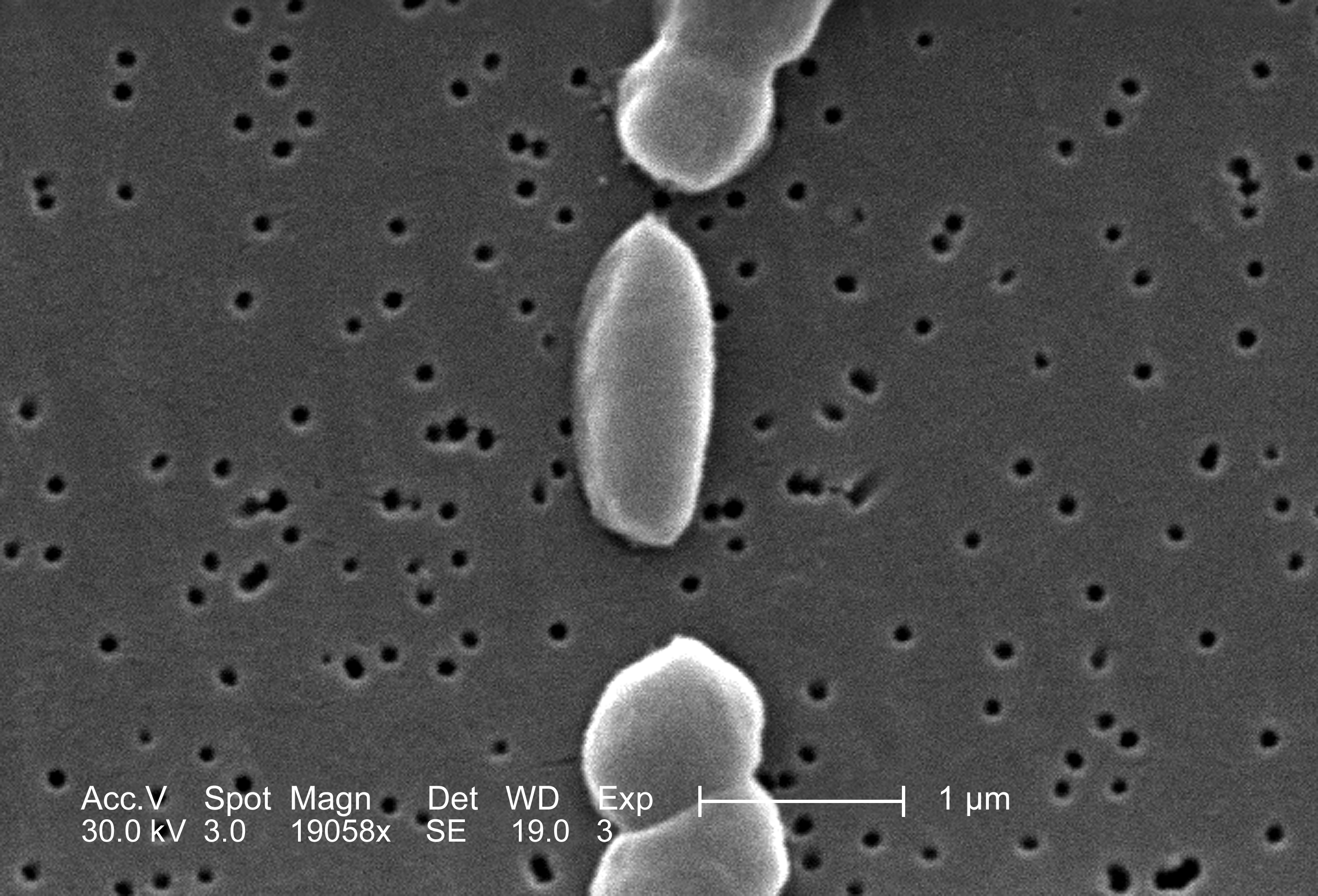
Image source: Wikipedia/Wikimedia
| Ecology, Host, and Life Cycle | |
|---|---|
| Oxygen requirements | Facultative anaerobe |
| Optimal temperature | 20 |
| Temperature range | Mesophilic |
| Habitat | Aquatic |
| Biotic relationship | Free living |
| Host(s) | Homo sapiens, Danio rerio, Pancrustacea |
| Cell arrangement | Singles |
| Sporulation | Nonsporulating |
| Energy source | Heterotroph |
| Pathogenicity | Human |
Gene Summary
Adenine Count
1461015 bp
Thymine Count
1460985 bp
Guanine Count
1187873 bp
Cytosine Count
1207651 bp
Genome Length
5317524 bp
Protein-coding Genes
4949 genes
Non-Coding Genes
161 genes
# of Chromosomes/Plasmids
1
Genes
| Name | Locus Tag | UniProt ID | Strand Orientation | Gene Start/End | Protein Molecular Weight |
|---|---|---|---|---|---|
| duf393 domain-containing protein | E4P16_04335 | Not Available | Positive | 869550 - 869936 | 15040.0 |
| methyl-accepting chemotaxis protein | E4P16_04340 | Not Available | Positive | 870116 - 871777 | 60563.5 |
| peptidyl-prolyl cis-trans isomerase | E4P16_04345 | Not Available | Positive | 871896 - 872390 | 18084.5 |
| hypothetical protein | E4P16_04350 | Not Available | Negative | 872493 - 873128 | 23919.3 |
| response regulator transcription factor | E4P16_04355 | Not Available | Negative | 873206 - 873997 | 29606.5 |
| sensor histidine kinase | E4P16_04360 | Not Available | Negative | 873999 - 875030 | 38196.7 |
| hypothetical protein | E4P16_04365 | Not Available | Negative | 875031 - 876371 | 50517.6 |
| outer membrane lipoprotein-sorting protein | E4P16_04370 | Not Available | Negative | 876404 - 877177 | 29137.9 |
| abc transporter permease | E4P16_04375 | Not Available | Negative | 877170 - 878438 | 46122.1 |
| abc transporter atp-binding protein | E4P16_04380 | Not Available | Negative | 878426 - 879124 | 25234.4 |
Pathways
0 pathways
No pathways found
No metabolic pathways have been associated with this bacterium yet.
Health Effects
| Health Condition | Relation | Reference |
|---|---|---|
| Vibriosis | Causes | PMC10472736 |
| Acute gastroenteritis | Causes | PMC11171697 |
| Wound infections | Causes | PMC11171697 |
| Septicemia | Causes | PMC11171697 |
| Food poisoning | Causes | PMC12108532 |
| Vibrio infections | Causes | PMC12108532 |
| Acute gastroenteritis | Causes | PMC12849298 |
| Wound infections | Causes | PMC12849298 |
| Ear infections | Causes | PMC12849298 |
| Septicemia | Causes | PMC12849298 |


