
Kingdom
Pseudomonadati
Phylum
Pseudomonadota
Class
Gammaproteobacteria
Order
Vibrionales
Family
Vibrionaceae
Genus
Vibrio
Description
Taxonomy
| Kingdom | Pseudomonadati |
|---|---|
| Phylum | Pseudomonadota |
| Class | Gammaproteobacteria |
| Order | Vibrionales |
| Family | Vibrionaceae |
| Genus | Vibrio |
| Species | Vibrio parahaemolyticus |
| Strain | strain 16763 |
Profile
| Physiology | |
|---|---|
| Gram staining properties | Negative |
| Shape | Rod |
| Mobility | Yes |
| Flagellar presence | Yes |
| Number of membranes | 2 |
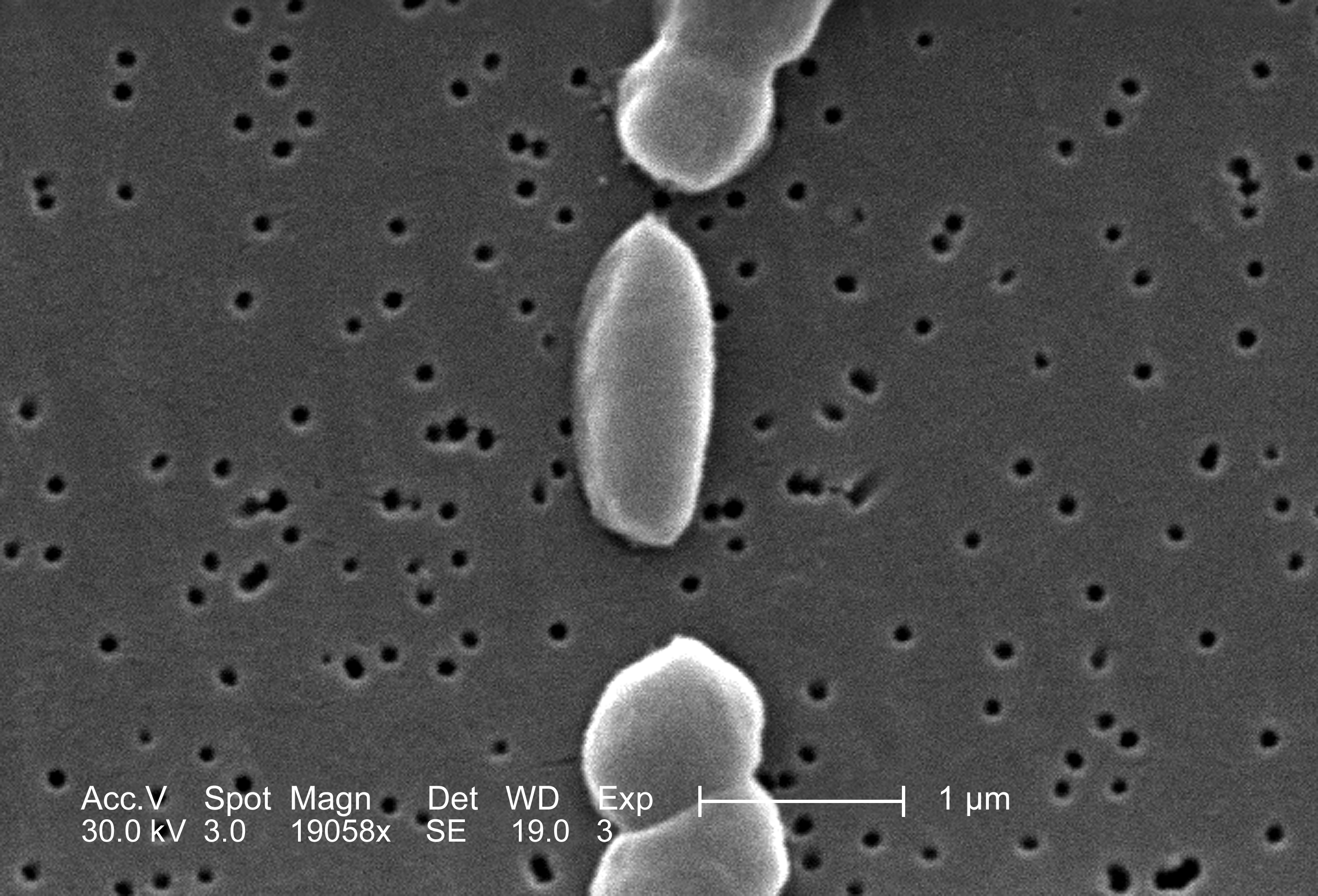
Image source: Wikipedia/Wikimedia
| Ecology, Host, and Life Cycle | |
|---|---|
| Oxygen requirements | Facultative anaerobe |
| Optimal temperature | 20 |
| Temperature range | Mesophilic |
| Habitat | Aquatic |
| Biotic relationship | Free living |
| Host(s) | Homo sapiens, Danio rerio, Pancrustacea |
| Cell arrangement | Singles |
| Sporulation | Nonsporulating |
| Energy source | Heterotroph |
| Pathogenicity | Human |
Gene Summary
Adenine Count
1461015 bp
Thymine Count
1460985 bp
Guanine Count
1187873 bp
Cytosine Count
1207651 bp
Genome Length
5317524 bp
Protein-coding Genes
4949 genes
Non-Coding Genes
161 genes
# of Chromosomes/Plasmids
1
Genes
| Name | Locus Tag | UniProt ID | Strand Orientation | Gene Start/End | Protein Molecular Weight |
|---|---|---|---|---|---|
| peptidylprolyl isomerase | E4P16_03665 | Not Available | Positive | 742599 - 743093 | 18071.3 |
| udp-2,3-diacylglucosamine diphosphatase | E4P16_03670 | Not Available | Positive | 743154 - 743882 | 28008.5 |
| eal domain-containing protein | E4P16_03675 | Not Available | Positive | 743991 - 745205 | 46488.1 |
| hypothetical protein | E4P16_03680 | Not Available | Positive | 745215 - 745307 | 3387.22 |
| hypothetical protein | E4P16_03685 | Not Available | Positive | 745279 - 745782 | 18936.9 |
| bifunctional phosphoribosyl-amp cyclohydrolase/phosphoribosyl-atp diphosphatase hisie | E4P16_03690 | Not Available | Negative | 745850 - 746485 | 23255.5 |
| imidazole glycerol phosphate synthase subunit hisf | E4P16_03695 | Not Available | Negative | 746482 - 747255 | 28417.9 |
| 1-(5-phosphoribosyl)-5-[(5- phosphoribosylamino)methylideneamino]imidazole-4- carboxamide isomerase | E4P16_03700 | Not Available | Negative | 747237 - 747974 | 26380.3 |
| imidazole glycerol phosphate synthase subunit hish | E4P16_03705 | Not Available | Negative | 747987 - 748601 | 22344.9 |
| bifunctional histidinol-phosphatase/imidazoleglycerol-phosphate dehydratase hisb | E4P16_03710 | Not Available | Negative | 748628 - 749701 | 39841.8 |
Pathways
0 pathways
No pathways found
No metabolic pathways have been associated with this bacterium yet.
Health Effects
| Health Condition | Relation | Reference |
|---|---|---|
| Vibriosis | Causes | PMC10472736 |
| Acute gastroenteritis | Causes | PMC11171697 |
| Wound infections | Causes | PMC11171697 |
| Septicemia | Causes | PMC11171697 |
| Food poisoning | Causes | PMC12108532 |
| Vibrio infections | Causes | PMC12108532 |
| Acute gastroenteritis | Causes | PMC12849298 |
| Wound infections | Causes | PMC12849298 |
| Ear infections | Causes | PMC12849298 |
| Septicemia | Causes | PMC12849298 |


