
Kingdom
Pseudomonadati
Phylum
Pseudomonadota
Class
Gammaproteobacteria
Order
Vibrionales
Family
Vibrionaceae
Genus
Vibrio
Description
Taxonomy
| Kingdom | Pseudomonadati |
|---|---|
| Phylum | Pseudomonadota |
| Class | Gammaproteobacteria |
| Order | Vibrionales |
| Family | Vibrionaceae |
| Genus | Vibrio |
| Species | Vibrio parahaemolyticus |
| Strain | strain 16763 |
Profile
| Physiology | |
|---|---|
| Gram staining properties | Negative |
| Shape | Rod |
| Mobility | Yes |
| Flagellar presence | Yes |
| Number of membranes | 2 |
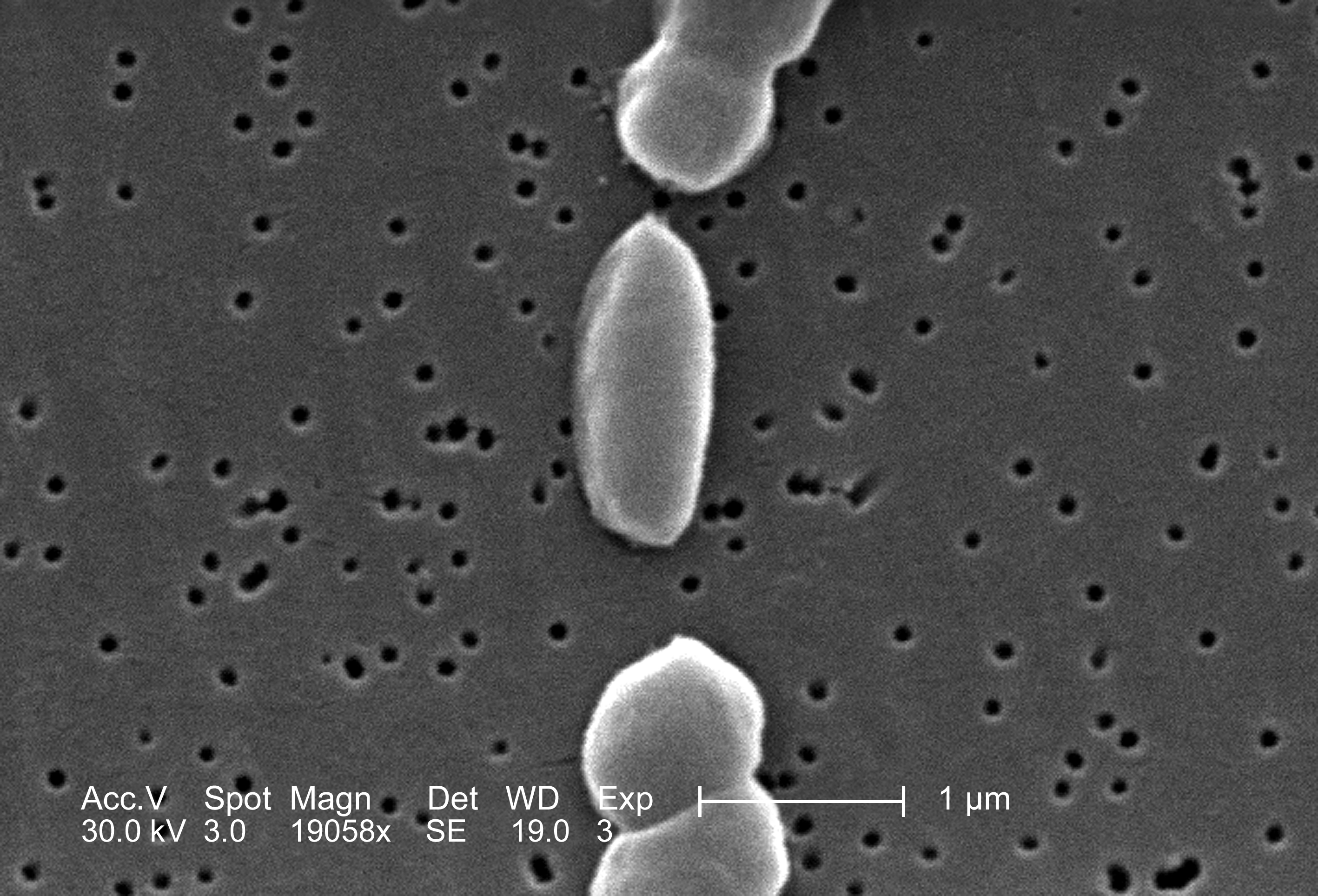
Image source: Wikipedia/Wikimedia
| Ecology, Host, and Life Cycle | |
|---|---|
| Oxygen requirements | Facultative anaerobe |
| Optimal temperature | 20 |
| Temperature range | Mesophilic |
| Habitat | Aquatic |
| Biotic relationship | Free living |
| Host(s) | Homo sapiens, Danio rerio, Pancrustacea |
| Cell arrangement | Singles |
| Sporulation | Nonsporulating |
| Energy source | Heterotroph |
| Pathogenicity | Human |
Gene Summary
Adenine Count
1461015 bp
Thymine Count
1460985 bp
Guanine Count
1187873 bp
Cytosine Count
1207651 bp
Genome Length
5317524 bp
Protein-coding Genes
4949 genes
Non-Coding Genes
161 genes
# of Chromosomes/Plasmids
1
Genes
| Name | Locus Tag | UniProt ID | Strand Orientation | Gene Start/End | Protein Molecular Weight |
|---|---|---|---|---|---|
| quinol dehydrogenase ferredoxin subunit naph | E4P16_19150 | Not Available | Positive | 3980182 - 3981036 | 31777.8 |
| mfs transporter | E4P16_19155 | Not Available | Positive | 3981240 - 3982421 | 43948.7 |
| energy-coupling factor transporter transmembrane protein ecft | E4P16_19160 | Not Available | Negative | 3982504 - 3983343 | 31337.3 |
| abc transporter atp-binding protein | E4P16_19165 | Not Available | Negative | 3983340 - 3985079 | 63978.7 |
| ecf-type riboflavin transporter substrate-binding protein | E4P16_19170 | Not Available | Negative | 3985086 - 3985634 | 19571.6 |
| hlyd family secretion protein | E4P16_19175 | Not Available | Negative | 3985972 - 3987102 | 41620.5 |
| duf3302 domain-containing protein | E4P16_19180 | Not Available | Negative | 3987102 - 3987482 | 15180.3 |
| ggdef domain-containing protein | E4P16_19185 | Not Available | Negative | 3987728 - 3989311 | 59925.0 |
| hypothetical protein | E4P16_19190 | Not Available | Negative | 3989295 - 3990779 | 57247.6 |
| purine-nucleoside phosphorylase | E4P16_19200 | Not Available | Negative | 3992482 - 3993192 | 25672.1 |
Pathways
1153 pathways
Health Effects
| Health Condition | Relation | Reference |
|---|---|---|
| Vibriosis | Causes | PMC10472736 |
| Acute gastroenteritis | Causes | PMC11171697 |
| Wound infections | Causes | PMC11171697 |
| Septicemia | Causes | PMC11171697 |
| Food poisoning | Causes | PMC12108532 |
| Vibrio infections | Causes | PMC12108532 |
| Acute gastroenteritis | Causes | PMC12849298 |
| Wound infections | Causes | PMC12849298 |
| Ear infections | Causes | PMC12849298 |
| Septicemia | Causes | PMC12849298 |


