
Kingdom
Pseudomonadati
Phylum
Pseudomonadota
Class
Gammaproteobacteria
Order
Vibrionales
Family
Vibrionaceae
Genus
Vibrio
Description
Taxonomy
| Kingdom | Pseudomonadati |
|---|---|
| Phylum | Pseudomonadota |
| Class | Gammaproteobacteria |
| Order | Vibrionales |
| Family | Vibrionaceae |
| Genus | Vibrio |
| Species | Vibrio parahaemolyticus |
| Strain | strain 16763 |
Profile
| Physiology | |
|---|---|
| Gram staining properties | Negative |
| Shape | Rod |
| Mobility | Yes |
| Flagellar presence | Yes |
| Number of membranes | 2 |
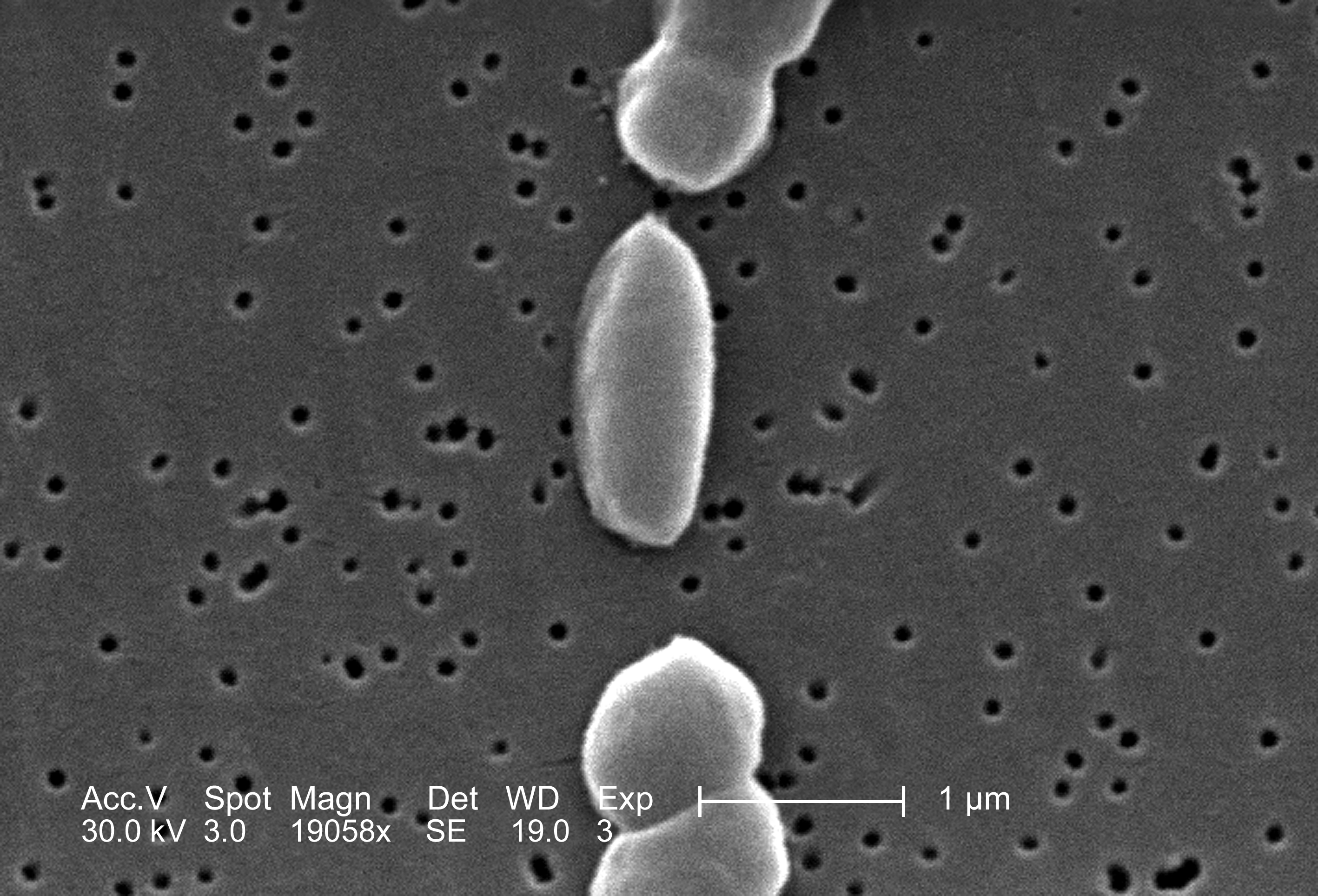
Image source: Wikipedia/Wikimedia
| Ecology, Host, and Life Cycle | |
|---|---|
| Oxygen requirements | Facultative anaerobe |
| Optimal temperature | 20 |
| Temperature range | Mesophilic |
| Habitat | Aquatic |
| Biotic relationship | Free living |
| Host(s) | Homo sapiens, Danio rerio, Pancrustacea |
| Cell arrangement | Singles |
| Sporulation | Nonsporulating |
| Energy source | Heterotroph |
| Pathogenicity | Human |
Gene Summary
Adenine Count
1461015 bp
Thymine Count
1460985 bp
Guanine Count
1187873 bp
Cytosine Count
1207651 bp
Genome Length
5317524 bp
Protein-coding Genes
4949 genes
Non-Coding Genes
161 genes
# of Chromosomes/Plasmids
1
Genes
| Name | Locus Tag | UniProt ID | Strand Orientation | Gene Start/End | Protein Molecular Weight |
|---|---|---|---|---|---|
| 3-deoxy-manno-octulosonate cytidylyltransferase | E4P16_16605 | Not Available | Negative | 3450564 - 3451319 | 27406.8 |
| trm112 family protein | E4P16_16610 | Not Available | Negative | 3451319 - 3451498 | 6760.35 |
| tetraacyldisaccharide 4'-kinase | E4P16_16615 | Not Available | Negative | 3451479 - 3452486 | 37132.6 |
| lipid a abc transporter atp-binding protein/permease msba | E4P16_16620 | Not Available | Negative | 3452492 - 3454240 | 64532.1 |
| dna internalization-related competence protein comec/rec2 | E4P16_16625 | Not Available | Negative | 3454272 - 3456530 | 84825.2 |
| duf2062 domain-containing protein | E4P16_16630 | Not Available | Positive | 3456539 - 3457048 | 19165.2 |
| lipoprotein-releasing abc transporter permease subunit lole | E4P16_16635 | Not Available | Negative | 3457257 - 3458501 | 44855.2 |
| lipoprotein-releasing abc transporter atp-binding protein lold | E4P16_16640 | Not Available | Negative | 3458504 - 3459211 | 25684.9 |
| lipoprotein-releasing abc transporter permease subunit lolc | E4P16_16645 | Not Available | Negative | 3459204 - 3460421 | 43644.9 |
| pilz domain-containing protein | E4P16_16650 | Not Available | Positive | 3460677 - 3461246 | 21675.8 |
Pathways
1153 pathways
Health Effects
| Health Condition | Relation | Reference |
|---|---|---|
| Vibriosis | Causes | PMC10472736 |
| Acute gastroenteritis | Causes | PMC11171697 |
| Wound infections | Causes | PMC11171697 |
| Septicemia | Causes | PMC11171697 |
| Food poisoning | Causes | PMC12108532 |
| Vibrio infections | Causes | PMC12108532 |
| Acute gastroenteritis | Causes | PMC12849298 |
| Wound infections | Causes | PMC12849298 |
| Ear infections | Causes | PMC12849298 |
| Septicemia | Causes | PMC12849298 |


