
Kingdom
Pseudomonadati
Phylum
Pseudomonadota
Class
Gammaproteobacteria
Order
Vibrionales
Family
Vibrionaceae
Genus
Vibrio
Description
Taxonomy
| Kingdom | Pseudomonadati |
|---|---|
| Phylum | Pseudomonadota |
| Class | Gammaproteobacteria |
| Order | Vibrionales |
| Family | Vibrionaceae |
| Genus | Vibrio |
| Species | Vibrio parahaemolyticus |
| Strain | strain 16763 |
Profile
| Physiology | |
|---|---|
| Gram staining properties | Negative |
| Shape | Rod |
| Mobility | Yes |
| Flagellar presence | Yes |
| Number of membranes | 2 |
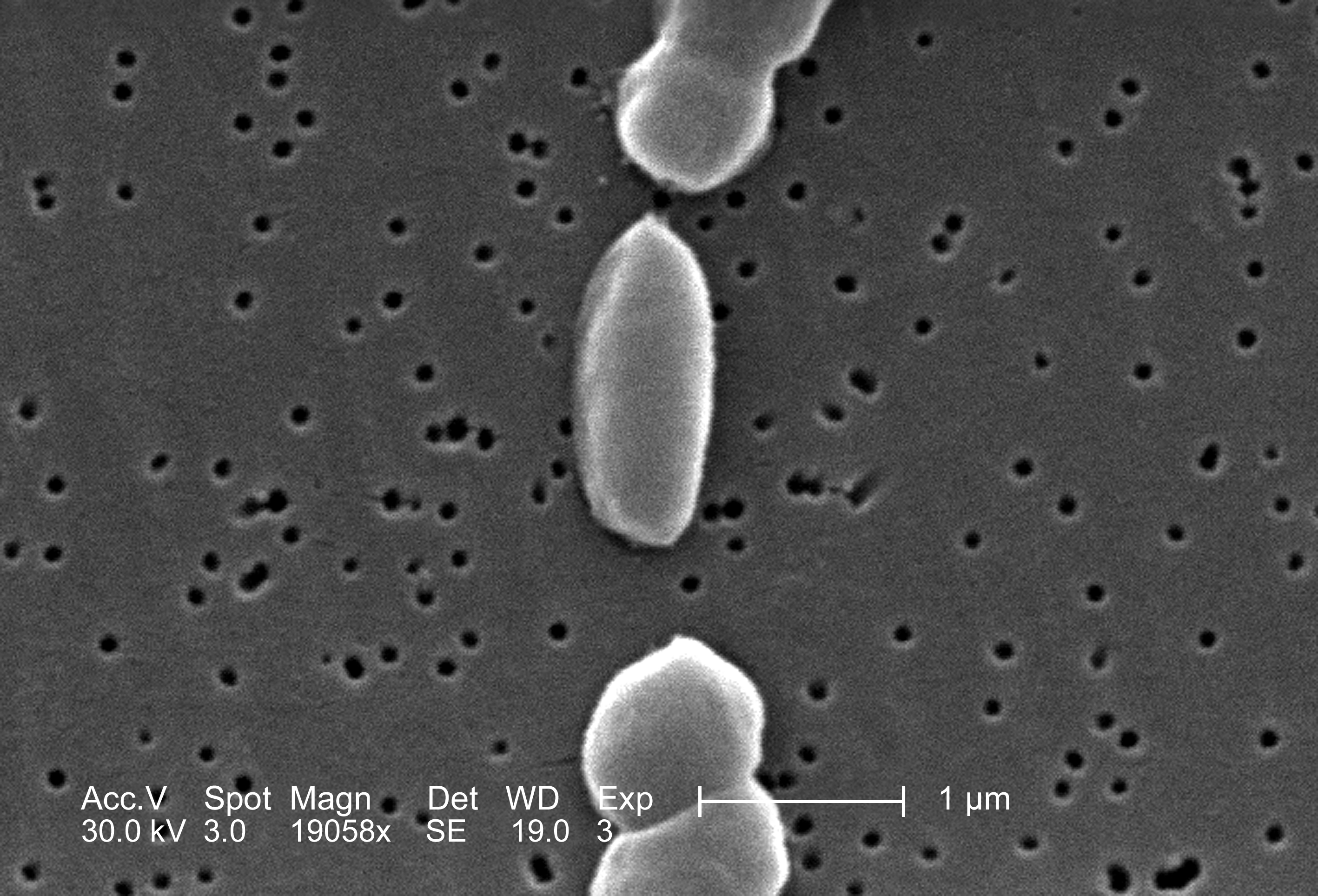
Image source: Wikipedia/Wikimedia
| Ecology, Host, and Life Cycle | |
|---|---|
| Oxygen requirements | Facultative anaerobe |
| Optimal temperature | 20 |
| Temperature range | Mesophilic |
| Habitat | Aquatic |
| Biotic relationship | Free living |
| Host(s) | Homo sapiens, Danio rerio, Pancrustacea |
| Cell arrangement | Singles |
| Sporulation | Nonsporulating |
| Energy source | Heterotroph |
| Pathogenicity | Human |
Gene Summary
Adenine Count
1461015 bp
Thymine Count
1460985 bp
Guanine Count
1187873 bp
Cytosine Count
1207651 bp
Genome Length
5317524 bp
Protein-coding Genes
4949 genes
Non-Coding Genes
161 genes
# of Chromosomes/Plasmids
1
Genes
| Name | Locus Tag | UniProt ID | Strand Orientation | Gene Start/End | Protein Molecular Weight |
|---|---|---|---|---|---|
| yeca family protein | E4P16_16200 | Not Available | Positive | 3362128 - 3362739 | 22705.9 |
| glutathionylspermidine synthase family protein | E4P16_16205 | Not Available | Negative | 3362812 - 3363978 | 45415.7 |
| duf1190 domain-containing protein | E4P16_16210 | Not Available | Negative | 3363981 - 3364550 | 21253.6 |
| duf350 domain-containing protein | E4P16_16215 | Not Available | Negative | 3364559 - 3364975 | 15065.0 |
| two pore domain potassium channel family protein | E4P16_16220 | Not Available | Negative | 3364975 - 3366018 | 38432.5 |
| quinolinate synthase nada | E4P16_16225 | Not Available | Negative | 3366137 - 3367198 | 38593.4 |
| tol-pal system protein ybgf | E4P16_16230 | Not Available | Negative | 3367410 - 3368165 | 28336.2 |
| peptidoglycan-associated lipoprotein pal | E4P16_16235 | Not Available | Negative | 3368181 - 3368705 | 18714.0 |
| tol-pal system protein tolb | E4P16_16240 | Not Available | Negative | 3368736 - 3370088 | 49788.6 |
| cell envelope integrity protein tola | E4P16_16245 | Not Available | Negative | 3370099 - 3371160 | 40104.9 |
Pathways
1153 pathways
Health Effects
| Health Condition | Relation | Reference |
|---|---|---|
| Vibriosis | Causes | PMC10472736 |
| Acute gastroenteritis | Causes | PMC11171697 |
| Wound infections | Causes | PMC11171697 |
| Septicemia | Causes | PMC11171697 |
| Food poisoning | Causes | PMC12108532 |
| Vibrio infections | Causes | PMC12108532 |
| Acute gastroenteritis | Causes | PMC12849298 |
| Wound infections | Causes | PMC12849298 |
| Ear infections | Causes | PMC12849298 |
| Septicemia | Causes | PMC12849298 |


