
Kingdom
Pseudomonadati
Phylum
Pseudomonadota
Class
Gammaproteobacteria
Order
Vibrionales
Family
Vibrionaceae
Genus
Vibrio
Description
Taxonomy
| Kingdom | Pseudomonadati |
|---|---|
| Phylum | Pseudomonadota |
| Class | Gammaproteobacteria |
| Order | Vibrionales |
| Family | Vibrionaceae |
| Genus | Vibrio |
| Species | Vibrio parahaemolyticus |
| Strain | strain 16763 |
Profile
| Physiology | |
|---|---|
| Gram staining properties | Negative |
| Shape | Rod |
| Mobility | Yes |
| Flagellar presence | Yes |
| Number of membranes | 2 |
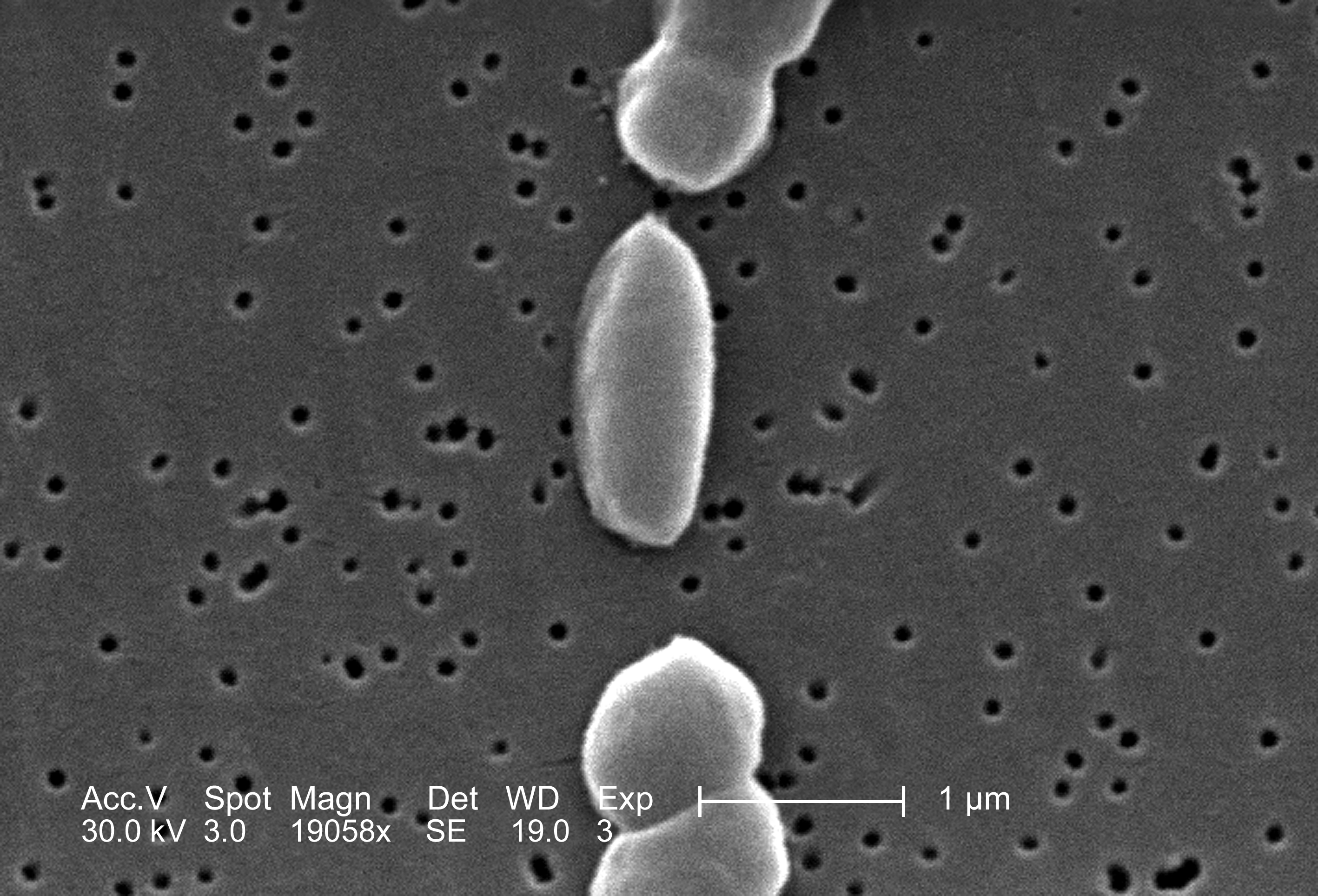
Image source: Wikipedia/Wikimedia
| Ecology, Host, and Life Cycle | |
|---|---|
| Oxygen requirements | Facultative anaerobe |
| Optimal temperature | 20 |
| Temperature range | Mesophilic |
| Habitat | Aquatic |
| Biotic relationship | Free living |
| Host(s) | Homo sapiens, Danio rerio, Pancrustacea |
| Cell arrangement | Singles |
| Sporulation | Nonsporulating |
| Energy source | Heterotroph |
| Pathogenicity | Human |
Gene Summary
Adenine Count
1461015 bp
Thymine Count
1460985 bp
Guanine Count
1187873 bp
Cytosine Count
1207651 bp
Genome Length
5317524 bp
Protein-coding Genes
4949 genes
Non-Coding Genes
161 genes
# of Chromosomes/Plasmids
1
Genes
| Name | Locus Tag | UniProt ID | Strand Orientation | Gene Start/End | Protein Molecular Weight |
|---|---|---|---|---|---|
| spermidine/putrescine abc transporter substrate-binding protein | E4P16_13260 | Not Available | Positive | 2761228 - 2762262 | 38667.9 |
| tyrosine--trna ligase | E4P16_13265 | Not Available | Negative | 2762369 - 2763628 | 46671.4 |
| luxr family transcriptional regulator | E4P16_13270 | Not Available | Negative | 2763711 - 2764517 | 31111.1 |
| hypothetical protein | E4P16_13275 | Not Available | Negative | 2764742 - 2765521 | 28692.2 |
| hypothetical protein | E4P16_13280 | Not Available | Positive | 2765478 - 2765588 | 4331.36 |
| phosphoenolpyruvate synthase | E4P16_13285 | Not Available | Negative | 2765741 - 2768128 | 88149.0 |
| kinase/pyrophosphorylase | E4P16_13290 | Not Available | Positive | 2768327 - 2769163 | 31525.9 |
| l-asparaginase 2 | E4P16_13295 | Not Available | Negative | 2769245 - 2770309 | 38020.0 |
| adenylosuccinate synthase | E4P16_13300 | Not Available | Negative | 2770723 - 2771979 | 45656.0 |
| lysr family transcriptional regulator | E4P16_13305 | Not Available | Positive | 2772085 - 2772954 | 32394.9 |
Pathways
1153 pathways
Health Effects
| Health Condition | Relation | Reference |
|---|---|---|
| Vibriosis | Causes | PMC10472736 |
| Acute gastroenteritis | Causes | PMC11171697 |
| Wound infections | Causes | PMC11171697 |
| Septicemia | Causes | PMC11171697 |
| Food poisoning | Causes | PMC12108532 |
| Vibrio infections | Causes | PMC12108532 |
| Acute gastroenteritis | Causes | PMC12849298 |
| Wound infections | Causes | PMC12849298 |
| Ear infections | Causes | PMC12849298 |
| Septicemia | Causes | PMC12849298 |


