
Kingdom
Pseudomonadati
Phylum
Pseudomonadota
Class
Gammaproteobacteria
Order
Vibrionales
Family
Vibrionaceae
Genus
Vibrio
Description
Taxonomy
| Kingdom | Pseudomonadati |
|---|---|
| Phylum | Pseudomonadota |
| Class | Gammaproteobacteria |
| Order | Vibrionales |
| Family | Vibrionaceae |
| Genus | Vibrio |
| Species | Vibrio parahaemolyticus |
| Strain | strain 16763 |
Profile
| Physiology | |
|---|---|
| Gram staining properties | Negative |
| Shape | Rod |
| Mobility | Yes |
| Flagellar presence | Yes |
| Number of membranes | 2 |
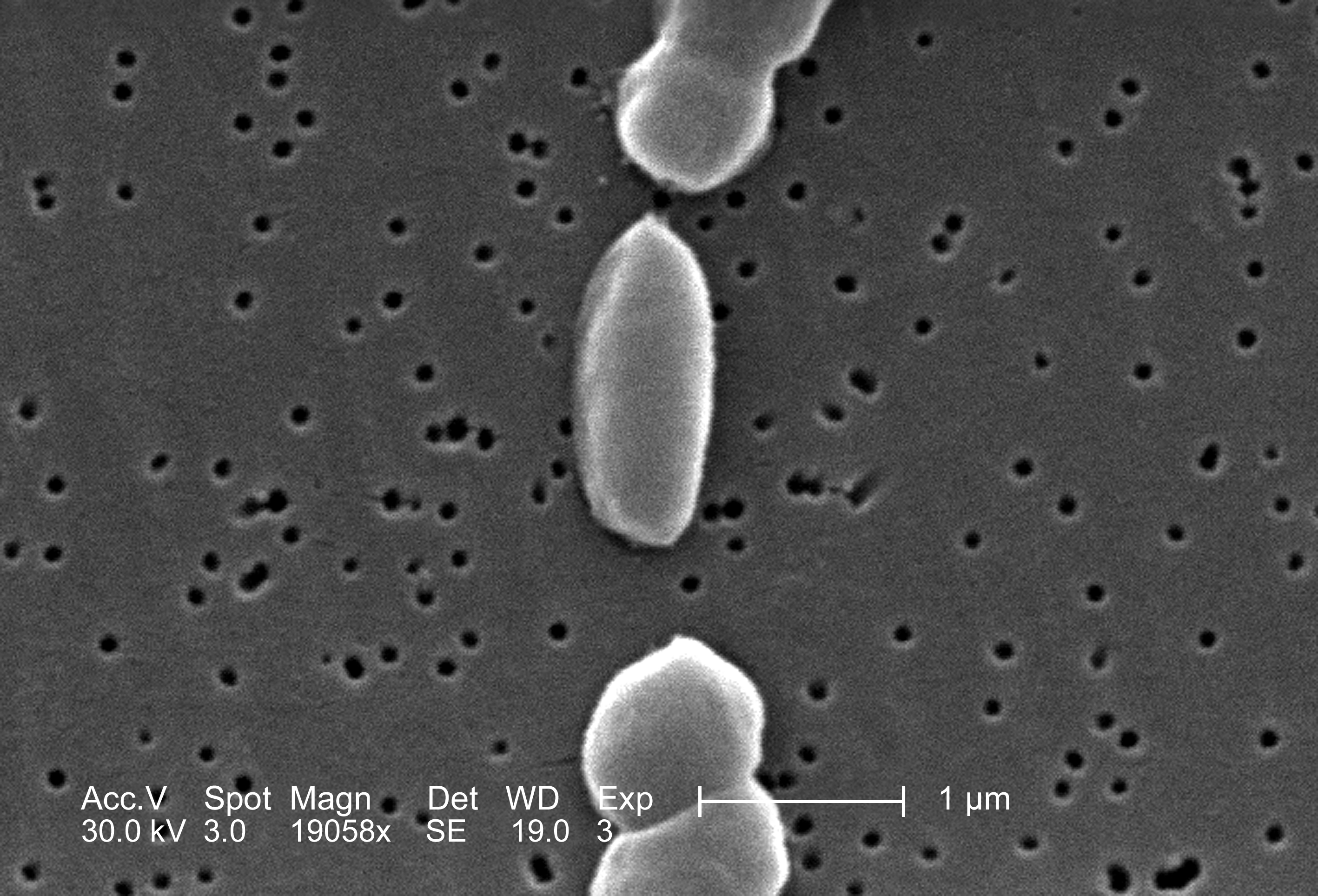
Image source: Wikipedia/Wikimedia
| Ecology, Host, and Life Cycle | |
|---|---|
| Oxygen requirements | Facultative anaerobe |
| Optimal temperature | 20 |
| Temperature range | Mesophilic |
| Habitat | Aquatic |
| Biotic relationship | Free living |
| Host(s) | Homo sapiens, Danio rerio, Pancrustacea |
| Cell arrangement | Singles |
| Sporulation | Nonsporulating |
| Energy source | Heterotroph |
| Pathogenicity | Human |
Gene Summary
Adenine Count
1461015 bp
Thymine Count
1460985 bp
Guanine Count
1187873 bp
Cytosine Count
1207651 bp
Genome Length
5317524 bp
Protein-coding Genes
4949 genes
Non-Coding Genes
161 genes
# of Chromosomes/Plasmids
1
Genes
| Name | Locus Tag | UniProt ID | Strand Orientation | Gene Start/End | Protein Molecular Weight |
|---|---|---|---|---|---|
| ribosome assembly rna-binding protein yhby | E4P16_11220 | Not Available | Negative | 2301983 - 2302279 | 10987.6 |
| 23s rrna (uridine(2552)-2'-o)-methyltransferase rlme | E4P16_11225 | Not Available | Positive | 2302418 - 2303047 | 23206.0 |
| atp-dependent zinc metalloprotease ftsh | E4P16_11230 | Not Available | Positive | 2303147 - 2305135 | 72996.6 |
| dihydropteroate synthase | E4P16_11235 | Not Available | Positive | 2305188 - 2306018 | 30174.8 |
| phosphoglucosamine mutase | E4P16_11240 | Not Available | Positive | 2306038 - 2307378 | 47698.4 |
| hypothetical protein | E4P16_11245 | Not Available | Negative | 2307344 - 2307718 | 14040.3 |
| preprotein translocase subunit secg | E4P16_11250 | Not Available | Positive | 2307601 - 2307939 | 11552.0 |
| Trna-leu | Not Available | Not Available | Positive | 2307955 - 2308038 | Not Available |
| Trna-met | Not Available | Not Available | Positive | 2308095 - 2308171 | Not Available |
| ribosome maturation factor rimp | E4P16_11265 | Not Available | Positive | 2308399 - 2308854 | 16619.8 |
Pathways
1153 pathways
Health Effects
| Health Condition | Relation | Reference |
|---|---|---|
| Vibriosis | Causes | PMC10472736 |
| Acute gastroenteritis | Causes | PMC11171697 |
| Wound infections | Causes | PMC11171697 |
| Septicemia | Causes | PMC11171697 |
| Food poisoning | Causes | PMC12108532 |
| Vibrio infections | Causes | PMC12108532 |
| Acute gastroenteritis | Causes | PMC12849298 |
| Wound infections | Causes | PMC12849298 |
| Ear infections | Causes | PMC12849298 |
| Septicemia | Causes | PMC12849298 |


