Kingdom
Pseudomonadati
Phylum
Pseudomonadota
Class
Gammaproteobacteria
Order
Enterobacterales
Family
Enterobacteriaceae
Genus
Salmonella
Description
Taxonomy
| Kingdom | Pseudomonadati |
|---|---|
| Phylum | Pseudomonadota |
| Class | Gammaproteobacteria |
| Order | Enterobacterales |
| Family | Enterobacteriaceae |
| Genus | Salmonella |
| Species | Salmonella enterica |
| Strain | subsp. enterica serovar Stanley strain |
Profile
| Physiology | |
|---|---|
| Gram staining properties | Negative |
| Shape | Spirilla |
| Mobility | No |
| Flagellar presence | Yes |
| Number of membranes | 2 |

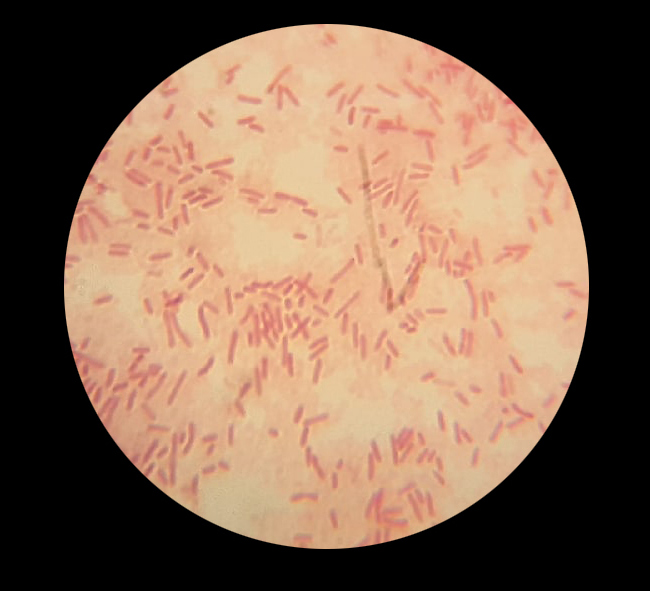
Image source: Wikipedia/Wikimedia
| Ecology, Host, and Life Cycle | |
|---|---|
| Oxygen requirements | Microaerophilic |
| Optimal temperature | 37 |
| Temperature range | Mesophilic |
| Habitat | HostAssociated |
| Biotic relationship | Free living |
| Host(s) | Not Available |
| Cell arrangement | Chains - Singles |
| Sporulation | Not Available |
| Energy source | Chemoorganotroph |
| Pathogenicity | Not Available |
Gene Summary
Adenine Count
1115001 bp
Thymine Count
1102402 bp
Guanine Count
1183452 bp
Cytosine Count
1235938 bp
Genome Length
4636793 bp
Protein-coding Genes
4300 genes
Non-Coding Genes
210 genes
# of Chromosomes/Plasmids
1
Genes
| Name | Locus Tag | UniProt ID | Strand Orientation | Gene Start/End | Protein Molecular Weight |
|---|---|---|---|---|---|
| Phage-tail assembly-like protein | E2E98_13205 | Not Available | Positive | 2572898 - 2573431 | 19470.1 |
| lytic enzyme | E2E98_13210 | Not Available | Negative | 2573688 - 2573855 | 6076.39 |
| hypothetical protein | E2E98_13215 | Not Available | Negative | 2573920 - 2574111 | 7478.18 |
| Bacteriophage terminase, small subunit | E2E98_13220 | Not Available | Positive | 2574163 - 2574654 | 18461.2 |
| Bacteriophage terminase, large subunit | E2E98_13225 | Not Available | Positive | 2574641 - 2575208 | 20863.8 |
| Bacteriophage side tail fiber protein | E2E98_13230 | Not Available | Positive | 2575207 - 2577261 | 72526.7 |
| Pagk-like protein | E2E98_13235 | Not Available | Negative | 2577358 - 2577558 | 7635.46 |
| Putative tail assembly chaperone | E2E98_13240 | Not Available | Negative | 2577749 - 2577871 | 4563.43 |
| arsenic transporter | E2E98_13245 | Not Available | Positive | 2578128 - 2578253 | 4583.71 |
| hypothetical protein | E2E98_13250 | Not Available | Positive | 2578382 - 2578648 | 9326.53 |
Pathways
0 pathways
No pathways found
No metabolic pathways have been associated with this bacterium yet.
Health Effects
No health effects information available for this bacterium.