Kingdom
Pseudomonadati
Phylum
Pseudomonadota
Class
Gammaproteobacteria
Order
Enterobacterales
Family
Enterobacteriaceae
Genus
Salmonella
Description
Taxonomy
| Kingdom | Pseudomonadati |
|---|---|
| Phylum | Pseudomonadota |
| Class | Gammaproteobacteria |
| Order | Enterobacterales |
| Family | Enterobacteriaceae |
| Genus | Salmonella |
| Species | Salmonella enterica |
| Strain | subsp. enterica serovar Corvallis strain |
Profile
| Physiology | |
|---|---|
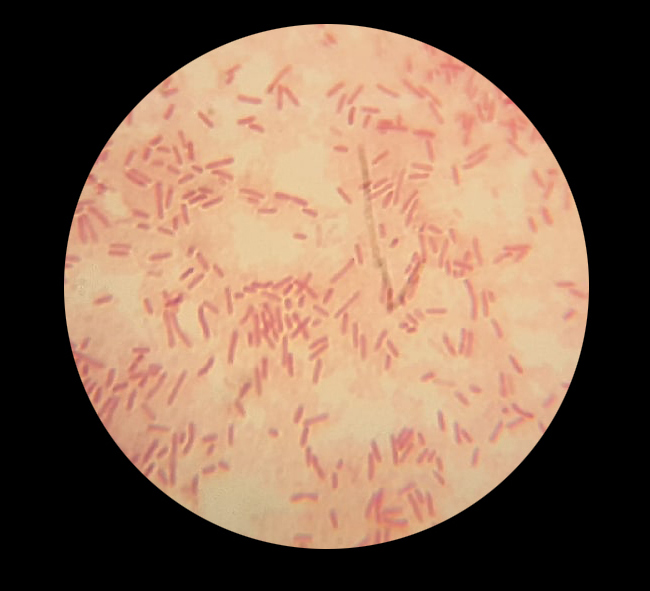
| Gram staining properties | Negative |
| Shape | Spirilla |
| Mobility | No |
| Flagellar presence | Yes |
| Number of membranes | 2 |

Image source: Wikipedia/Wikimedia
| Ecology, Host, and Life Cycle | |
|---|---|
| Oxygen requirements | Microaerophilic |
| Optimal temperature | 37 |
| Temperature range | Mesophilic |
| Habitat | HostAssociated |
| Biotic relationship | Free living |
| Host(s) | Homo sapiens, Aves |
| Cell arrangement | Chains - Singles |
| Sporulation | Not Available |
| Energy source | Chemoorganotroph |
| Pathogenicity | Not Available |
Genome Summary
Salmonella enterica subsp. enterica serovar Corvallis strain
Gene Summary
Adenine Count
1170173 bp
Thymine Count
1183755 bp
Guanine Count
1305156 bp
Cytosine Count
1250016 bp
Genome Length
4909100 bp
Protein-coding Genes
4472 genes
Non-Coding Genes
377 genes
# of Chromosomes/Plasmids
6
Genes
| Name | Locus Tag | UniProt ID | Strand Orientation | Gene Start/End | Protein Molecular Weight |
|---|---|---|---|---|---|
| nitrous oxide-stimulated promoter family protein | E2E55_07645 | Not Available | Positive | 1495274 - 1495618 | 13478.7 |
| formate hydrogenlyase transcriptional activator flha | E2E55_07650 | Not Available | Negative | 1495680 - 1497758 | 78257.1 |
| hydrogenase expression/formation protein hype | E2E55_07655 | Not Available | Negative | 1497977 - 1498987 | 35266.6 |
| hydrogenase formation protein hypd | E2E55_07660 | Not Available | Negative | 1498984 - 1500105 | 41538.1 |
| hydrogenase 3 maturation protein hypc | E2E55_07665 | Not Available | Negative | 1500105 - 1500377 | 9744.6 |
| hydrogenase nickel incorporation protein hypb | E2E55_07670 | Not Available | Negative | 1500368 - 1501240 | 31413.6 |
| hydrogenase maturation nickel metallochaperone hypa | E2E55_07675 | Not Available | Negative | 1501309 - 1501665 | 13486.1 |
| hypothetical protein | E2E55_07680 | Not Available | Negative | 1501626 - 1501829 | 7492.08 |
| formate hydrogenlyase regulator hyca | E2E55_07685 | Not Available | Positive | 1501875 - 1502336 | 17769.0 |
| 4fe-4s dicluster domain-containing protein | E2E55_07690 | Not Available | Positive | 1502482 - 1503090 | 21713.1 |
Pathways
0 pathways
No pathways found
No metabolic pathways have been associated with this bacterium yet.