Kingdom
Pseudomonadati
Phylum
Pseudomonadota
Class
Gammaproteobacteria
Order
Enterobacterales
Family
Enterobacteriaceae
Genus
Salmonella
Description
Taxonomy
| Kingdom | Pseudomonadati |
|---|---|
| Phylum | Pseudomonadota |
| Class | Gammaproteobacteria |
| Order | Enterobacterales |
| Family | Enterobacteriaceae |
| Genus | Salmonella |
| Species | Salmonella enterica |
| Strain | subsp. enterica serovar Agona strain SL_8_13 |
Profile
| Physiology | |
|---|---|
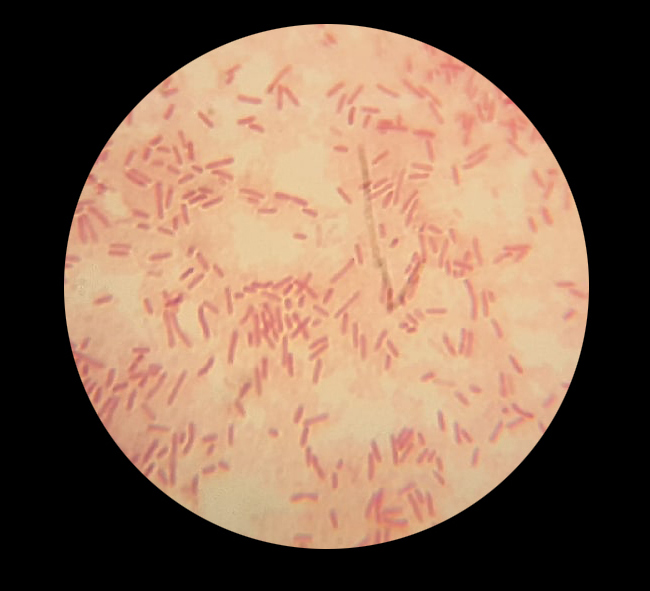
| Gram staining properties | Negative |
| Shape | Spirilla |
| Mobility | No |
| Flagellar presence | Yes |
| Number of membranes | 2 |

Image source: Wikipedia/Wikimedia
| Ecology, Host, and Life Cycle | |
|---|---|
| Oxygen requirements | Microaerophilic |
| Optimal temperature | 37 |
| Temperature range | Mesophilic |
| Habitat | HostAssociated |
| Biotic relationship | Free living |
| Host(s) | Not Available |
| Cell arrangement | Chains - Singles |
| Sporulation | Not Available |
| Energy source | Chemoorganotroph |
| Pathogenicity | Not Available |
Gene Summary
Adenine Count
1184319 bp
Thymine Count
1188688 bp
Guanine Count
1287285 bp
Cytosine Count
1272027 bp
Genome Length
4932319 bp
Protein-coding Genes
4567 genes
Non-Coding Genes
300 genes
# of Chromosomes/Plasmids
1
Genes
| Name | Locus Tag | UniProt ID | Strand Orientation | Gene Start/End | Protein Molecular Weight |
|---|---|---|---|---|---|
| duf1493 family protein | E2E45_02585 | Not Available | Negative | 497230 - 497562 | 12790.2 |
| hypothetical protein | E2E45_02595 | Not Available | Positive | 498450 - 498839 | 14487.0 |
| hypothetical protein | E2E45_02600 | Not Available | Positive | 498842 - 499195 | 13552.1 |
| type ii toxin-antitoxin system phd/yefm family antitoxin | E2E45_02605 | Not Available | Positive | 499608 - 499856 | 9090.84 |
| type ii toxin-antitoxin system rele/pare family toxin | E2E45_02610 | Not Available | Positive | 499846 - 500130 | 11076.5 |
| rida family protein | E2E45_02615 | Not Available | Positive | 500301 - 500690 | 14336.8 |
| s-adenosylmethionine:trna ribosyltransferase-isomerase | E2E45_02620 | Not Available | Negative | 500742 - 501821 | 41047.3 |
| marr family transcriptional regulator | E2E45_02625 | Not Available | Negative | 502014 - 502502 | 18309.2 |
| hypothetical protein | E2E45_02630 | Not Available | Positive | 502547 - 504055 | 55685.5 |
| mfs transporter | E2E45_02635 | Not Available | Positive | 504045 - 505286 | 43870.3 |
Pathways
0 pathways
No pathways found
No metabolic pathways have been associated with this bacterium yet.
Health Effects
No health effects information available for this bacterium.