Kingdom
Pseudomonadati
Phylum
Pseudomonadota
Class
Gammaproteobacteria
Order
Enterobacterales
Family
Enterobacteriaceae
Genus
Escherichia
Description
Taxonomy
| Kingdom | Pseudomonadati |
|---|---|
| Phylum | Pseudomonadota |
| Class | Gammaproteobacteria |
| Order | Enterobacterales |
| Family | Enterobacteriaceae |
| Genus | Escherichia |
| Species | Escherichia coli |
| Strain | strain EC_11 |
Profile
| Physiology | |
|---|---|
| Gram staining properties | Negative |
| Shape | Rod |
| Mobility | Yes |
| Flagellar presence | Yes |
| Number of membranes | 2 |

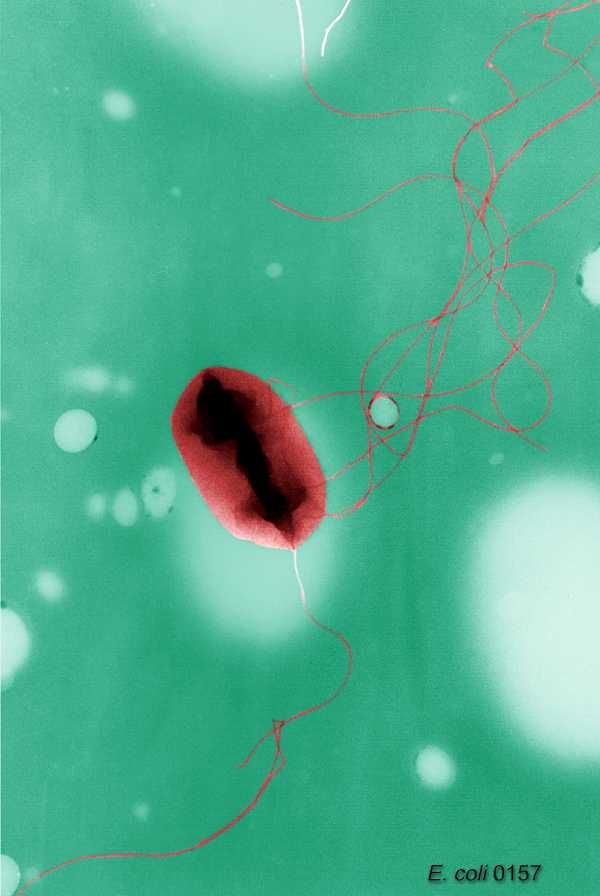
Image source: Wikipedia/Wikimedia
| Ecology, Host, and Life Cycle | |
|---|---|
| Oxygen requirements | Facultative anaerobe |
| Optimal temperature | 37 |
| Temperature range | Mesophilic |
| Habitat | HostAssociated |
| Biotic relationship | Free living |
| Host(s) | Homo sapiens, Gallus gallus, Bos taurus |
| Cell arrangement | Pairs - Singles |
| Sporulation | Not Available |
| Energy source | Not Available |
| Pathogenicity | Human |
Gene Summary
Adenine Count
1403876 bp
Thymine Count
1403803 bp
Guanine Count
1425476 bp
Cytosine Count
1394297 bp
Genome Length
5627615 bp
Protein-coding Genes
5194 genes
Non-Coding Genes
281 genes
# of Chromosomes/Plasmids
1
Genes
| Name | Locus Tag | UniProt ID | Strand Orientation | Gene Start/End | Protein Molecular Weight |
|---|---|---|---|---|---|
| Attl | Not Available | Not Available | Positive | 1393628 - 1393640 | Not Available |
| Attl | Not Available | Not Available | Positive | 1401973 - 1401984 | Not Available |
| Hypothetical protein | EXX13_06505 | Not Available | Negative | 1407144 - 1407299 | 5941.19 |
| Dna primase | EXX13_06510 | Not Available | Negative | 1407503 - 1409836 | 84832.2 |
| Hypothetical protein | EXX13_06515 | Not Available | Negative | 1409851 - 1410171 | 11802.6 |
| Hypothetical protein | EXX13_06520 | Not Available | Negative | 1410307 - 1410762 | 17783.2 |
| Helper derepression protein | EXX13_06525 | Not Available | Negative | 1410755 - 1411042 | 10937.0 |
| Putative ci repressor | EXX13_06530 | Not Available | Negative | 1411035 - 1411634 | 21408.0 |
| Transcriptional regulator | EXX13_06535 | Not Available | Negative | 1411631 - 1411897 | 9763.97 |
| hypothetical | EXX13_06540 | Not Available | Negative | 1411910 - 1412101 | 6776.18 |
Pathways
1297 pathways
Health Effects
| Health Condition | Relation | Reference |
|---|---|---|
| Renal failure | Causes | PMC3505186 |
| Meningitis | Causes | PMC3505186 |
| Urinary tract infections | Causes | PMC3789825 |
| Bloodstream infections | Causes | PMC3789825 |
| Acute pyelonephritis | Causes | PMC3789825 |
| Osteomyelitis | Causes | PMC3789825 |
| Septic arthritis | Causes | PMC3789825 |
| Septic shock | Causes | PMC3789825 |
| Invasive disease | Causes | PMC3789825 |
| Uti | Causes | PMC3789825 |