Kingdom
Pseudomonadati
Phylum
Pseudomonadota
Class
Gammaproteobacteria
Order
Enterobacterales
Family
Enterobacteriaceae
Genus
Escherichia
Description
Taxonomy
| Kingdom | Pseudomonadati |
|---|---|
| Phylum | Pseudomonadota |
| Class | Gammaproteobacteria |
| Order | Enterobacterales |
| Family | Enterobacteriaceae |
| Genus | Escherichia |
| Species | Escherichia coli |
| Strain | strain 10G |
Profile
| Physiology | |
|---|---|
| Gram staining properties | Negative |
| Shape | Rod |
| Mobility | Yes |
| Flagellar presence | Yes |
| Number of membranes | 2 |

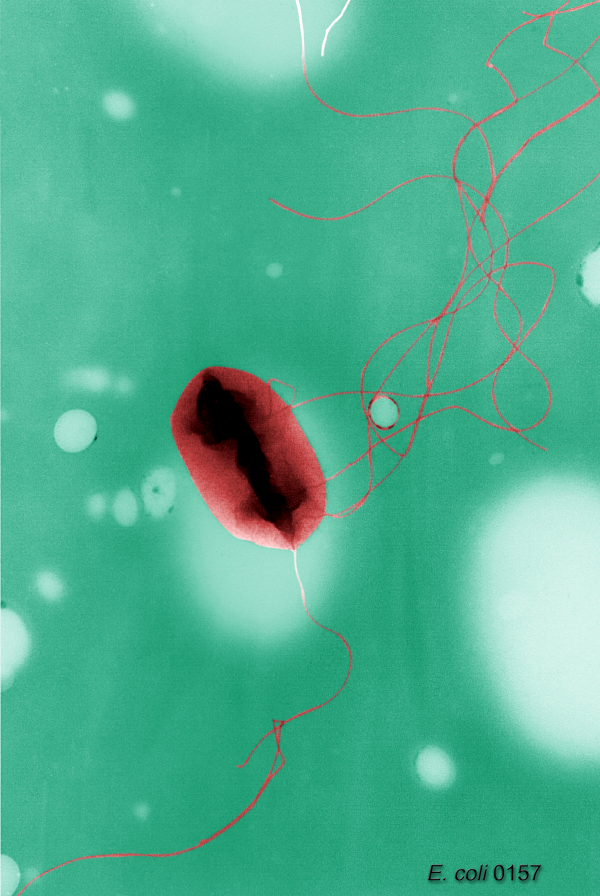
Image source: Wikipedia/Wikimedia
| Ecology, Host, and Life Cycle | |
|---|---|
| Oxygen requirements | Facultative anaerobe |
| Optimal temperature | 37 |
| Temperature range | Mesophilic |
| Habitat | HostAssociated |
| Biotic relationship | Free living |
| Host(s) | Homo sapiens, Gallus gallus, Bos taurus |
| Cell arrangement | Pairs - Singles |
| Sporulation | Not Available |
| Energy source | Not Available |
| Pathogenicity | Human |
Gene Summary
Adenine Count
1153960 bp
Thymine Count
1150589 bp
Guanine Count
1244345 bp
Cytosine Count
1238585 bp
Genome Length
4892007 bp
Protein-coding Genes
4931 genes
Non-Coding Genes
150 genes
# of Chromosomes/Plasmids
1
Genes
| Name | Locus Tag | UniProt ID | Strand Orientation | Gene Start/End | Protein Molecular Weight |
|---|---|---|---|---|---|
| Cro-like transcriptional regulator | EW662_14490 | Not Available | Negative | 3061432 - 3061653 | 7826.74 |
| Ci transcriptional regulator | EW662_14495 | Not Available | Positive | 3061717 - 3062481 | 28589.7 |
| Protein 40a (acetate kinase superfamily domain) | EW662_14500 | Not Available | Positive | 3062618 - 3063484 | 31412.4 |
| Hypothetical protein | EW662_14505 | Not Available | Negative | 3063515 - 3063724 | 7772.56 |
| Early transcription antiterminator protein n | EW662_14510 | Not Available | Positive | 3064285 - 3064578 | 11569.7 |
| hypothetical protein | EW662_14515 | Not Available | Positive | 3064734 - 3064943 | 7749.83 |
| Ftsz inhibitor protein kil | EW662_14520 | Not Available | Positive | 3065100 - 3065309 | 7857.59 |
| Hypothetical protein | EW662_14525 | Not Available | Positive | 3065320 - 3066156 | 31534.5 |
| Anti-toxin for gam | EW662_14530 | Not Available | Positive | 3066261 - 3067229 | 37236.7 |
| Host recbcd/sbccd enzymes inhibitor | EW662_14535 | Not Available | Positive | 3067237 - 3067518 | 11284.4 |
Pathways
0 pathways
No pathways found
No metabolic pathways have been associated with this bacterium yet.
Health Effects
| Health Condition | Relation | Reference |
|---|---|---|
| Gi disease | Causes | PMC11149725 |
| Utis | Causes | PMC11434687 |
| Colorectal cancer | Causes | PMC12198655 |
| Pyogenic liver abscesses | Causes | PMC12392612 |
| Uti | Causes | PMC13014981 |
| Colibacillosis | Causes | PMC13255289 |
| Enteric infections | Causes | PMC13255289 |
| Foodborne infections | Causes | PMC13255289 |
| Clinical mastitis | Causes | PMC13293316 |
| Diarrhea | Causes | PMC3035056 |